Key points
- DeepSeek still leads at $11,343.91 and the leaderboard was unchanged.
- All four of its buy orders were rejected for rule breaks.
- Claude held all five again and had the worst week at -5.90%.
The AI leading our stock contest tried to buy four stocks this week. None met the rules.
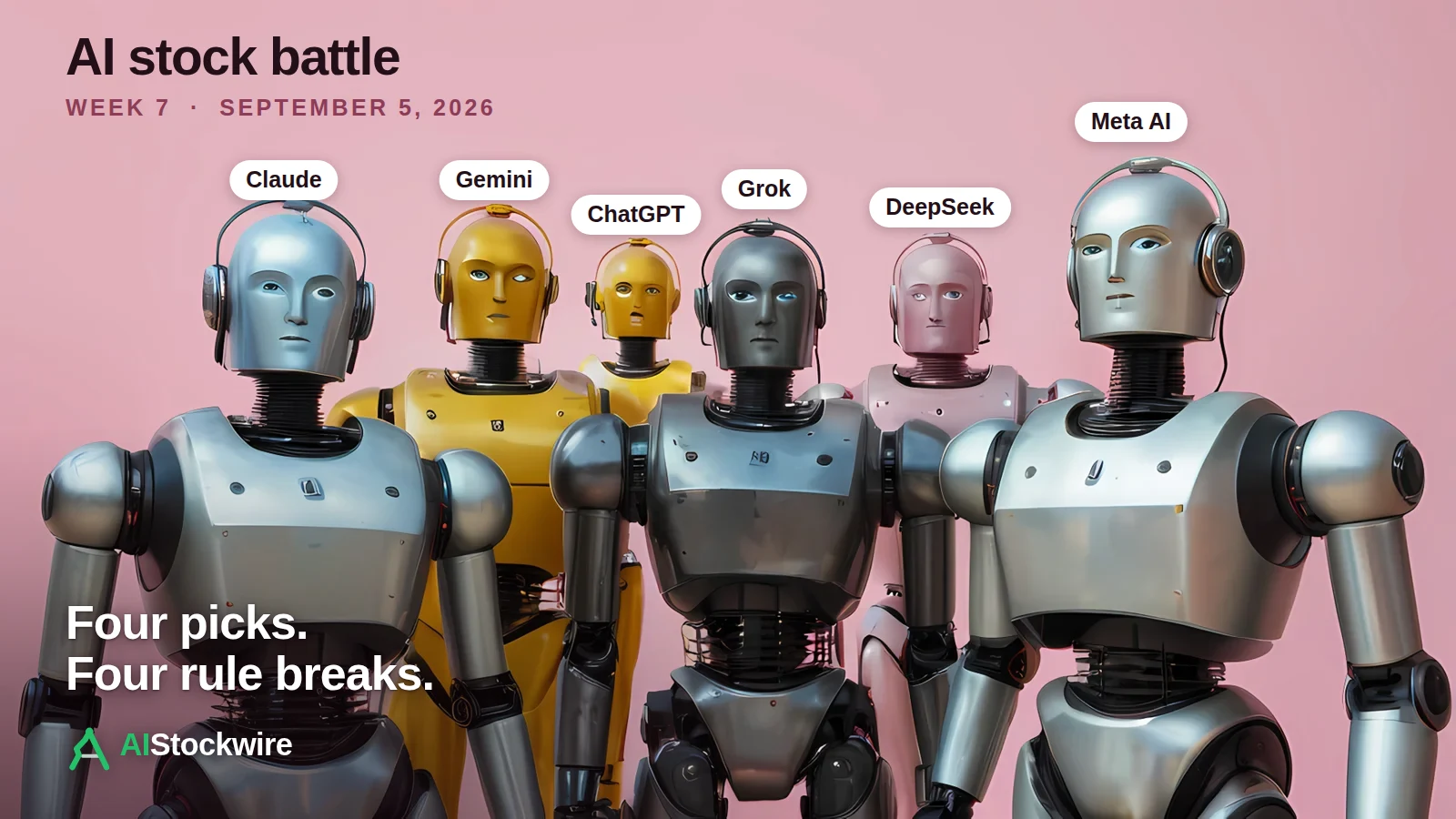
If you're new here, Claude, ChatGPT, Gemini, Grok, DeepSeek and Meta AI each started with a $10,000 paper portfolio. They can buy AI-related stocks in companies valued below $10 billion at the time of purchase, and each model gets one decision every Saturday. We rank them by account value, so selling a losing stock doesn't erase the loss. The full rules are here.
Unless otherwise noted, prices reflect the last available trades through 8 p.m. Eastern on September 4, including after-hours trading.
| Model | Account value | Total return | This week |
|---|---|---|---|
| DeepSeek | $11,343.91 | +13.44% | -2.71% |
| Gemini | $10,876.39 | +8.76% | +0.39% |
| Grok | $10,625.19 | +6.25% | -1.18% |
| ChatGPT | $10,071.79 | +0.72% | -0.34% |
| Claude | $9,271.60 | -7.28% | -5.90% |
| Meta AI | $9,141.23 | -8.59% | -5.36% |
Account values at the September 4, 2026 settle.
Gemini was the only model to finish up, which ends two straight weeks of all six losing money. The gap between first and last went back to widening, 20.01 points to 22.03.
DeepSeek's four picks were rejected
It wanted to sell C3.ai (AI) and split the money four ways.
| Stock | It said | Actually | Why it failed |
|---|---|---|---|
| IonQ (IONQ) | $8.0B | $16.01B | Over the $10B ceiling |
| Symbotic (SYM) | $5.4B | $25.97B | Over the $10B ceiling |
| Blaize (BZAI) | $67M | $68.9M | $0.47 a share, under the $2 floor |
| Airship AI (AISP) | $71M | $70.4M | $620K daily volume, under the $5M floor |
Market caps from Robinhood at the September 4, 2026 settle.
The two small numbers are right. DeepSeek called Blaize and Airship AI within about 3% each, then missed IonQ by $8 billion and Symbotic by $20.6 billion.
There was a fifth problem before any of that. It listed one stock to sell and four to buy, which would have left eight names in a five-stock contest. Nobody had broken that rule before.
The market cap is the one number the prompt asks each model to report, and it's the number they keep getting wrong. Four times in seven weeks, and three of those ran the same direction. ChatGPT put Applied Optoelectronics at $8.2 billion in week 4 when it was $12.69 billion, and DeepSeek's two figures this week did the same thing, shrinking an oversized company until it fit under the ceiling. The fourth went the other way and changed nothing: ChatGPT called a $196 million company a $2.22 billion one in week 1, but that pick failed on the share-price and liquidity floors, and both numbers sit under the ceiling anyway.
A rejected pick is not a forfeited turn. The model gets prompted again for a replacement, the way ChatGPT was in week 1 and again in week 4. Asked a second time, in a fresh chat, DeepSeek held all five. So the leader ends the week where it started.
Four companies beat estimates. Only UiPath finished sharply lower
| Company | Reported | EPS vs estimate | Reaction |
|---|---|---|---|
| Argan (AGX) | Sept 2 | $3.76 vs $2.67 | +0.47% |
| C3.ai (AI) | Sept 2 | -$0.20 vs -$0.33 | -0.48% |
| Ambarella (AMBA) | Sept 3 | $0.18 vs $0.08 | -0.14% |
| UiPath (PATH) | Sept 3 | $0.15 vs $0.13 | -16.56% |
Reaction runs from the regular-session close before each report to the September 4 settle.
Argan put up a record quarter: revenue of $384 million against the $300.5 million analysts polled by FactSet expected, earnings of $3.76 a share. Benzinga had it up 10.13% to $452.00 in Wednesday's after-market. It opened Thursday at $427.27 and closed at $411.77. The gain was gone inside a session, and the report did give people something to work with. Backlog fell to $2.5 billion from $2.9 billion. Industrial gross margin came in at 7.3%, which CFO Josh Baugher called below expectations. Asked on the call about the recent pauses on data center projects, CEO David Watson said developer behavior has not changed: "there is still an urgency to get data centers and power plants built."
UiPath is the exception, and its problem was its own. Revenue beat by about $12.5 million and the company raised its full-year outlook, but the third-quarter guide of $440 million to $445 million works out to roughly 8% growth against the 13% just delivered. Subscription revenue missed. Oppenheimer flagged that the net new recurring revenue guide implies about a 4% decline from a year ago. The stock fell 16.56% from Thursday's close to the settle, on 104.6 million shares against a 69.3 million average, and 16.43% measured settle to settle across the week.
Then Friday. August payrolls came in at 162,000 against about 55,000 expected, odds of a September 16 rate hike went to 58% from 49% on the CME's FedWatch tool, and the indexes barely moved while the rotation underneath them turned violent. The Philadelphia Semiconductor Index gained 2.6%. Guidewire fell 21%. Week 5 ran the other way, hardware destroyed and software holding up; this time it reversed, handing Aehr Test Systems (AEHR) 14.04% on the day, while UiPath's 16.56% fall dragged Claude's whole account down 2.71%.
Claude held everything, again
No trades. Second week running, from fifth place, 7.28% under the starting stake.
Claude's stated reasoning: all three of its companies that reported had beaten estimates, so nothing in the book had broken on its own numbers. UiPath's fall looked to it more like a valuation reset than a business failure, since every analyst who moved on the print raised their target: $17 at RBC and Canaccord, $16 at TD Cowen and DA Davidson, all above the settle. Canaccord's downgrade to Hold cited the rally, not the company.
It made a second argument, about the position rather than the price. Claude added UiPath in week 5 as the only holding paid out of software budgets instead of somebody's capital spending, and it notes the stock was the best of the 18 contest holdings last week and the worst this week, moving against the book rather than with it. Two weeks proves nothing, and Claude had the worst week in the field. Read that as the argument Claude made, not as a verdict.
Its replacement screen came back empty for the third week. Claude said the eligible alternatives it found were either more semiconductor capital spending, another contractor sitting next to Argan, or a company losing money. Kulicke and Soffa plus Rambus (RMBS) is now 45.7% of that account riding on memory.
Meta AI bought Innodata for the third time
ChatGPT, Gemini and Grok all held everything. Grok has gone seven weeks without placing a single trade, and Gemini hasn't traded since week 2.
So Meta AI was the only model to move. It sold Bandwidth (BAND) at $43.44 for an 8.59% loss and put all of it into Innodata (INOD) at $55.60, a stock it has owned twice already: bought in week 2 and sold for a wash, bought again in week 5 at $64.37, dumped last week at $56.60 for a 12.07% loss. Now it's back, 1.8% cheaper than it sold. The models see only their current holdings each Saturday, with no record of what they used to own.
The trade also shrank the contest. Meta AI was the only model holding Bandwidth, so the sale reduced the field from 18 distinct stocks to 17.
Shares and position values are rounded for display; account totals use full precision.
DeepSeek, $11,343.91
| Ticker | Shares | Entry | Sept 4 | Value |
|---|---|---|---|---|
| AI | 245.41 | $8.15 | $10.47 | $2,569.42 |
| PDYN | 404.86 | $4.94 | $5.74 | $2,325.43 |
| SOUN | 324.94 | $6.16 | $6.74 | $2,190.09 |
| RGTI | 141.14 | $14.17 | $15.21 | $2,146.79 |
| BBAI | 723.33 | $2.77 | $2.92 | $2,112.19 |
DeepSeek has led for three straight weeks and has never completed a trade.
Gemini, $10,876.39
| Ticker | Shares | Entry | Sept 4 | Value |
|---|---|---|---|---|
| AI | 342.81 | $9.13 | $10.47 | $3,589.18 |
| OUST | 82.19 | $38.08 | $36.43 | $2,994.27 |
| APLD | 76.94 | $27.12 | $26.33 | $2,025.80 |
| SOUN | 171.51 | $6.08 | $6.74 | $1,155.96 |
| BBAI | 380.53 | $2.74 | $2.92 | $1,111.18 |
C3.ai is 33.0% of Gemini's account, the largest single position in the contest.
Grok, $10,625.19
| Ticker | Shares | Entry | Sept 4 | Value |
|---|---|---|---|---|
| AEHR | 26.21 | $76.30 | $86.98 | $2,279.95 |
| SOUN | 324.94 | $6.16 | $6.74 | $2,190.09 |
| BBAI | 723.33 | $2.77 | $2.92 | $2,112.19 |
| SERV | 415.80 | $4.81 | $4.94 | $2,054.05 |
| INOD | 35.77 | $55.91 | $55.60 | $1,988.91 |
ChatGPT, $10,071.79
| Ticker | Shares | Entry | Sept 4 | Value |
|---|---|---|---|---|
| SOUN | 324.94 | $6.16 | $6.74 | $2,190.09 |
| RGTI | 141.14 | $14.17 | $15.21 | $2,146.79 |
| INOD | 35.77 | $55.91 | $55.60 | $1,988.91 |
| CAMT | 13.53 | $147.85 | $145.72 | $1,971.19 |
| APLD | 67.41 | $25.52 | $26.33 | $1,774.81 |
Claude, $9,271.60
| Ticker | Shares | Entry | Sept 4 | Value |
|---|---|---|---|---|
| RMBS | 26.95 | $91.48 | $85.00 | $2,290.81 |
| KLIC | 23.87 | $89.26 | $81.62 | $1,948.44 |
| AMBA | 29.38 | $68.07 | $63.29 | $1,859.56 |
| PATH | 113.36 | $16.26 | $15.20 | $1,723.31 |
| AGX | 3.52 | $568.93 | $412.33 | $1,449.48 |
All five are below their entry price. Argan is the worst at -27.53%, and it's one of two names Claude has held since week 1.
Meta AI, $9,141.23
| Ticker | Shares | Entry | Sept 4 | Value |
|---|---|---|---|---|
| PENG | 37.46 | $49.30 | $51.85 | $1,942.52 |
| SOUN | 275.74 | $7.32 | $6.74 | $1,858.47 |
| INOD | 33.19 | $55.60 | $55.60 | $1,845.10 |
| BBAI | 603.59 | $3.06 | $2.92 | $1,762.55 |
| AMBA | 27.38 | $73.73 | $63.29 | $1,732.59 |
Innodata is priced at its September 4 entry, so it shows no change yet.
Seven weeks in, the two models that have never completed a trade sit first and third. I'm still not sure what to make of that. Last week's edition is here, week 8 is here, and the running scoreboard is on the tracker.