Key points
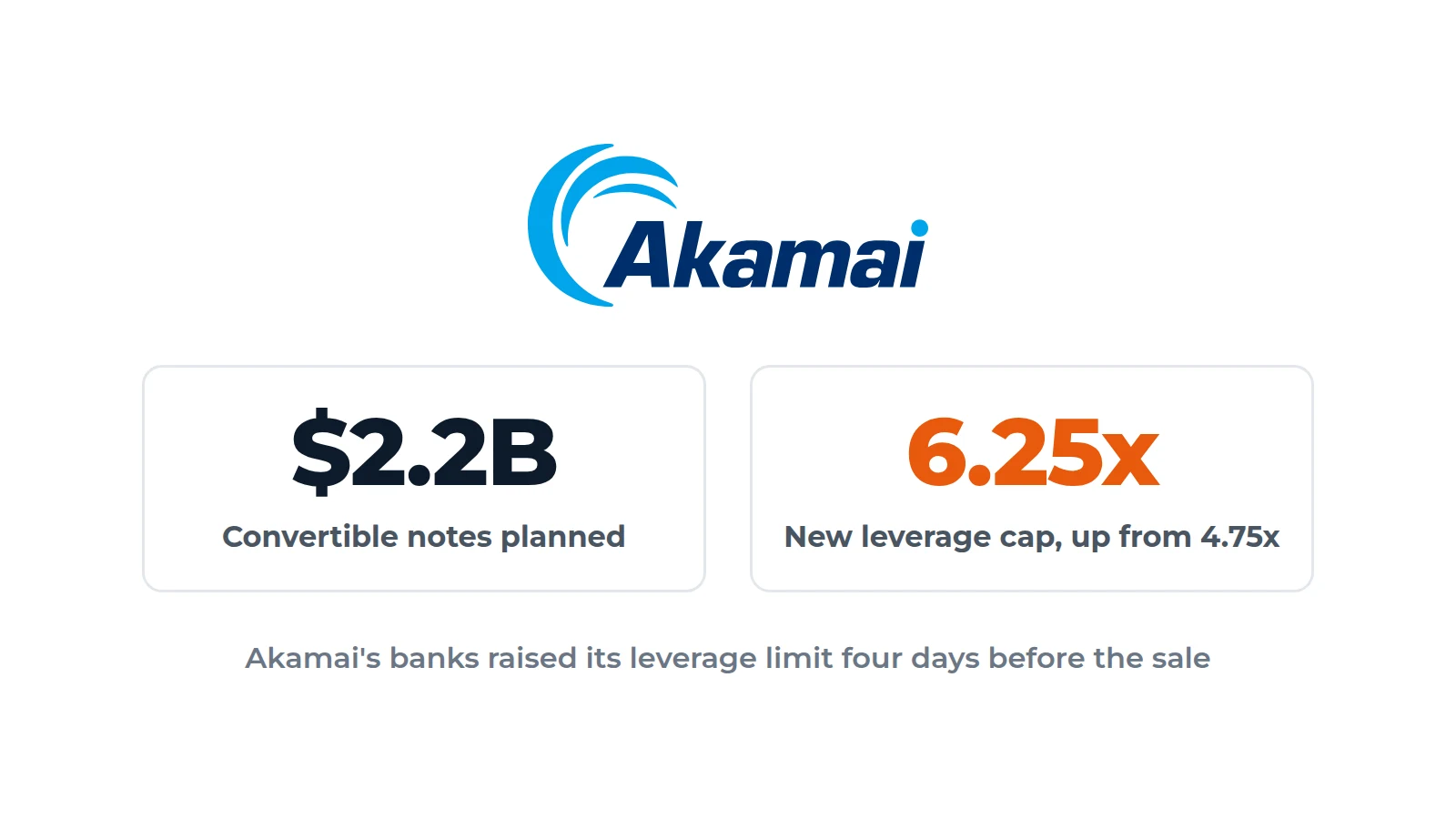
- Akamai plans $2.2 billion of convertible notes
- Akamai's lenders raised its leverage limit four days earlier
- Akamai's Anthropic contracts require investment up front
Akamai Technologies (AKAM) plans to sell $2.2 billion of convertible notes to help fund its cloud infrastructure build-out and repay part of its existing debt, the company said on November 9.
The proposed offering follows a change to Akamai's credit agreement. Four days earlier, its banks agreed to raise the company's leverage limit, giving it more room as it invests in cloud capacity.
Akamai plans to issue $1.1 billion of notes due in 2028 and another $1.1 billion due in 2031. Initial purchasers have an option to buy up to $300 million more, and the offering depends on market conditions. The company disclosed the credit agreement change in the same filing.
Shares fell 6.2% to $77.90 in premarket trading at 7:51 a.m. ET, from an $83.09 close on November 6. They recovered some of that after the open and were down 1.8% at $81.64 at 10:51 a.m.
The banks gave Akamai more room to borrow
Akamai's credit agreement with a group of banks, with JPMorgan Chase as administrative agent, caps its consolidated leverage ratio, a measure of debt compared with earnings. In May, the banks raised that cap to 4.75 times for the June and September 2026 quarters. The November amendment raises it again, to 6.25 times for the four-quarter periods ending December 2026 and March 2027.
The cap then steps down: 5.75 times in June 2027, 5.00 times in September 2027, 4.50 times in December 2027, and 3.75 times in March 2028. The amendment also tightens one limit, cutting a general allowance, or basket, for secured debt and liens at Akamai's subsidiaries to 3.5% of total assets, from 10%, through March 2028.
Akamai had no borrowings under that credit line at September 30 and was in compliance with all its covenants, it said in its quarterly report. A higher cap gives Akamai more room as it adds debt ahead of revenue from its new cloud contracts.
| Four quarters ending | Maximum leverage ratio |
|---|---|
| June and Sept. 2026 (May amendment) | 4.75 times |
| Dec. 2026 and March 2027 | 6.25 times |
| June 2027 | 5.75 times |
| Sept. 2027 | 5.00 times |
| Dec. 2027 | 4.50 times |
| March 2028 | 3.75 times |
Source: Akamai's November 9 and May 18 filings.
Akamai's cloud build-out includes Anthropic capacity
In September, Anthropic committed about $11.6 billion to Akamai cloud capacity over two seven-year project plans. The note release doesn't say how much of the new spending is for Anthropic. We list the Anthropic deal on our AI compute commitments tracker.
Akamai's quarterly report spells out the catch. It says the Anthropic contracts "require substantial investments before we recognize the associated revenue" and depend on getting hardware in place on time. After signing the plans, Akamai hired Lenovo to supply hardware and placed a build request with Jabil, which makes equipment under contract.
In the same report, filed on November 6, Akamai estimated the capital spending for its "recently announced large, multi-year cloud infrastructure services arrangements" at about $6.8 billion. It expects that spending to begin in the fourth quarter of 2026, accelerate in 2027, and continue into 2028. Akamai said it expected to pay for it with cash, operating cash flow, and available borrowing, but that it "may evaluate a range of financing alternatives." It announced the notes three days later.
Akamai's property-and-equipment spending had already risen before that build-out: it paid $761.5 million in the first nine months of 2026, up from $376.1 million a year earlier.
Akamai already has $7.6 billion of convertible notes
Convertible notes are debt that can be exchanged for shares under specified conditions. Akamai had five series of them outstanding at September 30, with a combined face value of $7.64 billion. The new notes would add $2.2 billion before Akamai repays any part of the $1.15 billion due in September 2027. The interest rates and conversion prices will be set when the notes are priced.
Akamai also plans hedge and warrant trades alongside the notes, which are meant to reduce dilution if the notes convert into stock. That protection has limits: the warrants can themselves dilute shareholders if Akamai's stock rises above their strike price. Friday's close was about 25% below Akamai's $110.40 close on September 24, the day it announced the Anthropic deal after the market closed.