Key points
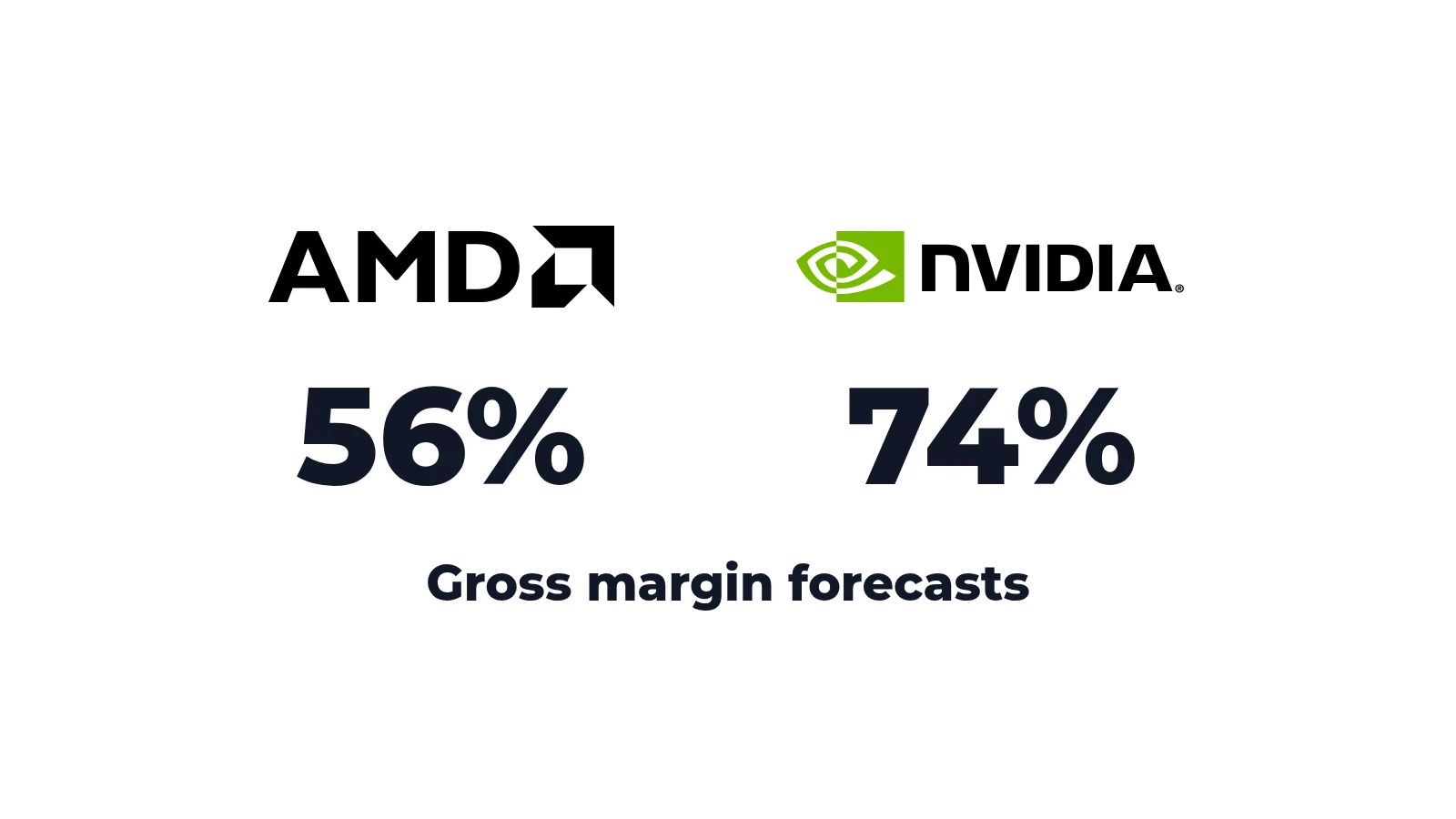
- AMD guides to a 56% margin, Nvidia to 74%
- Nvidia's data center sales run about 13 times AMD's
- What I'm watching in AMD's November 3 report
AMD (AMD) reports third-quarter results after the close on November 3, Election Day. The stock fell 10.9% to $504.80 on October 30, which left it about 23% below its 52-week high of $658.52. Nvidia (NVDA) fell 4.2% to $204.64 the same day.
In September, when AMD closed above $1 trillion for the first time, I wrote that I'd sold it too early. I've been asking one question about this stock ever since. Is AMD actually winning AI business from Nvidia, or is it winning on price?
AMD's November 3 report should offer some clues before Nvidia reports on November 17. Two numbers are worth watching: gross margin and data center revenue.
AMD's margin is about 18 points below Nvidia's
AMD forecast a companywide adjusted gross margin of about 56% for the third quarter, unchanged from the second quarter, according to its August 4 release. Nvidia's gross margin was 75.0% in its latest quarter, and it forecast 74%, plus or minus half a point, for the current one, according to its August 26 release.
Gross margin gives us one read on pricing power, though costs and product mix matter too. Nvidia expects to keep about 74 cents of every sales dollar after direct costs. AMD expects to keep about 56.
I want to be fair to AMD here: its figure includes PC and gaming chips, while about 92% of Nvidia's revenue came from data centers last quarter, by our calculations. AMD reports operating income by segment but doesn't give a separate gross margin for its data center business. The companywide figure is what we have.
Nvidia's data center business is about 13 times bigger
AMD's data center revenue was $6.7 billion in the second quarter, up 107% from a year earlier. The segment includes EPYC server processors as well as the Instinct AI chips that compete with Nvidia. Nvidia's data center revenue was $89.0 billion in its latest quarter, up 117%.
Both more than doubled their sales, but the gap is in the dollars added. By our calculations, Nvidia added about $48 billion of quarterly data center revenue in a year; AMD added about $3.5 billion. AMD is growing fast, but it's chasing a company growing slightly faster from a much larger base.
Lisa Su sounded confident in August. "We enter the second half with strong momentum as EPYC demand accelerates, Instinct deployments scale and Helios begins to ramp," she said in the release. Helios is AMD's full-rack AI system, and HPE landed a $1.2 billion Helios order from Vultr in September.
Jensen Huang was confident too. "The AI infrastructure buildout is at full steam," he said in Nvidia's release.
What I'm watching on November 3
First, revenue against the guide. AMD forecast about $13 billion, plus or minus $300 million. That's about 41% growth at the midpoint.
Second, whether data center sales actually speed up. CFO Jean Hu made that promise in August. "We expect Data Center sales to accelerate in the second half of 2026, driving stronger overall revenue growth and continued earnings expansion," she said. She didn't say whether she meant faster growth from a year earlier or bigger gains from quarter to quarter. Growth was already 107% from a year earlier in the second quarter, so if she meant the yearly rate, that's a high bar.
Third, and this is the one I care about most, the margin line in the fourth-quarter forecast. If data center sales accelerate and AMD guides its companywide margin above 56%, I'd take that as an encouraging sign. If sales accelerate while the margin stays flat or slips, I'll want to know why. Either way, AMD's mix of PC, gaming, and data center products makes it hard to isolate AI chip pricing from that one number.
There's a reason to watch that closely. SemiAnalysis reported in October that some neocloud executives feel pressure to stay Nvidia-only. If buyers are nervous about switching, discounts are one way to get them over the line.
None of this means AMD is a bad business. It posted record revenue of $11.5 billion last quarter, up 50%. At $504.80, AMD is still worth about $824 billion, according to Nasdaq. The margin forecast on November 3 will be one of the bigger tests of whether that price holds up.