Key points
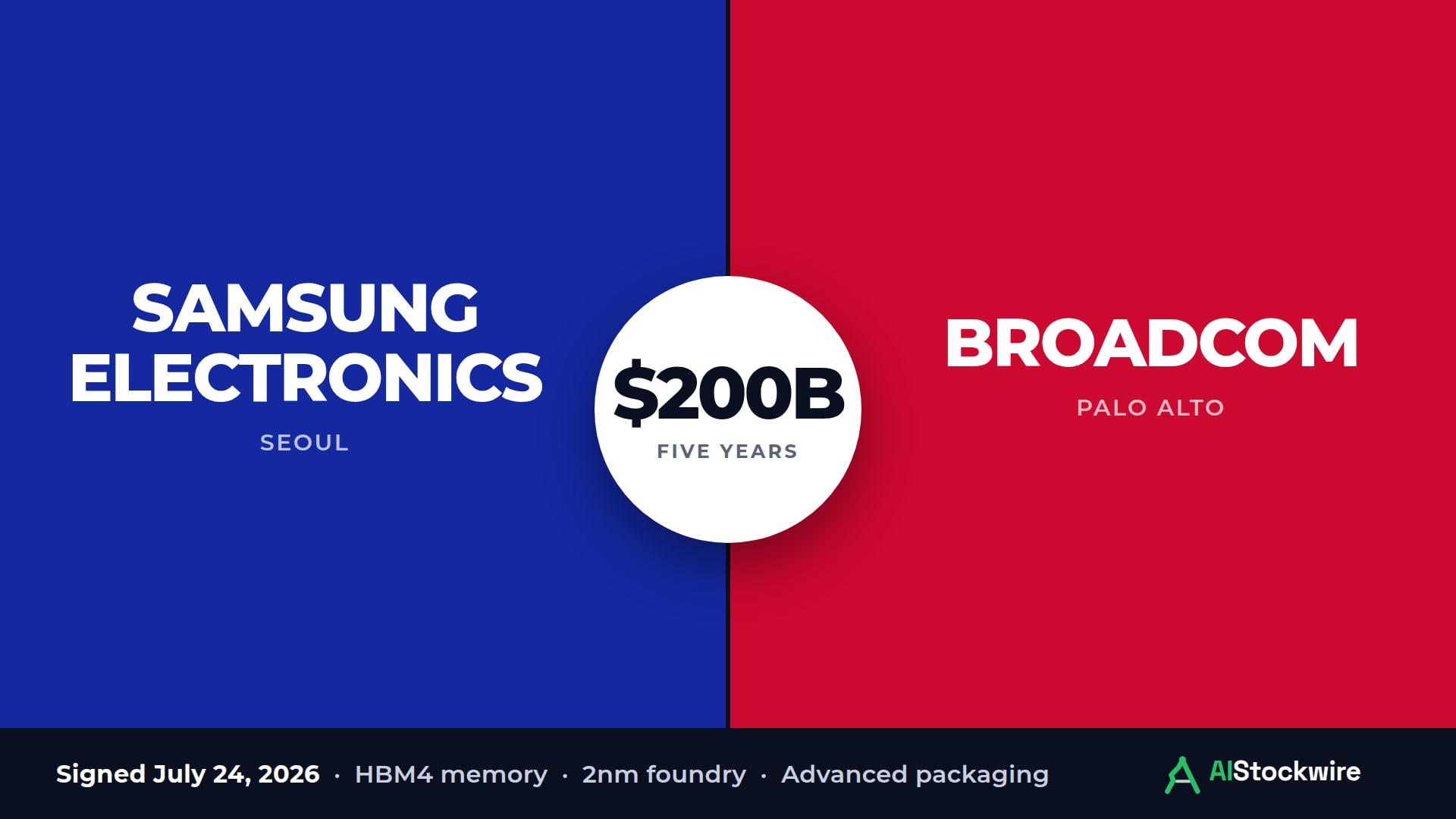
- Samsung Electronics and Broadcom signed a memorandum of understanding in San Francisco on July 24, covering more than $200 billion of work over five years, through 2030. Korean media reported the figure as 292 trillion won.
- Broadcom has had TSMC make its chips since 1994, and about 95% of the wafers it outsourced last year came from there. This is the first time it has committed leading edge work to Samsung.
- Samsung will supply HBM4 and HBM4E memory and do the advanced packaging. It will also build Broadcom's next generation communication chips on 2 nanometer and below, which is the part that matters most to its foundry business.
- Samsung's foundry business held 6.5% of the world market in the first quarter against TSMC's 72%, and it has been losing money.
- It is a memorandum, not a supply contract. Seoul had closed for the week before any of it was announced.
On July 24, at an AI summit held at The Midway in San Francisco, Samsung Electronics (005930.KS) and Broadcom (AVGO) signed a memorandum of understanding covering more than $200 billion of work over five years, through 2030. Korean media reported the figure as 292 trillion won. It is the largest agreement Samsung has ever announced.
The two signatures belonged to Han Jin-man, president of Samsung Electronics' foundry business division, and Hock Tan, chief executive of Broadcom. President Lee Jae-myung was there watching, since he was in the United States on an official visit that week, and so was Samsung chairman Lee Jae-yong.
What Samsung agreed to supply
Three parts of the chip business at once, which is the thing Samsung wants people to notice.
Samsung will sell Broadcom high bandwidth memory for its AI accelerators, both HBM4 and the newer HBM4E. The foundry part is the bigger change, because Samsung will also manufacture Broadcom's next generation high speed communication chips on 2 nanometer and below, then handle the advanced packaging afterward, which is the step where the memory and the logic are assembled into one finished part. Korea Economic Daily reported that people in the industry expect that work to happen at Samsung's Pyeongtaek campus, its most advanced site.
Jun Young-hyun, who heads Samsung Electronics' device solutions division, said the combination is the whole point.
"In the AI era, a semiconductor solution that tightly integrates memory, logic and advanced packaging is more important than anything else," Jun said.
"Samsung Electronics is the only semiconductor company in the world that can do a one stop solution, from logic to memory to foundry and advanced packaging," he added.
That claim is fair. It's also the sales pitch, and it's the reason Samsung keeps using the phrase turnkey. A customer working with one supplier from design through packaging doesn't have to coordinate three of them.
Broadcom has had TSMC make its chips since 1994
TSMC (TSM) has been Broadcom's manufacturing partner for more than three decades, and about 95% of the wafers Broadcom sent out to be made last year came from TSMC fabs.
Broadcom designs the custom AI chips that Google (GOOGL), Meta (META) and OpenAI use in place of some of their Nvidia (NVDA) chips, so who builds them is not a small question. For thirty two years the answer was one company. Now some of it moves to Korea.
Charlie Kawwas, president of Broadcom's semiconductor solutions group, put it in terms of supply.
"As AI infrastructure rapidly expands, tight cooperation across the semiconductor ecosystem has become critical," Kawwas said.
"Together with Samsung Electronics, which has world class capabilities, we will create next generation solutions," he said.
Broadcom already buys from Korea further down the chain. Back in April its name came up as a new customer of Samsung Electro-Mechanics (009150.KS), a separate Samsung Group company that makes the small boards AI chips sit on, and LG Innotek (011070.KS) has been chasing the same work. Those are components, though. This one is the chip.
How far behind Samsung's foundry actually is
Far enough that the size of the headline number can mislead.
In the first quarter of this year Samsung's foundry division took 6.5% of the world market. TSMC took 72%. Measured on revenue the difference was about eleven times over. Samsung's foundry has also been losing money for a while now, and that is the state of the business the Broadcom agreement lands on. Korean analysts are treating it as a turning point because it makes a profit by 2028 look reasonable rather than hopeful.
The memory business has its own version of the same problem. SK Hynix (000660.KS) holds the largest share of the HBM market by a wide margin, and Micron (MU) has moved past Samsung into second place. A multi year commitment at HBM4 and HBM4E volumes is what pays for the capacity needed to change that.
It is a memorandum, not a contract
Korean coverage has been consistent on this point, and it matters. What was signed on July 24 is a memorandum of understanding. The $200 billion describes the intended scale of cooperation through 2030. Volumes, prices and delivery dates still have to be settled in separate contracts.
That doesn't make it empty. Both companies put their chief executives on a stage for it, with the Korean president watching. But a memorandum and a purchase order are different documents, and plenty of announced Korean chip partnerships have quietly stopped somewhere in between.
Samsung was not the only Korean company signing
The summit was arranged around President Lee's trip, and Samsung's was one agreement among several.
SK Group announced about $750 billion of AI infrastructure cooperation with American technology companies over five years. More than $500 billion of that is with Nvidia and covers AI factory construction, HBM supply and joint development of HBM4. The rest includes Microsoft (MSFT) and others on AI server memory. Add Samsung's $200 billion and the presidential office arrives at $950 billion.
Lee Jae-yong framed the week as a national one.
"The AI era cannot be opened by the strength of any one company or nation alone," Lee said, adding that building a complete ecosystem requires cooperation across borders.
Seoul has not had a chance to respond
The Korean market closed for the week on Friday afternoon, hours before any of this was announced.
Samsung Electronics fell 7.59% that day and SK Hynix fell 8.34%, but neither had anything to do with the deals. Kospi fell 5.72% on Friday on oil above $100 a barrel and rising odds of a Federal Reserve rate increase, and the chip stocks went with it. Monday, July 27 is the first session that can respond to the announcements.
Meanwhile, SK Hynix reports its second quarter earnings on July 29.
Sources
- Korea Economic Daily (Korean language): Samsung to apply 2nm and below foundry processes to Broadcom products, July 25
- Herald Business (Korean language): Samsung signs 292 trillion won MOU with Broadcom, with Jun Young-hyun's remarks, July 25
- Munhwa Ilbo (Korean language): Broadcom's reliance on TSMC and the 292 trillion won 2nm agreement, July 25
- Financial News (Korean language): SK Group announces $500 billion AI cooperation with Nvidia, July 25
Deal figures are as announced by the two companies and reported by South Korean media. Share price moves are July 24, 2026 closes on the Korea Exchange. This is general market commentary and not investment advice. Always do your own research and consider speaking with a licensed financial professional before making any investment decision.
Related coverage
- Broadcom just picked its next supplier, and it is not Samsung Electronics or SK Hynix.
- SK Hynix (SKHY) sells the memory in Nvidia's (NVDA) Rubin racks. SK Group is committing $1.44T USD to the chips and data centers around them.
- SK Hynix (SKHY) reports July 29, and it will most likely be the best quarter the company has ever had