Key points
- IREN's quarterly revenue topped estimates
- IREN pushed back its $4 billion revenue target
- IREN gave no new delivery date for Microsoft's Texas buildings
IREN (IREN) reported fiscal first-quarter revenue of $228 million on November 5, above the $219.95 million Zacks consensus estimate. But the company pushed back its target for more than $4 billion in annual run-rate revenue to January 31, 2027, from the end of 2026. It said the target could slip to the end of February.
IREN blamed a customer-requested design change and supplier timing. It didn't name the customer or say which sites were affected.
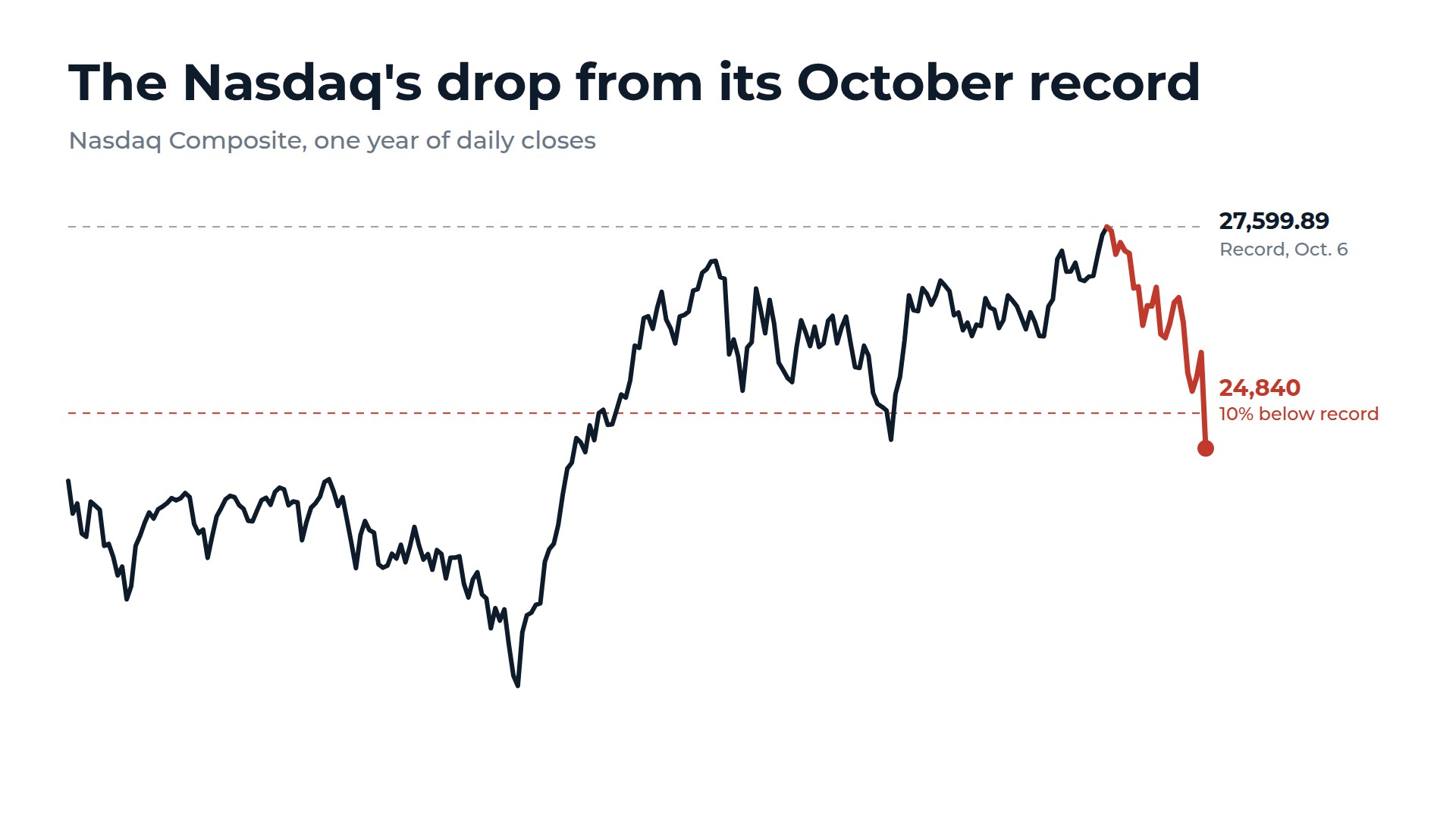
The shares closed down 17% at $18.03 before the report, then traded at $18.81 at 4:58 p.m. ET, up 4.3%. The decline came on the day the Nasdaq entered a correction.
What moved the $4 billion target?
Annual run-rate revenue is what a business would bring in over a year at its current pace. IREN counts only GPUs that have been commissioned and are under contract, so reaching the target depends on finishing the work on time.
Co-CEO Daniel Roberts said in the release that the more than $4 billion in contracted annual run-rate revenue is funded. He attributed the delay to the customer-requested design change and supplier timing.
IREN's contracts include Nvidia (NVDA), Microsoft (MSFT), and 13 other customers. The company didn't say which one requested the change.
IREN gives no new date for Microsoft's buildings
The revised target comes eight days after Microsoft cut its 2026 spending forecast by $5 billion, citing delays in capacity from outside providers. Microsoft didn't name those providers. The Information reported on November 4 that delays at IREN were part of the reason.
IREN is building four 50-megawatt data centers for Microsoft in Childress, Texas, under a contract worth about $9.7 billion. One, Horizon 1, has been delivered. In August, IREN targeted delivery of the other three, Horizons 2, 3, and 4, in the October-to-December quarter. The new release says they have "progressed to late-stage construction," but doesn't repeat the delivery target or give a new one.
IREN's results presentation gives more detail. At Horizons 2 and 3, electrical and networking work is complete, while cooling and GPU deployment are in progress. At Horizon 4, electrical work and cooling are still in progress, and GPU deployment is listed as planned. None of the three is marked as handed over.
Neither the release nor the presentation says whether the customer-requested change involved Microsoft.
AI cloud revenue nearly tripled
| US$ million | Quarter ended September 30 | Quarter ended June 30 |
|---|---|---|
| Total revenue | 228 | 137 |
| AI cloud revenue | 200 | 71 |
| Bitcoin mining revenue | 28 | 67 |
| Net loss | 263 | 684 |
| Adjusted EBITDA | 66 | 19 |
Revenue backlog rose 22% from the prior quarter to $20.3 billion, and IREN said about two-thirds is with investment-grade customers. Backlog is revenue the company expects to book under signed contracts. Microsoft is the largest piece, at $9.6 billion.
Pricing also rose. IREN said three-year deals signed last quarter carried about 11% more estimated annual revenue per megawatt than deals signed the quarter before, and five-year deals carried about 12% more.
After the quarter ended, IREN signed a five-year contract at about $22 million a year per megawatt of IT capacity, with the customer prepaying 90% of the GPU cost. It also signed a three-to-six-month contract at about $40 million per megawatt on the same annualized basis, so the two prices aren't directly comparable. IREN also expanded its contract with an unnamed frontier AI lab.
IREN still has $6 billion to line up
IREN expects $15 billion of remaining capital spending this fiscal year, which runs through June 2027. It said $9 billion is covered by cash, committed GPU financing, and customer prepayments. IREN is still seeking financing and other sources for the remaining $6 billion, subject to market conditions. It says that spending would go toward future capacity.
Cash and cash equivalents fell to $3.52 billion at September 30 from $5.90 billion at June 30. IREN says the $4 billion target itself is fully funded, as long as it meets the conditions on its committed financing.
IREN's next Texas site sits in the state's data center fight
IREN said its 2-gigawatt Sweetwater hub has conditional inclusion in Batch Zero, ERCOT's process for studying large power requests as a group. The release doesn't say what the conditions are.
ERCOT paused that study to carry out Gov. Greg Abbott's audit of data centers, and the audit was expected to finish by December. Gina Hinojosa, the incoming governor, campaigned on a data center moratorium. IREN's presentation lists the audit among its risks, but it doesn't say how the audit or a moratorium could affect Sweetwater.
The next test is whether IREN reaches the $4 billion run rate by January 31, the date in its release, or needs until the end of February.