Key points
- Who must approve a Tesla-SpaceX merger
- How many Tesla votes Elon Musk would need
- What Democrats can do about a SpaceX deal
Congress won't get a vote on a possible merger between Tesla (TSLA) and SpaceX (SPCX). The companies' October filings show that a deal would instead run through their special committees and other required approvals.
The two companies lost more than $450 billion in combined market value from the November 3 close through the November 5 close, by our calculations.
Tesla closed at $343.69 on November 5, down 10.8% on the day. SpaceX closed at $123.62, down 9%. Both are below their October 20 closes, the day Elon Musk said the companies had formed committees to explore a deal.
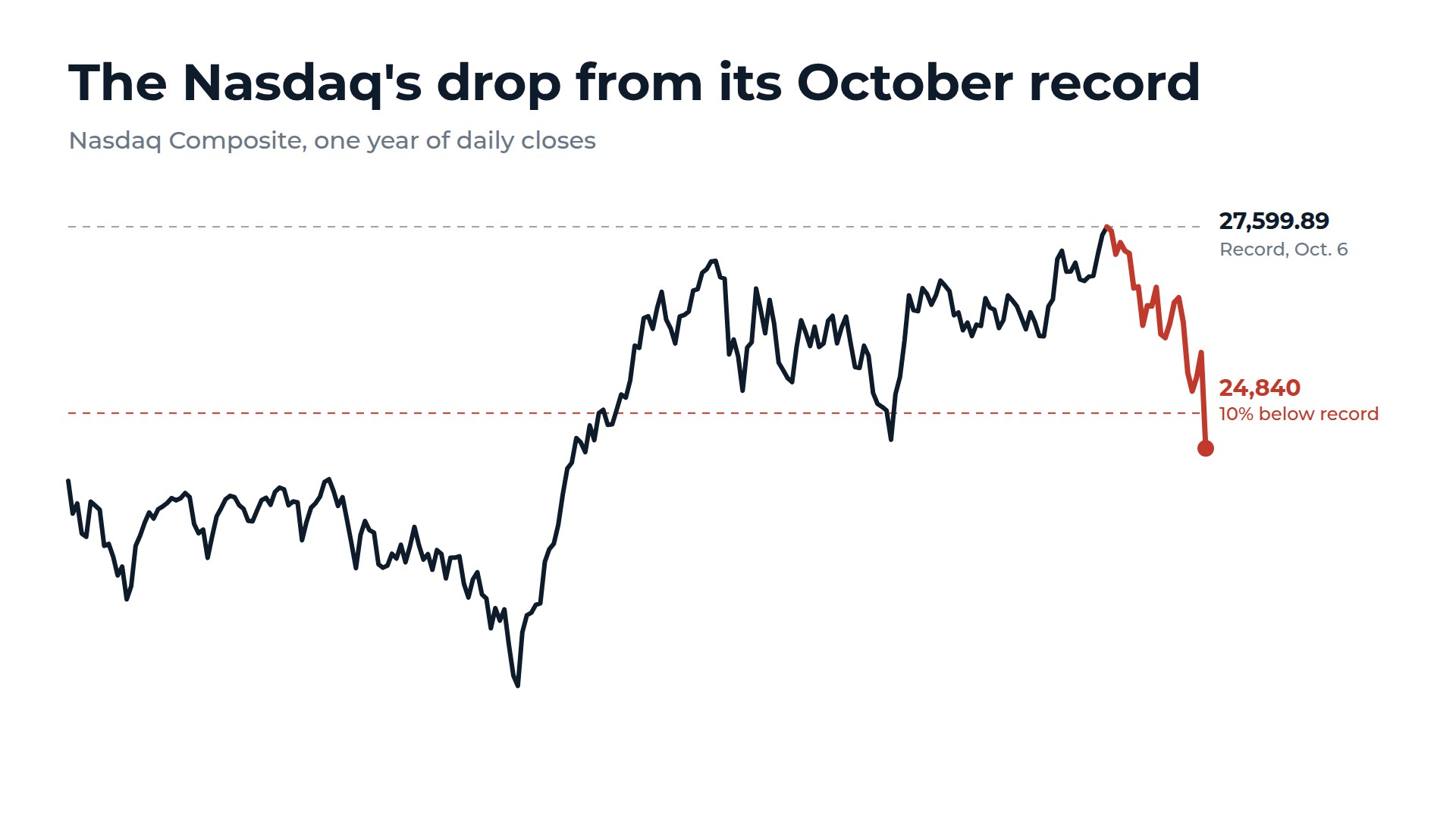
The drop isn't only about the merger. Reuters tied the November 5 losses to worries about data center build-outs, and the Nasdaq entered a correction the same day.
What the two filings say
SpaceX's quarterly report, filed October 22, says the board formed a special committee and that the committee hasn't reached a decision. Any combination would need "further approval by our special committee, our board of directors and our controlling shareholder."
That controlling shareholder is Musk. SpaceX's June prospectus said he would hold about 82.4% of the voting power after the IPO. Musk said on the earnings call that he can't take part in the committees' talks because he leads both companies. So he's outside the talks, but his approval is still on SpaceX's list.
Tesla's quarterly report, also filed October 22, is worded more broadly. It says Tesla's committee was formed to "explore deepening Tesla's relationship with SpaceX," and that this could include a business combination. A deal would need the committee's recommendation and "any necessary shareholder approval." That wording doesn't limit the committee to a merger.
Tesla's shareholder vote is the hard part
Musk said last month that a merger would need approval from a majority of all outstanding Tesla shares, not just a majority of the votes cast. If that standard applies, the October 15 count of 3,952,757,946 shares would put the threshold at about 1.98 billion votes in favor. A share that doesn't vote would count the same as a no.
Musk can't reach that number alone. Those shares fall into three groups:
- 699.6 million shares Musk can vote, according to Tesla's proxy statement.
- 423.7 million restricted shares from his 2025 pay package. Musk doesn't control these votes. Under a voting agreement, Tesla's corporate secretary votes them in proportion to the votes of all other shares, including Musk's.
- 2.83 billion other shares, held by everyone else.
The middle group matters because it follows the rest of the vote. If 70% of the 2.83 billion other shares vote, and 50.9% of those votes are yes, then 63.7% of all votes outside the restricted group are yes once Musk's shares are counted. The 423.7 million restricted shares would then split the same way, adding about 270 million yes votes and just clearing the threshold.
Here's how that works at three turnout levels, assuming Musk votes all 699.6 million shares yes.
| Turnout among the 2.83 billion other shares | Yes share needed from them | Yes votes from them | Yes votes from restricted shares |
|---|---|---|---|
| 60% | 57.8% | 981 million | 297 million |
| 70% | 50.9% | 1.01 billion | 270 million |
| 80% | 45.5% | 1.03 billion | 247 million |
For comparison, about 2.47 billion of 3.33 billion outstanding shares, or 74%, voted on Tesla's director elections at last year's annual meeting. That figure includes Musk's shares. That isn't directly comparable with the turnout figures above, which exclude Musk's shares and the restricted shares.
These are our estimates, with the yes shares rounded up to clear the threshold. They assume Musk can vote his shares on a deal, but neither filing says whether he could. They also assume no shares abstain. The voting agreement leaves the effect of abstentions and nonvotes to the corporate secretary's good-faith estimate.
What Democrats can and can't do
Congress won't vote on a merger, but Democrats will gain control of its committees in January. That gives them the power to hold hearings and issue subpoenas. Lawmakers told Politico they're looking at Musk's role in DOGE, his alleged conflicts of interest, and his reported disruption of Starlink service to Ukraine, The Verge reported.
Timing is one concern. "Now any merger vote plays out while Democrats hold subpoena power," Gordon Johnson, CEO of GLJ Research, told Business Insider. Johnson described the plan as announcing a deal in the first half of 2027 and closing it while Donald Trump is still in office. Neither company has given a timeline.
Federal agencies that review mergers stay under Trump, whose term runs to January 2029. Dan Ives of Yorkville still expects a merger, but he wrote that the merger "now faces a much tougher regulatory roadmap to get this deal done in 2027."
Texas could matter too. Both companies are based there, and Tesla is incorporated there. Democrats won all three seats on the state's 15th Court of Appeals, according to unofficial results reported by The Texan. That court hears appeals from the Texas Business Court, so a shareholder lawsuit over a deal could reach those judges.
Polymarket traders cut the near-term odds
Polymarket traders have lowered the odds of an announcement soon, while the longer-dated odds have edged up. The odds of an announcement by December 31, 2026, fell from 16.5% on November 2 to 9.5% on November 5. The odds of an announcement by January 31, 2027, fell from 26.5% to 18%. The odds of an announcement by December 31, 2027, rose from 66.5% to 68.5%.
These are small markets. The 2027 contract has traded about $102,000, and it measures an announcement, not a completed deal.
What Musk would control after a deal
Wall Street's estimates differ. These figures measure Musk's voting power in a combined company, not his votes on the merger.
Piper Sandler said in a note reported on November 2, before the election, that a proposal is likelier than not, and that Musk would have more than 70% voting control of any new company in most scenarios. Barclays estimated that if SpaceX acquired Tesla, Musk could own about 37% of the combined company and control about 56% of its voting power.
No structure has been agreed, and no merger proposal is on the ballot for Tesla's December 3 annual meeting.
Separately, Texas Governor-elect Gina Hinojosa said on November 5 that she asked the state to take no action on Boca Chica land reported as a possible sale to SpaceX.