Key points
- Thermal drone footage published August 27 shows at least 45 of 62 gas generators running at the Vineland, New Jersey site that serves Microsoft under Nebius' $17 billion deal.
- New Jersey's DEP says it has issued no permits and has none under review. Former EPA air enforcement chief Bruce Buckheit says that does "violate federal law."
- Vineland separately issued two stop-construction orders in August, for LNG tank work and the Bloom Energy fuel cells meant to replace the generators.
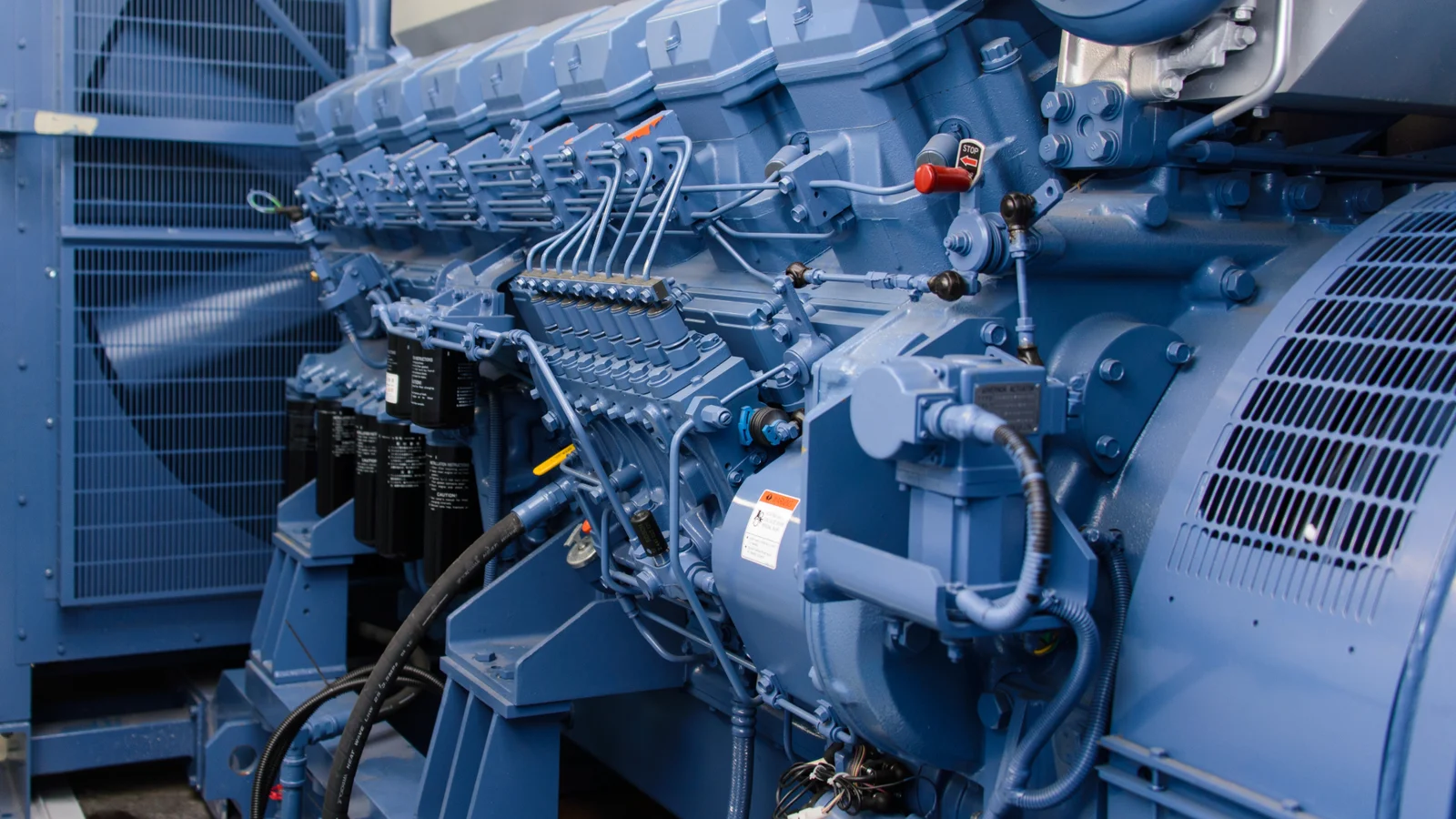
A thermal drone flight over the DataOne data center in Vineland, New Jersey found at least 45 of the site's 62 gas generators running. The state says none of them has an air permit. The facility is being built for Nebius (NBIS) and will supply AI computing to Microsoft (MSFT) under a $17 billion agreement.
The footage was captured last week by Floodlight, a nonprofit newsroom, and published in partnership with The Guardian. The 300-megawatt facility, called DataOne, sits about 40 miles outside Philadelphia and about a mile from two schools. It is the first data center in New Jersey seeking to build its own power plant.
A New Jersey Department of Environmental Protection spokesperson confirmed to Floodlight that the agency "has issued no permits, nor are any permit applications under review for power generators at the DataOne facility in Vineland." The spokesperson said the agency noticed the generators during a site inspection on July 29 and has yet to make "a full compliance determination." They declined to answer follow-up questions.
Federal and state law requires DataOne "to have a final permit before bringing those generators onsite, and certainly before firing them up," Bruce Buckheit, the former air enforcement chief at the Environmental Protection Agency, told Floodlight. Buckheit, who served under multiple Republican administrations, said the activity does "violate federal law" and that the company should immediately stop operating the generators and pay a fine for "their illegal emissions." He said "that one might be seeing administrative enforcement action [soon]." The EPA told Floodlight, after being presented with the findings, that New Jersey's regulators are responsible for air permitting at DataOne.
Why does the site have no air permit?
DataOne originally applied for a permit covering more than 30 Bergen gas-burning engines, the type used to propel cruise ships. NJDEP found multiple deficiencies in that application, according to public records reviewed by Floodlight. DataOne withdrew it in May and switched to an array of Bloom Energy (BE) fuel cells rated at 300 megawatts. Fuel cells run on gas but generate electricity through a combustion-free electrochemical reaction, which produces far less of the pollution that the Bergen engines would have.
The fuel cells aren't running yet. Until they are, the site runs on the unpermitted generators. Maintenance logs cited by Floodlight suggest the first of them were switched on in October. Thermal footage captured by a data intelligence company appears to show 25 operating in late June.
A Bloom official testified at a planning board meeting that the fuel cells, if completed, could emit more than 2 billion pounds of carbon dioxide a year.
What has the city of Vineland done?
The city issued two stop-construction orders in August. One covers work on the 1.5-million gallon liquefied natural gas storage tank. The other covers installation of the Bloom fuel cell units. The orders state "you did work without first obtaining a construction permit" and that "we have no prior approvals, plans or permits in reference to Bloom Energy Units," according to documents shared with WHYY News. Hunterbrook Media, which first reported the fuel cell work on X, put the date of the Bloom order at August 10.
Failure to comply carries a penalty of $2,000 per violation per day, according to the orders. DataOne may appeal to the Construction Board of Appeals of Cumberland County, or resume work once the city issues the approvals.
A DataOne spokesperson told WHYY the notices were "limited to equipment placement work under the approved site plan" and added, "We do not expect this temporary pause to affect our construction and delivery timeline."
On August 18, eight days after the Bloom order, the Vineland Planning Board approved phase two of the site plan by a vote of 8 to 1. The vote came near midnight, after a six-hour hearing at a local theater. Nobody spoke in favor of the plan during public comment. Board member John Casadia cast the dissenting vote and said there needs to be a "thorough investigation" of the environmental impacts first. The other members argued the plan requires no variance relief and is permitted under local zoning.
What is the sequence so far?
| Date | Event |
|---|---|
| 2025 | DataOne breaks ground in Vineland |
| October | First generators appear to be switched on, per maintenance logs cited by Floodlight (Floodlight does not give the year) |
| March 2026 | Cumberland County Department of Public Health cites DataOne over nighttime noise levels, per a residents' lawsuit |
| May 2026 | DataOne withdraws its air permit application for more than 30 Bergen engines |
| Late June 2026 | Thermal footage from a data intelligence company appears to show 25 generators running |
| July 29, 2026 | NJDEP notices the generators during a site inspection |
| August 2026 | Vineland issues two stop-construction orders, for the LNG tank and the Bloom fuel cells |
| August 18, 2026 | Vineland Planning Board approves phase two, 8 to 1 |
| August 27, 2026 | Floodlight publishes thermal footage showing at least 45 of 62 generators running |
What approvals are still outstanding?
Casandia Bellevue, an attorney at Earthjustice, told WHYY it isn't clear which additional approvals DataOne needs to operate the energy plan, but that she believes the developers must apply for a pre-construction permit from NJDEP and a certificate of operation from the state for the 300-megawatt fuel cell array.
NJDEP hasn't said whether it will bring an enforcement action over the generators. It would not be the first citation at the site. A lawsuit brought by local residents alleges the Cumberland County Department of Public Health cited DataOne in March 2026 for violating noise ordinances on nighttime sound levels. A separate class action claims construction and operational noise will hurt property values.
What have the companies said?
DataOne didn't answer Floodlight's questions about the generators, but said the company "remains committed to meeting all applicable environmental and permitting requirements." Nebius didn't respond to requests for comment by publication. Microsoft declined to comment.
On its second-quarter earnings call on August 12, two days after the Bloom stop order, Nebius management described the hearing as a normal part of the regulatory process following the switch to Bloom. It said it expected "no significant impact" on the project timeline. Construction of the building itself finished earlier in the summer, the company said. After the August 18 vote, a DataOne spokesperson told WHYY the company will "continue to engage with the Vineland community as we complete construction and operate at full capacity later this year."
How does this fit the wider data center buildout?
Nationwide, close to 60 data centers are planning their own gas plants, according to research by the energy analytics firm Cleanview cited by Floodlight. The approach was pioneered at Elon Musk's data centers on the Tennessee and Mississippi border. Floodlight reports it has driven yearslong backlogs for gas-powered turbines, pushing facilities toward less conventional sources such as modified jet engines and portable generators.
Local and state friction of this kind is what our AI Bubble Index tracks under the commitment gap, the distance between announced data center capacity and capacity that clears permitting and financing. New York froze new data center connections for a year in July, and Pennsylvania Governor Josh Shapiro signed an executive order on local approvals on August 18.
NBIS finished Friday's regular session at $209.25, down 4.2% from Thursday's close of $218.48. Bloom Energy ended at $210.67, down 3.3%. Microsoft closed up 1.7% at $513.67. Nebius launched a $4.5 billion convertible note offering on August 19 and closed it on August 24 at $5.75 billion after upsizing and the initial purchasers' options, with proceeds earmarked in part for data center construction.
Andrew and Stevi Groetsch live less than a mile from the site and told Floodlight the noise wakes them at night. "It's just constant. It never goes away," Andrew Groetsch said.
"If you don't follow one rule, what makes us have any reason to believe that you would then follow others?" Stevi Groetsch asked. "It's so upsetting."
On September 22, New Jersey fined DataOne $1.07 million over the 62 generators.
Sources
- Evan Simon, "One of East Coast's largest data centers accused of 'violating federal law'", Floodlight, in partnership with The Guardian, August 27, 2026. Source for the thermal footage, the 45-of-62 count, the NJDEP statement and July 29 inspection, the Buckheit quotes, the withdrawn Bergen application, the October maintenance logs, the Cleanview figure and the Groetsch quotes.
- Zoe Read, "City of Vineland, N.J. issues stop-work order to parts of data center", WHYY, updated August 14, 2026. Source for the two stop-construction orders, the order text, the $2,000 daily penalty, the appeal route and the DataOne response.
- Zoe Read, "Vineland planning board approves 2nd phase of 300-megawatt data center plan", WHYY, August 18, 2026. Source for the 8-1 vote, the Casadia and Bellevue quotes, the LNG tank size and the post-vote DataOne statement.
- Nebius Group, second quarter 2026 results and the accompanying earnings call, August 12, 2026. Source for the Vineland site plan commentary, the "no significant impact" timeline language and the construction status.
- Price data for NBIS, BE and MSFT retrieved at the close on August 28, 2026.
This article is for information only and is not investment advice. Prices are as of Friday's close on August 28, 2026 and will move.