Key points
- Nvidia unveils factory-built AI data centers
- Huang puts a price on deployment delays
- OpenShell targets AI agent security
- Nvidia expands its European investments
Nvidia (NVDA) unveiled DSX POD on Wednesday, Oct. 21, a factory-built AI data center design that it says can cut deployment time at a prepared site from six months to as little as 14 days. Announced at GTC Berlin, the design lets partners assemble and test systems inside modular containers before delivery.
Each unit contains a complete Vera Rubin system, including computing equipment, networking, cabling, power, and liquid cooling. Once delivered, it connects to the site's power, cooling, and network infrastructure.
Partners including Dell Technologies (DELL), Hewlett Packard Enterprise (HPE), Foxconn, Schneider Electric, and Vertiv (VRT) plan to begin worldwide deliveries in early 2027.
Nvidia shares were up 1.9% at $220.53 in premarket trading as of 6:47 a.m. ET, compared with Tuesday's close of $216.47.
Huang puts a price on deployment delays
On stage, CEO Jensen Huang said a one-gigawatt AI data center costs about $50 billion and is expected to generate about $40 billion in annual revenue. Under those assumptions, a three-month delay would postpone about $10 billion in potential revenue.
On stage, Huang described a separate timeline: how long it takes computers to start producing tokens after arriving at a site. "We think something along the lines of four to five months down to about a month," he said in a clip of the keynote. That estimate differs from the prepared-site deployment figure in Nvidia's announcement.
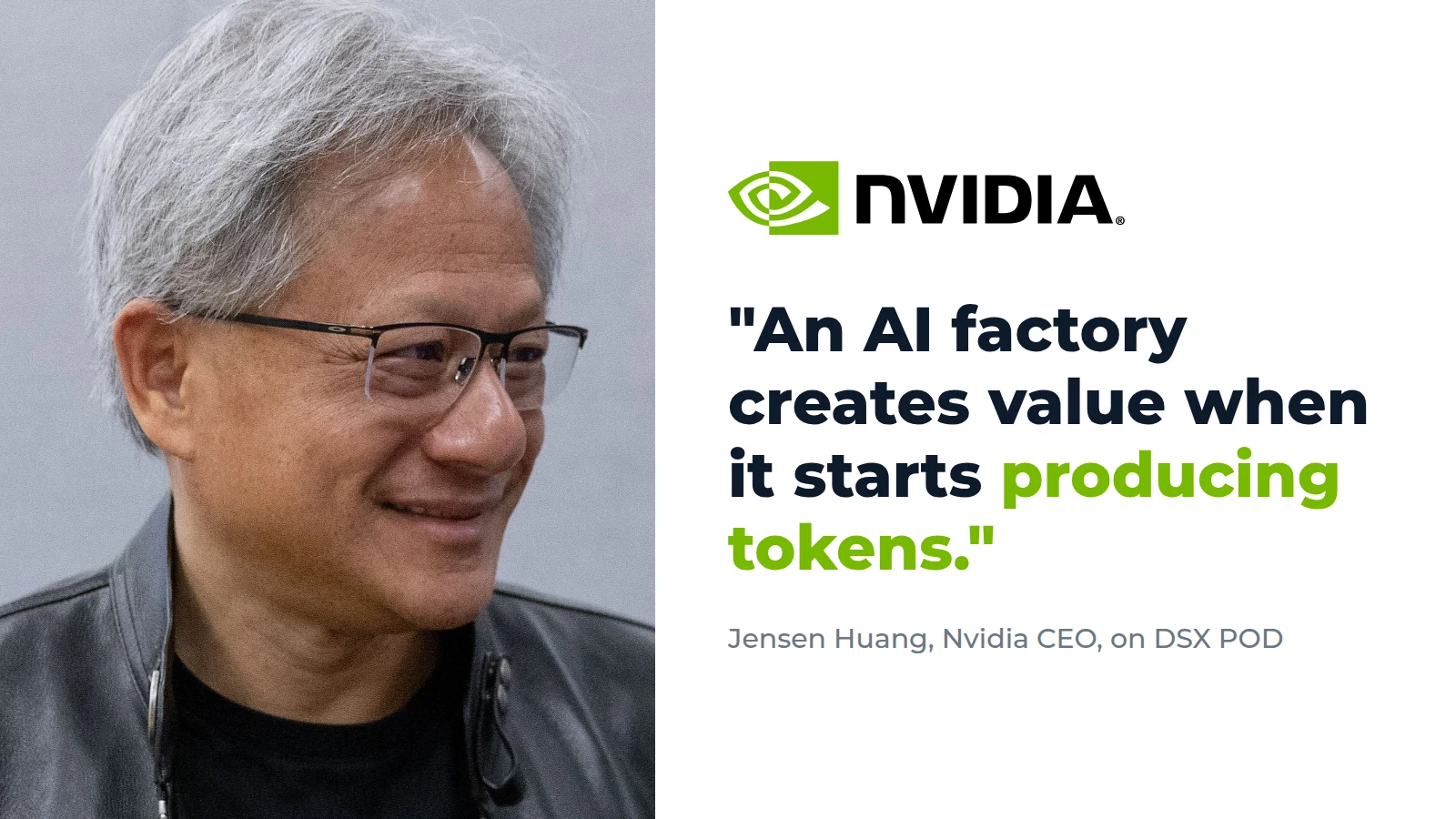
As Huang put it in the release, an AI factory "creates value when it starts producing tokens."
Nvidia also pitched robots, agent security, and telecom
Agile Robots announced Agile ONE SN, a reference humanoid robot built on Nvidia's Isaac GR00T models and Jetson Thor computer and scheduled for early 2027. The robot stands 1.40 meters (4.59 feet) tall, weighs 40 kilograms (88 pounds), and has two five-finger hands. Nvidia also made its Isaac Lab 3.0 robot-training software generally available. Huang said "the ChatGPT moment for robotics is fast approaching."
Nvidia released the OpenShell Reference Architecture, a hardware and software design for running AI agents inside set boundaries. Nvidia said its BlueField-4 chips can monitor agents and stop one in milliseconds if it tries to move outside those limits. Enterprises can run agents from model builders including Anthropic, OpenAI, Google, Meta (META), and SpaceX Super Intelligence on it. The reference architecture is available now, and the OpenShell software is open source.
Nvidia also said supply-chain partners will expand capacity. Substrate deals with IBIDEN, Samsung Electro-Mechanics, and Unimicron will raise substrate capacity 2.5 times over three years, and Nvidia is giving test company KYEC a $1.1 billion advance for new U.S. facilities. "Demand is extraordinary. Capacity is the constraint," Huang said.
Nvidia and Nokia (NOK) said T-Mobile (TMUS) completed what they described as the first AI-RAN call on a live network, in Bellevue, Washington. In this setup, radio network software runs on Nvidia hardware that can also handle AI workloads. Finland's Elisa completed a field trial, and BT and Deutsche Telekom plan field trials in 2027. Nine operators across Europe, the Middle East, and Africa are building or expanding Nvidia-powered infrastructure.
"Telecom networks were built to carry the world's conversations. Now, they will also carry the world's intelligence," Huang said.
The keynote capped a week of deals in Europe
Huang spent the past week touring France, Britain, Sweden, and Germany before the keynote. In Paris on Oct. 13, Nvidia said it would invest in four French startups, and Huang promised $2 billion more in European deals. In London on Oct. 14, he announced stakes in five U.K. startups, Boltz, Foresight, Hiverge, Prima Mente, and Riverlane, and shouted "I am giving you money! And I am giving you money! And I am giving you money!" from the stage, Axios reported.
The pitch is what Huang calls sovereign AI, the idea that every country should build and control its own AI computing, data, and models. Nvidia has about $10 billion in investments in Europe and is helping build AI infrastructure projects in Saudi Arabia, South Korea, India, and Malaysia, and across Africa. The tour comes as shares and bonds of Nvidia-backed CoreWeave (CRWV) and other neoclouds, which rent out AI computing, have fallen, and as investors question Nvidia financing companies that buy its chips.