Key points
- Cybersecurity called AI's next major use case
- CrowdStrike, Cisco and Palantir named on stage
- Each plays a different role in the stack
- No cybersecurity revenue figures or timelines
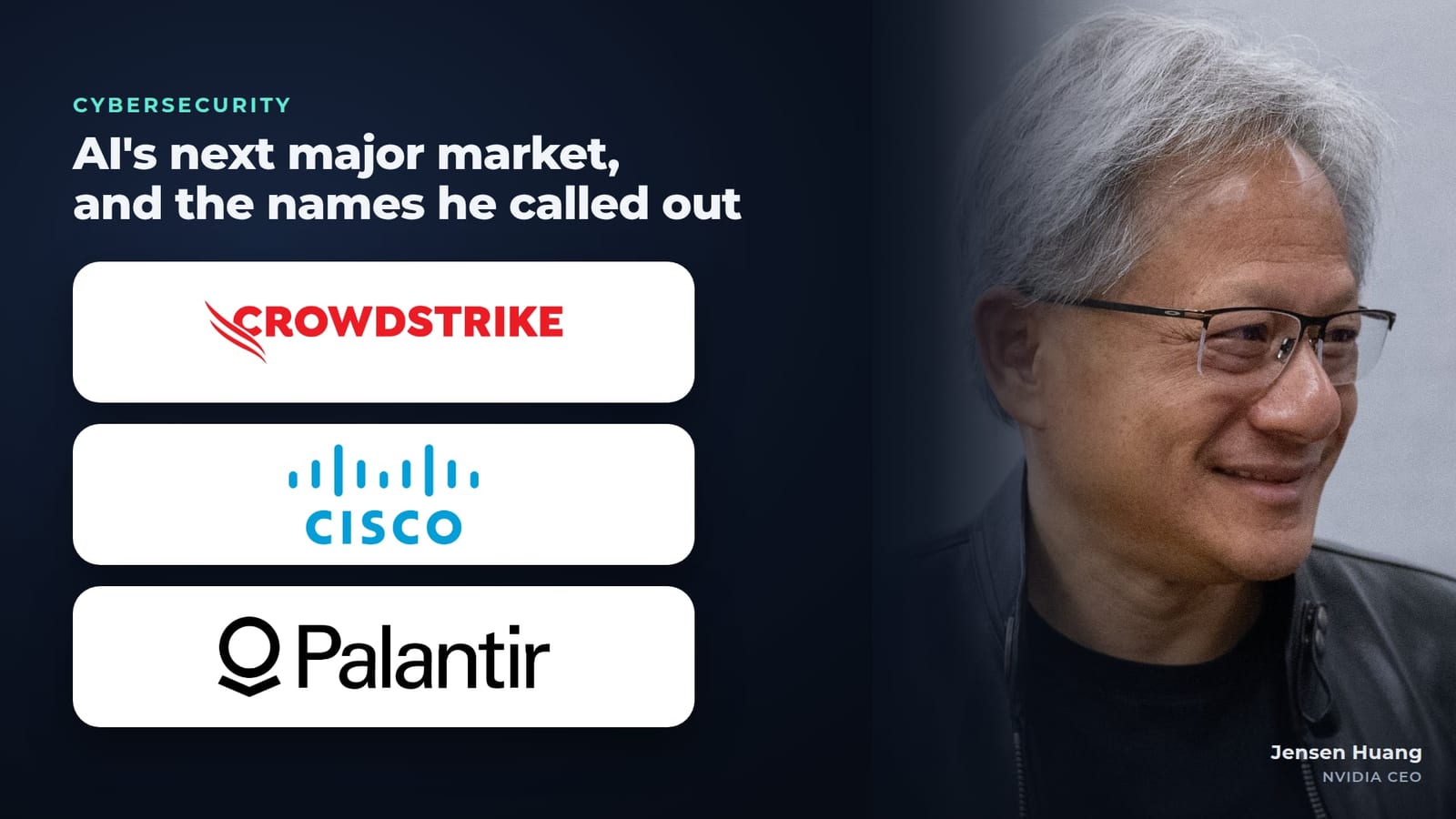
Nvidia (NVDA) chief executive Jensen Huang said cybersecurity will be the next big use case for AI, and he named three companies already building on Nvidia's technology to do it. He was speaking Thursday at the Goldman Sachs Communacopia + Technology Conference in San Francisco, where he also repeated his forecast that AI infrastructure spending reaches $3 trillion to $4 trillion by 2030, the same figure he used when he walked through the GPT-6 Astra training run on Sunday.
The three companies are CrowdStrike (CRWD), Cisco (CSCO) and Palantir (PLTR), and they are not doing the same job. Huang said Cisco would offer an Nvidia AI factory platform, meaning the infrastructure layer, and that Palantir would build on top of it for deployments to companies and to countries, an extension of the sovereign AI push Palantir laid out on Tuesday. The model layer is where CrowdStrike sits. Its new security models are built on Nemotron, the family of open models Nvidia makes available for others to customize.
Huang's argument starts with code. "Coding is an important part of it. A derivative of coding is, of course, bug finding. A derivative of that, which is a very large market, is called cybersecurity," he said. "If you can code well, you must be able to debug well. Red teaming is finding a bug. Blue teaming is patching a bug." Red teaming is the practice of attacking your own systems to see what breaks. Blue teaming is defending them. Both are jobs a model that writes software should, in principle, be able to do.
"The fact of the matter is cybersecurity will likely be the next major use case of AI. It is going to run continuously," Huang said, according to Bloomberg. The "continuously" part is the commercial point. Security agents can operate continuously, creating recurring demand for compute rather than demand tied to individual prompts. He added that it "will be a great new business opportunity for the labs" and "a fabulous opportunity for CrowdStrike."
How CrowdStrike fits
That last name was not a guess. On September 1, at its own Fal.Con conference, CrowdStrike launched SafeMind, a pair of security models built with Nvidia as design partner and trained on top of Nemotron. One model, Red Tempest, plays attacker. The other, Blue Solano, plays defender. They run against each other inside a digital twin of a customer environment so the defensive side keeps learning. Huang called CrowdStrike Nvidia's "number one cybersecurity partner" at that event. CrowdStrike CEO George Kurtz put it this way in the release: "The future of cybersecurity won't be defined by AI that simply identifies threats, it will be defined by AI that defeats them." Neither company has said what SafeMind costs or when it reaches general availability.
Who else is on Nvidia's stack
Nvidia has been signing security vendors for most of the year, and the published partner lists are a better guide to who benefits than a sector screen is. In a January 5 post, Nvidia said nine security platforms had been validated against its Enterprise AI Factory design, which puts security enforcement on BlueField, a dedicated chip that sits beside the GPUs. The public names on that list are Check Point (CHKP), F5 (FFIV), Fortinet (FTNT), Palo Alto Networks (PANW), Red Hat, which IBM (IBM) owns, and Trend Micro, listed in Tokyo. Armis, Rafay and Spectro Cloud are private.
A second group covers factories and industrial control systems. At the S4x26 conference in February, Nvidia named Akamai (AKAM), Siemens (SIEGY), Palo Alto Networks, Forescout and Xage Security as partners on that work, Network World reported. Forescout and Xage are private.
Palo Alto is worth a second look because it spent real money on the same thesis. It closed its $25 billion purchase of identity vendor CyberArk on February 11, paying $2.3 billion in cash and 112 million of its own shares, or $45.00 in cash and 2.2005 Palo Alto shares for each CyberArk share. The reason it gave was identity, all of it. CEO Nikesh Arora framed the deal around securing every identity, human, machine and agent, and the company said machine identities already outnumber human ones by more than 80 to 1. We looked at what that consolidation wave was doing to sector valuations in July. That deal is also why CYBR no longer trades in New York.
Two large names Huang did not mention are worth naming anyway, because they compete for the same budget rather than sit on Nvidia's stack. Microsoft (MSFT) sells Security Copilot into Microsoft's enormous installed base, and Zscaler (ZS) and SentinelOne (S) both sell agentic detection products of their own. A partner list tells you who gets a slide at GTC. It does not tell you who wins the renewal.
What investors know so far
Investors have already been paying up for a version of this. On August 10, after the Black Hat conference in Las Vegas, CrowdStrike and Palo Alto both jumped more than 5% to record highs, and BTIG analysts wrote that the most consistent theme in their conversations was that "AI agents have fundamentally changed the threat landscape." CrowdStrike went on to touch $233.88 on August 31. Palo Alto hit $398.88 on August 13 and has given back a good deal of that since.
Thursday's reaction was small, which is roughly what you would expect for a CEO restating a theme he has been on since Fal.Con. As of 3 p.m. ET, CrowdStrike traded at $209.30, up 0.7%, and Palo Alto at $338.39, up 1%. The First Trust Nasdaq Cybersecurity ETF (CIBR) was little changed against a 1% drop in the Nasdaq 100. Nvidia itself fell 2.5% to $218.08.
What Huang did not do was put a number on the cybersecurity opportunity itself. He gave no market size, no timeline, and no disclosure of what Nvidia earns from these partnerships, which matters because Nvidia sells the compute whether the winning security model belongs to CrowdStrike or to somebody else. He framed cybersecurity as one of several markets beyond coding, alongside drug discovery and physical AI. The one number he did repeat was not new. Chief financial officer Colette Kress told analysts on the August 26 earnings call that total revenue would grow 70% in fiscal 2028, against a 44% average analyst estimate, and Huang said Thursday he remains confident in it. He has consistently described that 70% as a supply ceiling rather than a demand ceiling, telling analysts on the same call that Nvidia's demand is much greater than 70%.