Key points
- A $201 million filing without an outright stock sale
- Arora gets cash now and settles in 2029
- A tax bill is part of the reason
Something interesting turned up on our insider tracker on Tuesday. Palo Alto Networks (PANW) chief executive Nikesh Arora filed a Form 144 covering 500,000 shares worth $201.4 million. A Form 144 is the notice an insider files before selling stock, so it looked like a very large sale. The paperwork describes something different.
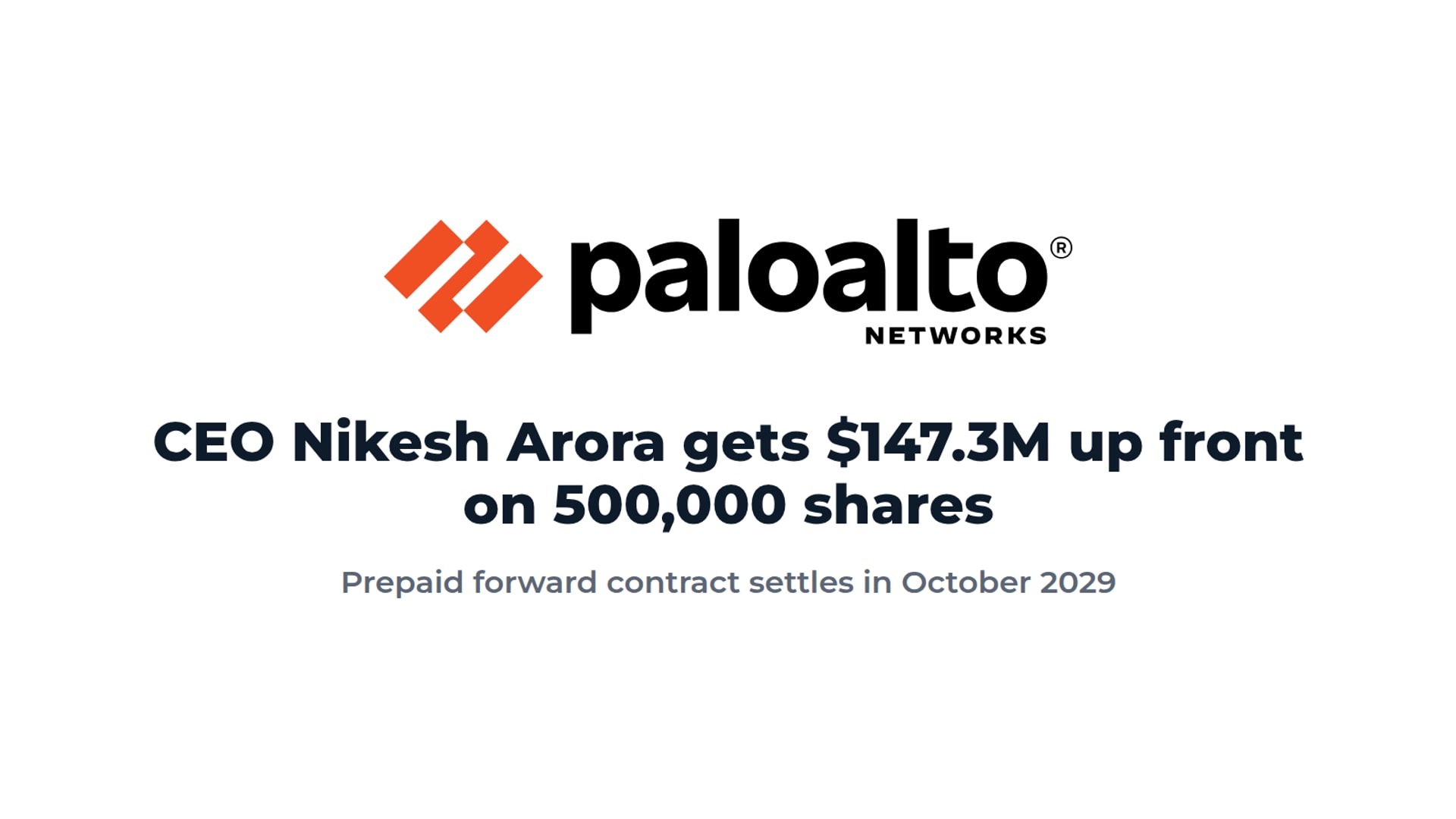
Arora didn't sell those shares on the market. On October 12th, a trust he controls signed a deal with a dealer that the filings call a variable prepaid forward contract. A Form 4 filed Wednesday shows he received about $147.3 million in cash up front. In return, he'll owe the dealer up to 500,000 shares, or a cash equivalent calculated under the contract, when the contract settles in October 2029.
Until then, he still owns the shares. He's pledged them to the dealer, but he keeps the voting rights unless he settles by handing them over, or the deal defaults or ends early.
How does the deal work?
The number of shares Arora gives up depends on Palo Alto's closing price on the valuation date in 2029. If it's $342.38 or lower, he hands over all 500,000. Between $342.38 and $755.25, he hands over fewer shares as the price rises. By our arithmetic from the contract's formula, the shares he delivers in that range are always worth $171.19 million. Within that range, the value of his retained shares rises or falls with the stock price. Below $342.38, further losses fall on the dealer. Above $755.25, the extra gains go to the dealer. He can also choose to pay cash instead of delivering shares.
The Form 144 valued the shares at $402.80 each. By our arithmetic, $342.38 is 85% of that price, and the $147.3 million up front is about 73% of what the 500,000 shares were worth.
The shares themselves go back a long way. Most came from open-market purchases in June 2018 under the offer letter Arora signed that May, and from stock awards that vested in 2022. The newest 68,085 came from a purchase on March 27th, when he paid about $147 a share.
Why didn't he just sell?
Arora explained it in a note attached to the Form 4. He expects to owe more than $100 million in stock-related taxes over the next three years, including taxes tied to settling this contract. A big part of his stock sits in a company plan that lets him put off receiving shares after they vest, with payouts expected in 2028 and 2036. He still owes his share of Social Security and Medicare taxes in cash as those shares vest. "The Contract is not an outright sale of Issuer shares of Common Stock and preserves the Reporting Person's alignment with the Issuer's long-term performance," the note says.
Palo Alto's governance committee approved the deal after getting advice from outside counsel. The committee weighed the fact that a large block sale on the open market "could be interpreted negatively by the equity markets." It also noted that Arora recently pushed back a payout of 1,479,229 deferred shares from 2027 to 2036, and that he told the committee he plans to push another 1,479,230 from 2028 to at least 2033.
As of October 12th, Arora held 1,101,946 shares outright and had 2,958,459 more deferred under the company plan. Those two figures add up to about 4.06 million shares, and 500,000 is about 12.3% of that, by our arithmetic. The note's estimate that the pledged shares are less than 10% of his total also counts shares he has the right to acquire within the next 60 days, a number it doesn't give.
Other Palo Alto insiders have sold stock this fall, including chief financial officer Dipak Golechha, who sold 27,500 shares in September under a pre-set trading plan. Palo Alto shares closed down 5.5% at $375.04 on Wednesday, more than two and a half times what Arora paid in March. How many shares he actually hands over won't be known until the contract settles in October 2029.