Key points
- Three big pension funds have less US stock exposure than their benchmarks
- They cite stretched valuations and AI concentration
- Index funds can't make the same choice
Some of the world's biggest pension funds are allocating less to US stocks than their benchmarks call for, and AI concentration is a big reason why. Australia's $260 billion Australian Retirement Trust, Canada's $388 billion La Caisse, and the UK's £45 billion People's Pension are all underweight US equities, the Financial Times reported on Oct. 5.
These funds are limiting their exposure to a US market increasingly concentrated in a handful of AI stocks. I've written about dot-com warning signs and thin market breadth. What stands out here is that pension managers are putting those concerns into practice by allocating less to US stocks than their benchmarks.
The funds point to stretched valuations and concentration
Companies tied to the AI investment cycle, including Nvidia (NVDA), Alphabet (GOOGL), and Microsoft (MSFT), now account for more than a third of the S&P 500's weight, according to the FT.
Australian Retirement Trust cut its US stock position this year relative to the MSCI World index. Senior portfolio manager Jimmy Louca told the FT that valuations of "the AI sector and US equities are a little bit stretched." He added, "When you look at where we are in the cycle, we assess those US fundamentals as being more than fully priced."
La Caisse still has more money in the US than anywhere else. "We're diversifying outside of the megacap technology stocks," Vincent Delisle of La Caisse told the FT. "Valuations can be a trap right now, sustainability of earnings growth should be a focus."
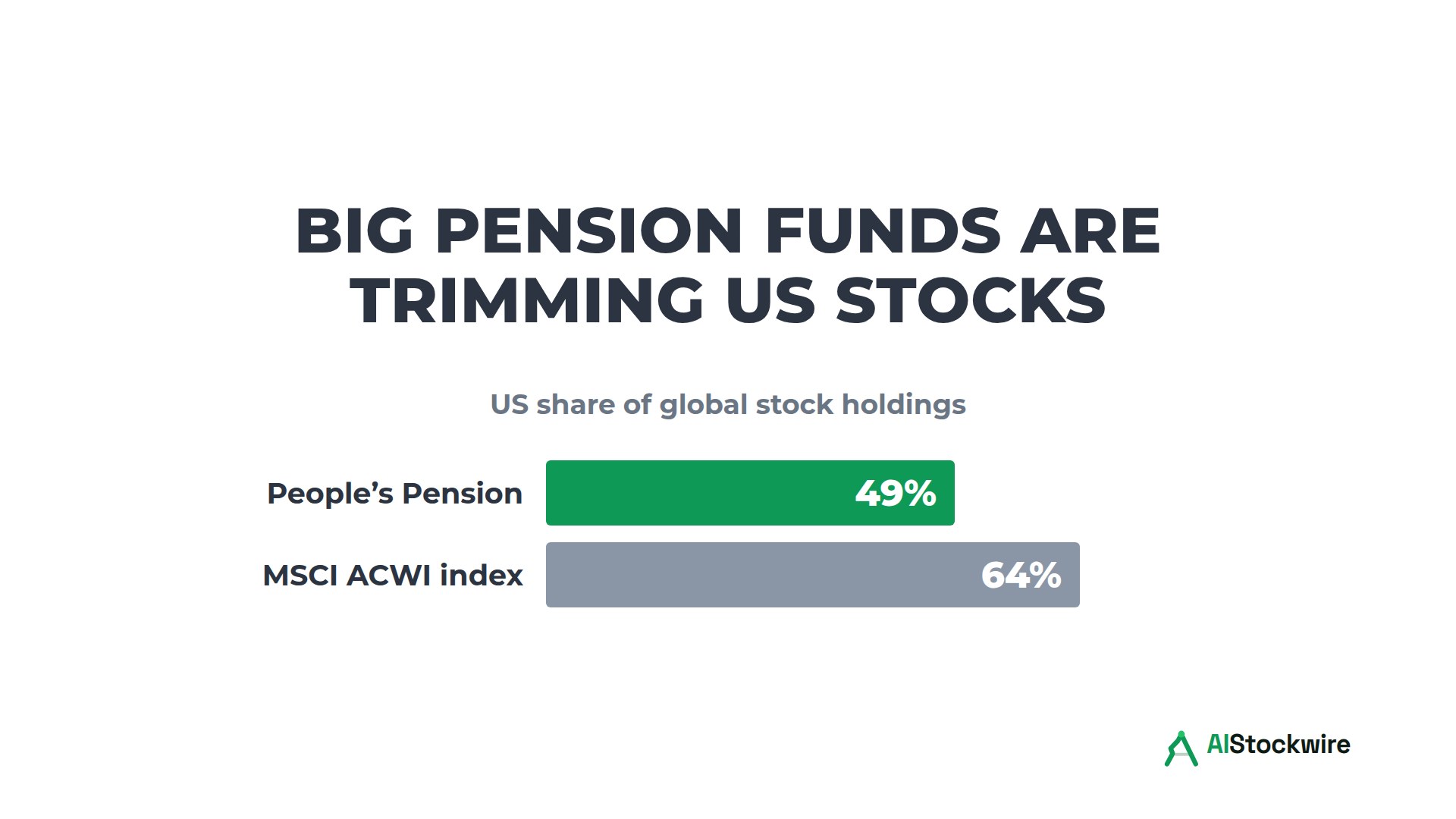
People's Pension has the clearest number. The US is now 49% of its main fund's global stock exposure, down from 53% at the end of last year, the FT reported. The MSCI ACWI global index puts the US at about 64%.
Your index fund can't do what they're doing
This is the part that matters for regular investors. A fund tracking a market-cap-weighted index such as the S&P 500 follows the index's holdings. When AI stocks outperform, they take up more of the index and more of each new dollar invested in the fund.
People's Pension chief investment officer Dan Mikulskis raised a similar concern with the FT. He said concentration risk "does merit real discussion" given the US share of global portfolios and the amount of money tracking indexes.
I don't think that's a reason to dump an index fund. Moving away from the biggest AI stocks has meant missing some strong gains. But investors should know how much of their broad-market fund now depends on the same AI companies.
More big investors are moving the same way
It isn't just three funds. A survey by Marsh of 430 asset owners with $5.76 trillion under management found that 48% changed their geographic positioning over the past year. About a third plan to cut US stock exposure over the next 12 months, double last year's share, according to the FT. And 38% plan to raise cash, up from 9% in 2025.
Denmark's ATP, which oversees more than $100 billion, is monitoring valuations and concentration risk, the FT reported. Its chief investment officer, Mikkel Svenstrup, said today's valuations assume very strong earnings growth for years to come.
These funds are betting that diversification is worth the risk of falling behind if the biggest AI stocks keep outperforming. I think that's the useful point for ordinary investors: an index fund spreads your money across many companies, but a handful can still drive much of its return. Our AI Bubble Index tracks valuations and other signs of froth in the AI trade.