Key points
- Appeals court upholds Thomson Reuters' copyright win
- Ross' fair use defense fails; the reasoning remains sealed
- The case concerns AI search, not generative AI
A federal appeals court on Tuesday upheld Thomson Reuters' (TRI) copyright win against Ross Intelligence, a former rival that used material from Westlaw to train an AI legal search engine.
The 3rd U.S. Circuit Court of Appeals rejected Ross' fair use defense. It is the first ruling by a U.S. appeals court in a copyright dispute over AI training, Reuters reported. Reuters is owned by Thomson Reuters. The court's reasoning is sealed for now. The parties have 10 days to propose redactions before the opinion is released.
What the case is about
Thomson Reuters sued Ross in 2020 over Westlaw's headnotes, short summaries of the points of law in court opinions. The company accused Ross of using thousands of them to train a search engine that found relevant court opinions for users' questions.
Fair use is a defense that lets people use copyrighted material without permission in some cases, such as when the new use transforms the original. A federal judge in Delaware rejected Ross' defense in February 2025.
"Ross took the headnotes to make it easier to develop a competing legal research tool," the judge said. "So Ross's use is not transformative."
Ross shut down its platform in 2021, citing the cost of the litigation.
What it means for other AI cases
Authors, news outlets, music labels, and others have filed dozens of lawsuits accusing tech companies of training AI systems on their work without permission. Tech companies argue that generative AI makes fair use of that material by turning it into something new.
Ross' search engine retrieved court opinions rather than generating new content. That difference matters when comparing this case with lawsuits against generative AI companies. With the appeals court's reasoning still sealed, the ruling offers limited guidance on how it assessed Ross' fair use defense.
In the New York Times' (NYT) case against OpenAI, the Justice Department sided with OpenAI on fair use this month.
Thomson Reuters shares fell 1.1% on Tuesday.
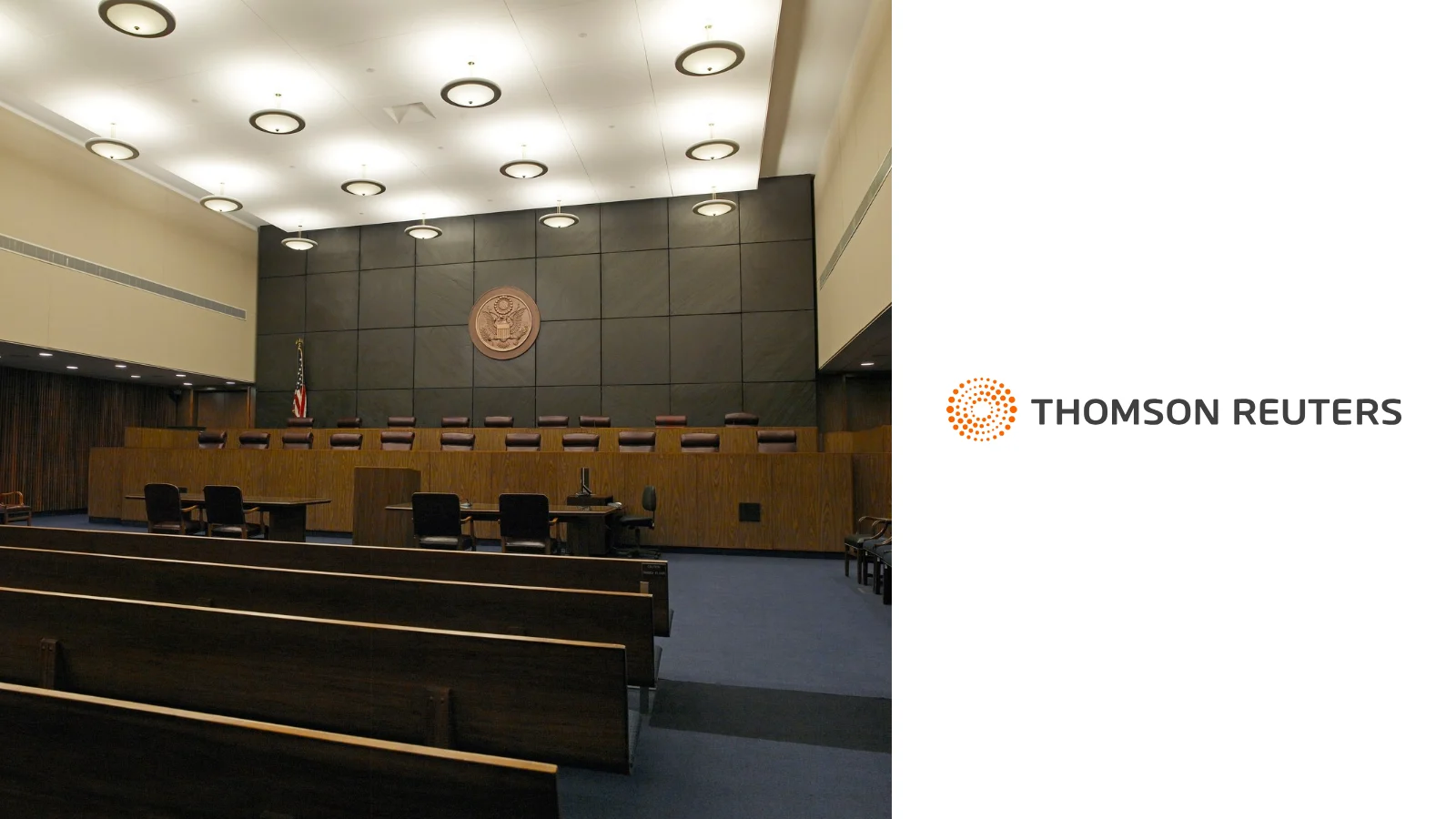
Cover photo: a courtroom in the James A. Byrne U.S. Courthouse in Philadelphia, where the 3rd Circuit sits, by Carol M. Highsmith, Library of Congress.