Key points
- Applied Materials is using AI to find new chip materials
- Its Japan chief says shrinking is nearing its limits
- The company wants Japanese partners and engineers
- Applied says its Silicon Valley center is on track for 2026
Applied Materials (AMAT) is using artificial intelligence to search for the materials that could extend chip progress after transistor shrinking becomes harder. Hitoshi Nakao, president of Applied Materials Japan, told Nikkei Asia that the company is looking for Japanese partners and engineers to help develop them.
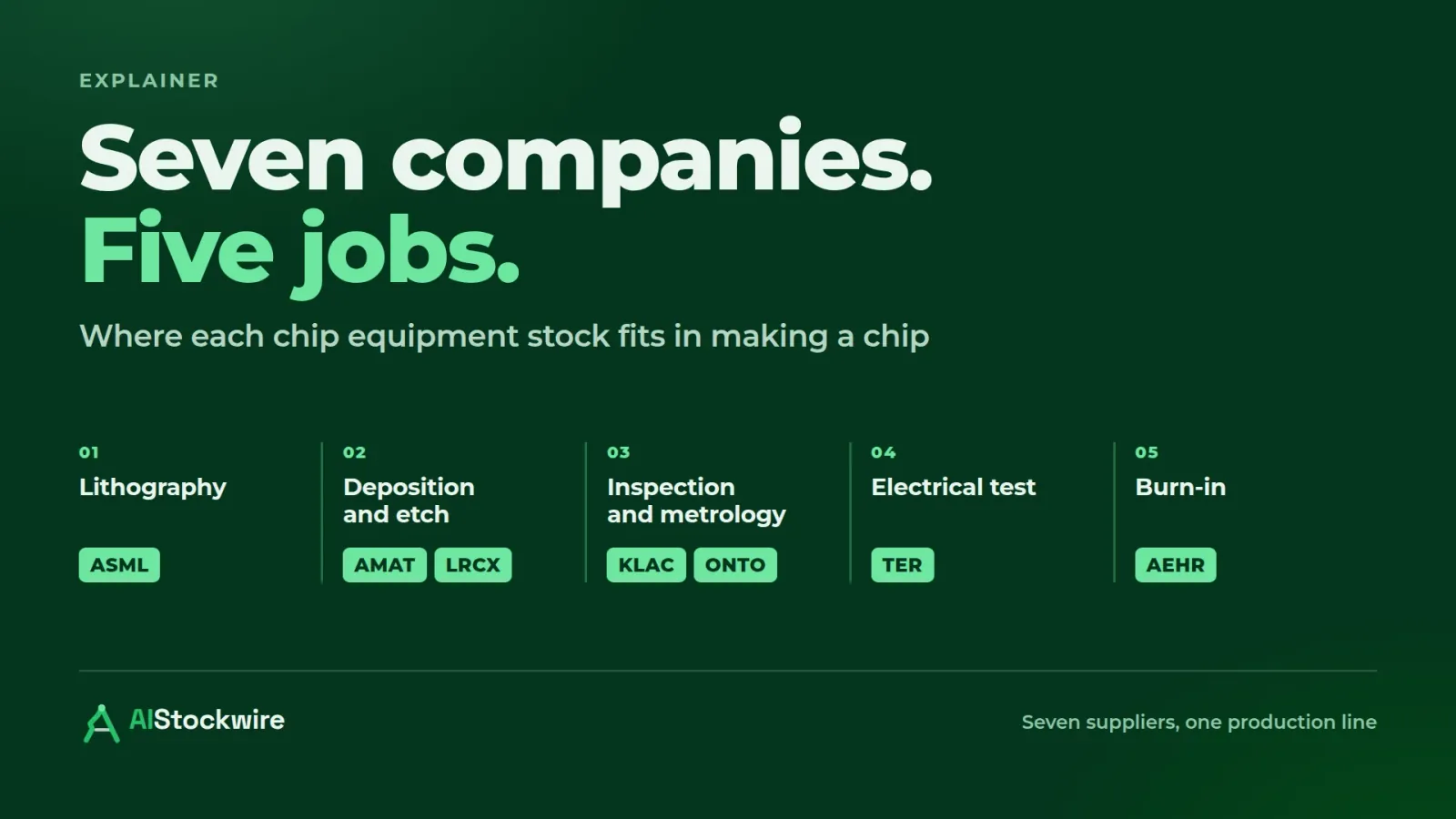
That work sits directly inside Applied's business. The company sells the deposition, etch and inspection equipment used to put materials onto a wafer, shape them and measure the result. A new material that reaches high-volume production can add process steps and create demand for those tools.
Why materials are the product
Applied does not design processors. It sells deposition, etch and related tools to foundries and memory makers. As transistors become harder to shrink, chipmakers increasingly need new materials, structures and production methods to improve performance. That is why AI-assisted materials discovery matters to Applied: it may shorten the path from a candidate material to a manufacturable process.
Where the work happens
A key site for that research is the EPIC Center, a $5 billion chip equipment research site in Silicon Valley with more than 180,000 square feet of cleanroom. Applied says the EPIC Center is on track to become operational in 2026. The pitch is that chipmakers, universities and suppliers run experiments on industry-scale equipment in one building rather than handing prototypes down a chain.
The partner list has filled in through the year. Samsung Electronics signed on in February for joint work on materials engineering for advanced nodes, future memory and 3D integration. Advantest (ATEYY), the Japanese chip-testing equipment maker, joined in April as the first test company in the program and is building its own innovation center on Applied's campus, which Advantest says is on track to become operational in 2026. Arizona State, Rensselaer Polytechnic and Stanford followed in May, and UC Berkeley joined on August 11 to work on material and process innovations for AI computing.
The business is at a record. Revenue for the quarter ended July 26 came to $9.12 billion, up 25% from a year earlier, and the company guided the current quarter to about $10.25 billion, plus or minus $500 million. Shares closed at $456.49 on Friday, September 11, down about 15% from the $535.54 close on August 13, the day of that earnings release.