Key points
- Seven equipment companies serve five different chipmaking jobs
- Product mix and customer spending explain different growth rates
- Bookings can rise while revenue falls
- AI demand commentary does not isolate AI revenue
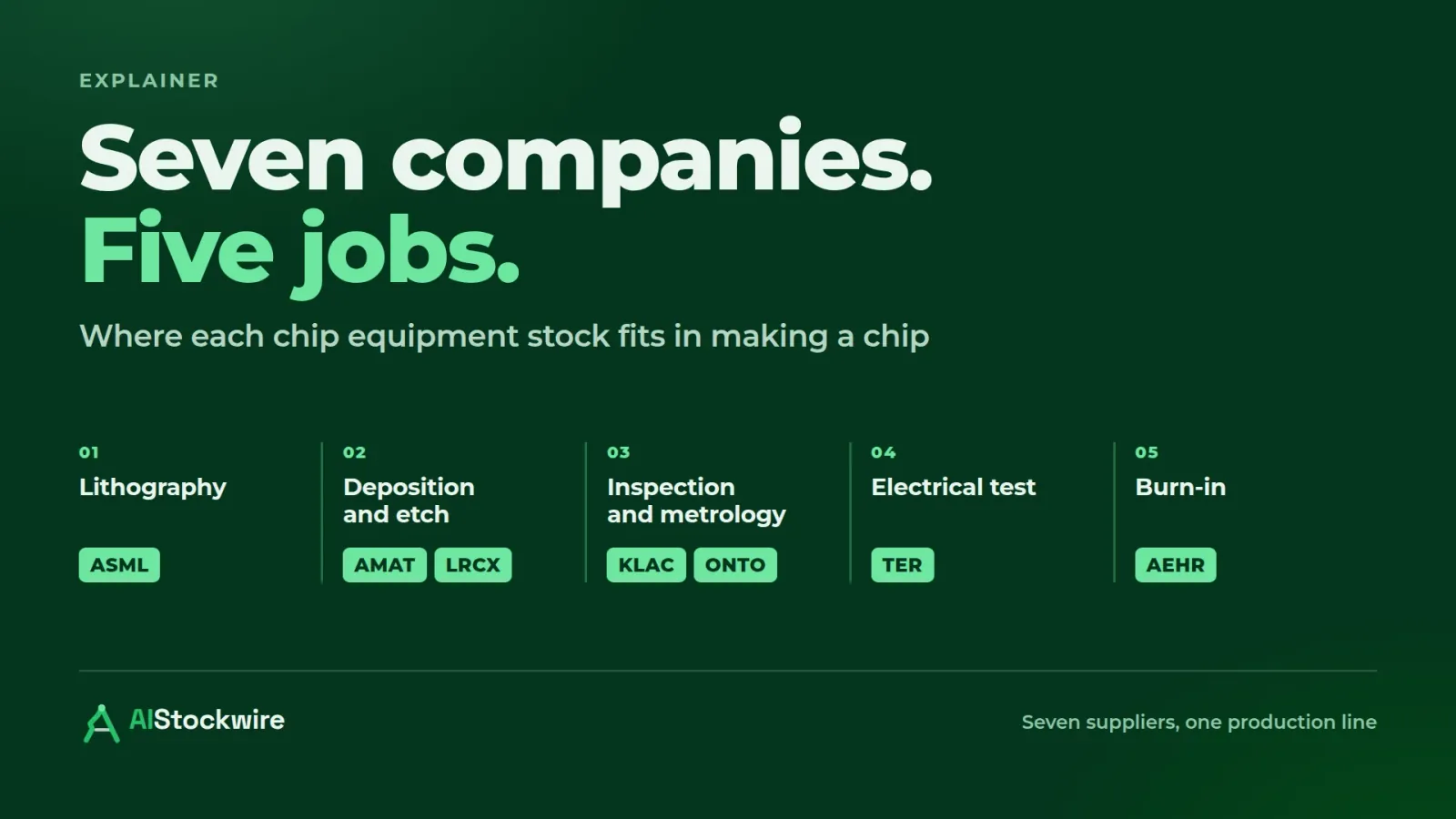
Semiconductor equipment stocks give investors exposure to different parts of chip production. ASML sells the machines that print circuit patterns. Applied Materials and Lam Research supply tools that build and shape material layers. Others inspect those layers, test electrical performance or screen for early failures.
Those differences help explain why suppliers serving the same industry can report sharply different results. Their customers, product mixes and spending cycles determine when demand turns into revenue. The seven companies below illustrate those differences, with the 2026 reporting cycle as a worked example. Financial figures come from company earnings releases; currency conversions and calculated growth rates are noted.
Where each company fits in chipmaking
Making a chip takes months of processing, inspection and testing. Manufacturers build circuits on a wafer one patterned layer at a time, checking for defects along the way. Finding a problem early matters because each subsequent step adds cost to a part that may eventually have to be discarded.
| Company | Job | What its machines do |
|---|---|---|
| ASML | Lithography | Prints the circuit pattern onto the wafer |
| Applied Materials (AMAT) | Deposition and etch | Adds material layers and cuts them away |
| Lam Research (LRCX) | Deposition and etch | Same steps, weighted to memory and 3D structures |
| KLA (KLAC) | Inspection and metrology | Finds defects and measures dimensions between steps |
| Onto Innovation (ONTO) | Inspection and metrology | Same, weighted to advanced packaging |
| Teradyne (TER) | Electrical test | Proves a finished chip works to specification |
| Aehr Test Systems (AEHR) | Burn-in | Stresses parts to force early failures before shipment |
These categories describe the businesses covered here, rather than every product each company sells.
Lithography defines circuit patterns on the wafer. ASML's extreme ultraviolet machines are used in advanced chip production, making its orders an indicator of customers' investment in leading-edge capacity.
Deposition adds material; etch selectively removes it. Applied Materials and Lam Research supply both types of equipment. Memory is an important market for Lam, including the complex structures in 3D NAND and the connections used to stack dies in high-bandwidth memory. These are distinct manufacturing challenges, both of which require deposition and etch technology. Lam sets out these applications on its advanced memory solutions page.
Inspection finds defects, while metrology measures dimensions. These checks help manufacturers identify problems during production. KLA and Onto Innovation supply equipment for this work, including advanced packaging, which connects separately manufactured dies in a package.
Electrical test checks whether a chip works to specification, both at the wafer stage and after packaging. Teradyne supplies equipment for both stages. Burn-in screens for early failures by operating devices under stress, such as elevated temperatures and voltages, before shipment.
For investors, the next question is what drives demand for each machine. Factory expansion supports equipment orders, but so do more complex manufacturing processes and greater testing requirements. Production volume matters alongside the work required for each chip. Understanding that mix is the starting point for comparing these companies' growth.
Why their growth rates differ
Five things move these companies apart, and most quarters involve more than one.
Product mix. A company weighted to memory moves with the memory cycle; one weighted to leading-edge logic moves with foundry capacity decisions. The same end-market boom reaches them in different quarters.
The memory cycle itself. DRAM and NAND run through gluts and shortages on their own schedule, and equipment orders follow the memory makers' capital budgets rather than end demand directly.
Packaging complexity. Stacking dies vertically and wiring them through the silicon raises the value of catching a failure before assembly, because one bad die can ruin a finished stack worth many times an ordinary chip. That pulls spending toward inspection, metrology and test.
When the customer spends. Equipment is bought against a plan, not against last month's sales. Orders arrive in lumps and convert to revenue on the customer's installation schedule, so a strong order year and a weak revenue year can be the same year.
The comparison base. A percentage is a ratio, and a company coming off a weak quarter a year earlier will post a larger one than a company coming off a strong quarter, on identical underlying demand.
A snapshot from the 2026 reporting cycle shows how far apart that pushes them. All seven reported between July 14 and August 13, 2026, on fiscal calendars that do not line up.
| Company and quarter | Revenue | Year-over-year growth |
|---|---|---|
| ASML, Q2 2026 to June 28 | $10.8B | 21% |
| Applied Materials, Q3 FY26 to July 26 | $9.12B | 25% |
| Lam Research, quarter to June 28 | $6.72B | 30% |
| KLA, Q4 FY26 to June 30 | $3.66B | 15% |
| Teradyne, Q2 2026 to June 28 | $1.33B | 104% |
| Onto Innovation, Q2 2026 to June 30 | $343.1M | 35% |
| Aehr Test Systems, Q4 FY26 to May 29 | $18.8M | 34% |
ASML reports in euros. Its quarter was 9.33 billion euros, converted here at the European Central Bank reference rate of 1.1592 dollars to the euro on September 11, 2026. Applied Materials, Teradyne and Onto stated their growth rates; the ASML, Lam, KLA and Aehr figures are calculated from the year-earlier revenue in each company's own release, by our arithmetic.
Teradyne shows how strongly memory demand can move a test supplier's results. It reported revenue of $1.33 billion for the June quarter, said it was "up 104% and earnings up over 300% from Q2'25," and credited record memory revenue driven by DRAM and what it called "a resurgence in NAND final test." Semiconductor Test accounted for $1.12 billion of the total. The release identifies the sources of demand but does not quantify each one's contribution to growth.
ASML is the customer-investment driver, and it is the only one of the seven that published a capacity commitment rather than a demand comment. It said on July 15 that customers "continue to accelerate their capacity expansion plans," and set out its response: adding 30 percent to its 2026 low-NA EUV capacity of around 65 units for 2027, with a further 30 percent under investigation for 2028, and the same increase to a DUV immersion capacity of around 130. A capacity plan is a statement about several years, which is why this company's guidance is read differently from the others'.
Aehr Test Systems is the clearest case of orders and revenue pointing opposite ways in the same report. Its fiscal 2026 revenue fell to $50.0 million from $59.0 million, with a GAAP net loss of $7.1 million for the year. In the same July 14 release it reported record quarterly bookings of $60.7 million, effective backlog of $100.6 million, and fiscal 2027 revenue guidance of $130 million to $150 million, or 2.6 to 3.0 times fiscal 2026. Both sets of figures are true at once, and the smaller the company, the more violently this swings.
What investors should watch
The same five questions come back every reporting season, and the answers are usually in the release rather than in the headline.
Are orders converting into revenue? Backlog and bookings are a claim on future quarters, not a result. Check whether recognized revenue is following a prior year's orders, and whether management has moved the conversion timing.
Is the growth broad or concentrated? A single customer's capacity decision can carry a quarter. Geographic and segment splits in the release are the cheapest place to see it.
How exposed is the company to export restrictions? Lam disclosed that China accounted for 26 percent of its June-quarter revenue, behind Taiwan at 27 percent and ahead of Korea at 20 percent. Rules on this equipment have changed more than once, and buyer concentration is what turns a rule change into a revenue problem.
Are the capacity additions supported by sustained demand? Adding 30 percent to EUV output commits ASML's own spending against customer plans that can be revised. The same question applies to any supplier expanding a factory against a forecast.
Is the AI contribution measured, or only described? None of these companies reports an AI segment, so the disclosures show total growth alongside management commentary about AI demand; they do not isolate AI's contribution to revenue. The closest any of them gets is a product-line split such as Teradyne's Semiconductor Test line or Onto's Advanced Nodes revenue, and those carry non-AI customers too.
The useful comparison starts with what each company sells, which customers buy it and when those orders become revenue. A shared AI label tells you much less about why their results move differently.