Key points
- Applied Optoelectronics opens another stock-sale program
- How many shares AAOI could issue
- What AAOI is spending on expansion
- What AAOI's earlier programs raised
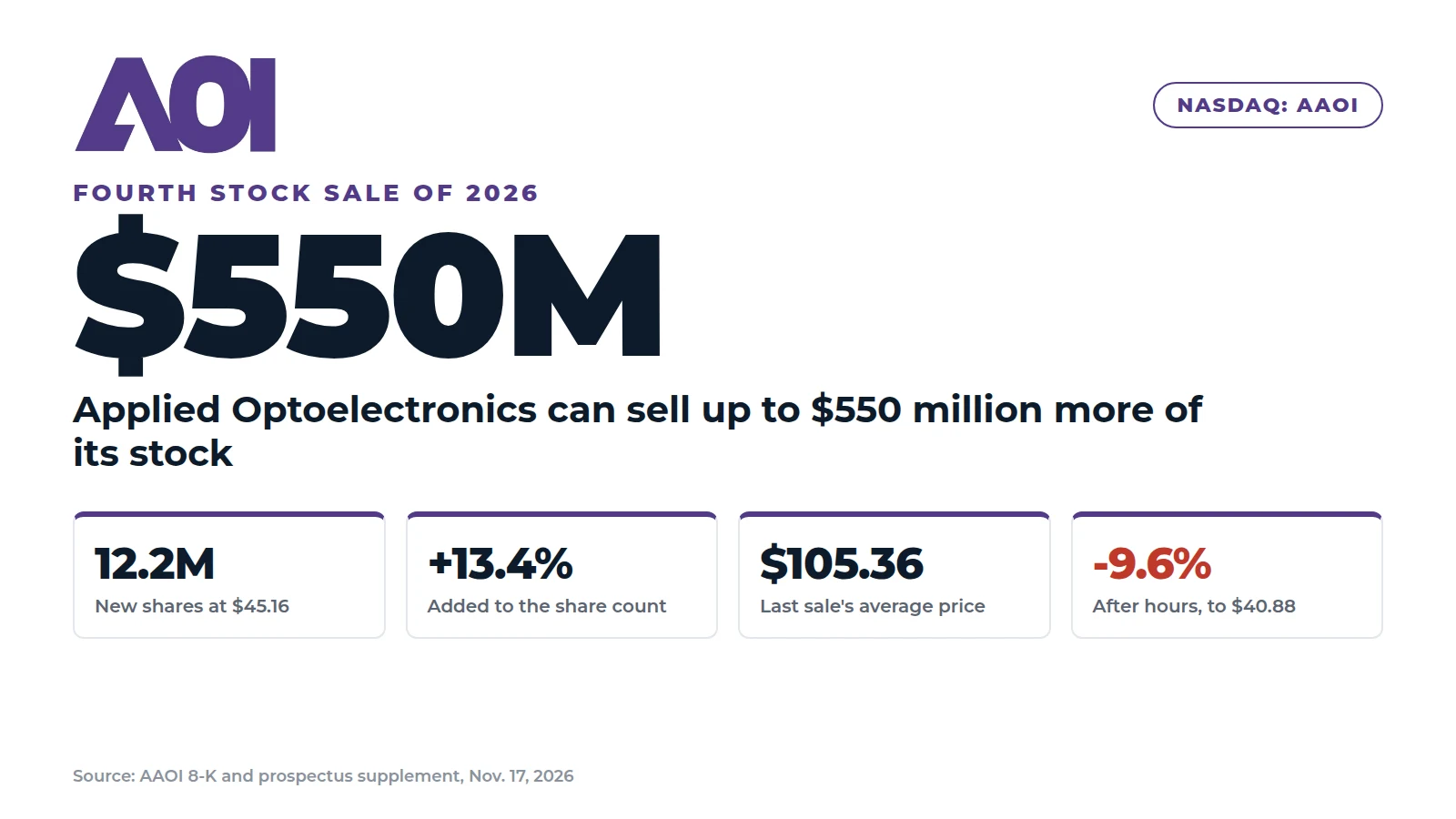
Applied Optoelectronics (AAOI) can now sell up to $550 million of new stock, its fourth sale like this in 2026, according to an 8-K filed after the market closed on Nov. 17.
The company's own example uses the Nov. 16 closing price of $45.16. At that price, $550 million works out to 12.2 million new shares, which would add 13.4% to the share count. If every one of those shares were sold and nothing else changed, today's shareholders would own 88.2% of the bigger company. That's an 11.8% smaller slice for each of them.
The stock closed at $45.22 on Nov. 17 and was at $40.88 at 8:49 p.m. ET, after the market closed, down 9.6%. It had closed at $130.16 on Oct. 6.
How does this sale compare with the last one?
In this kind of sale, called an at-the-market offering, two banks, Raymond James and Needham, sell new shares a little at a time at whatever the stock trades for, and they keep 2% of the money raised. Applied Optoelectronics doesn't have to sell anything and can pause whenever it wants.
The last program, which wrapped up in early October, sold 5.7 million shares at an average of $105.36 and raised $600 million. The example price in the new prospectus is less than half that. At $45.16, each dollar raised would require about 2.3 times as many shares. At the $40.88 price after the close, it'd take 13.5 million shares to reach $550 million, or 14.8% more.
Over the whole year, the share count has already climbed a lot. AAOI had 74,998,000 shares at the end of 2025 and 90,771,506 on Nov. 16, 21% more. If the new sale goes all the way at the example price, there'd be 37% more shares than at the start of the year.
Where is the money going?
The company's quarterly report for the three months to Sept. 30 shows the spending and commitments behind its expansion. AAOI had $605.4 million in cash at the end of September. The company had also signed about $928.8 million of contracts to buy equipment and build out factories, and the report says most of that is for adding manufacturing capacity.
In the first nine months of 2026, AAOI spent $702.1 million on buildings and equipment and paid another $406.9 million up front for machines that hadn't arrived yet. The US got $315.4 million of the building and equipment money, with the rest split between Taiwan and China. The day-to-day business took in $76.7 million less cash than it spent over those nine months, mostly because more money was tied up in unpaid customer bills and inventory.
On Nov. 6, after the quarter ended, AAOI paid $102.25 million in cash for three buildings in Houston that Applied Optoelectronics had been renting since May.
Applied Optoelectronics also lined up more borrowing, which isn't spending by itself. On Oct. 30, AAOI signed a $200 million loan agreement with East West Bank as the lead bank. It's made up of $170 million in loans that can pay for equipment and a $30 million credit line for running the business.
The prospectus says money from the new sale is for general corporate purposes, which may include paying down debt, running the business, and buying equipment and buildings.
AAOI expects sales to jump but pushed back its US expansion
On Nov. 5, AAOI reported their third-quarter results, and sales more than doubled. They came to $269.9 million, up from $118.6 million a year earlier, and the company made a $6.3 million profit, according to the results release. For the fourth quarter, AAOI forecast sales of $385 million to $420 million.
There's a less cheerful line in the same release, from chief financial officer Stefan Murry. He said the company expects its 2027 US expansion "to take longer to complete due to longer than expected time to obtain necessary electrical power among other construction related issues." AAOI now expects to have equipment in place to make more than 500,000 of its fastest optical parts a month by the end of 2026, and more than 1 million a month by the end of 2027. In August, Murry had put the end-of-year number at around 650,000.
What did AAOI's earlier sales raise?
All four programs use the same shelf registration, a filing from December 2024 that lets the company sell stock without starting the paperwork over each time.
| Program | Signed | Size | Shares sold | Average price |
|---|---|---|---|---|
| First | Feb. 26 | $500 million | 4,830,426 | $103.51 |
| Second | May 14 | $600 million | 3,277,525 | About $183 |
| Third | Aug. 21 | $600 million | 5,694,845 | $105.36 |
| Fourth | Nov. 17 | $550 million | None yet | $45.16 example |
The first program started at $250 million and grew to $500 million in March. Together, the first three sold 13,802,796 shares for about $1.7 billion before the banks' cut. We broke down the first two when the third was filed in August.
The new prospectus also lists shares that could show up later on top of this sale. Some are stock awards promised to employees. Others could come from AAOI's 2.75% notes due 2030, which can turn into stock, and from rights the company gave Amazon (AMZN) to buy shares.