Key points
- Microsoft opens Cobalt 200 to Azure customers
- How Arm compared Cobalt with AMD
- What Arm's coding-agent test measured
- Where Arm expects its cloud server share to go
Microsoft (MSFT) has made its second-generation Cobalt 200 processor generally available to Azure customers. The in-house chip powers virtual machines for databases, web services, and AI agent workloads in 14 regions.
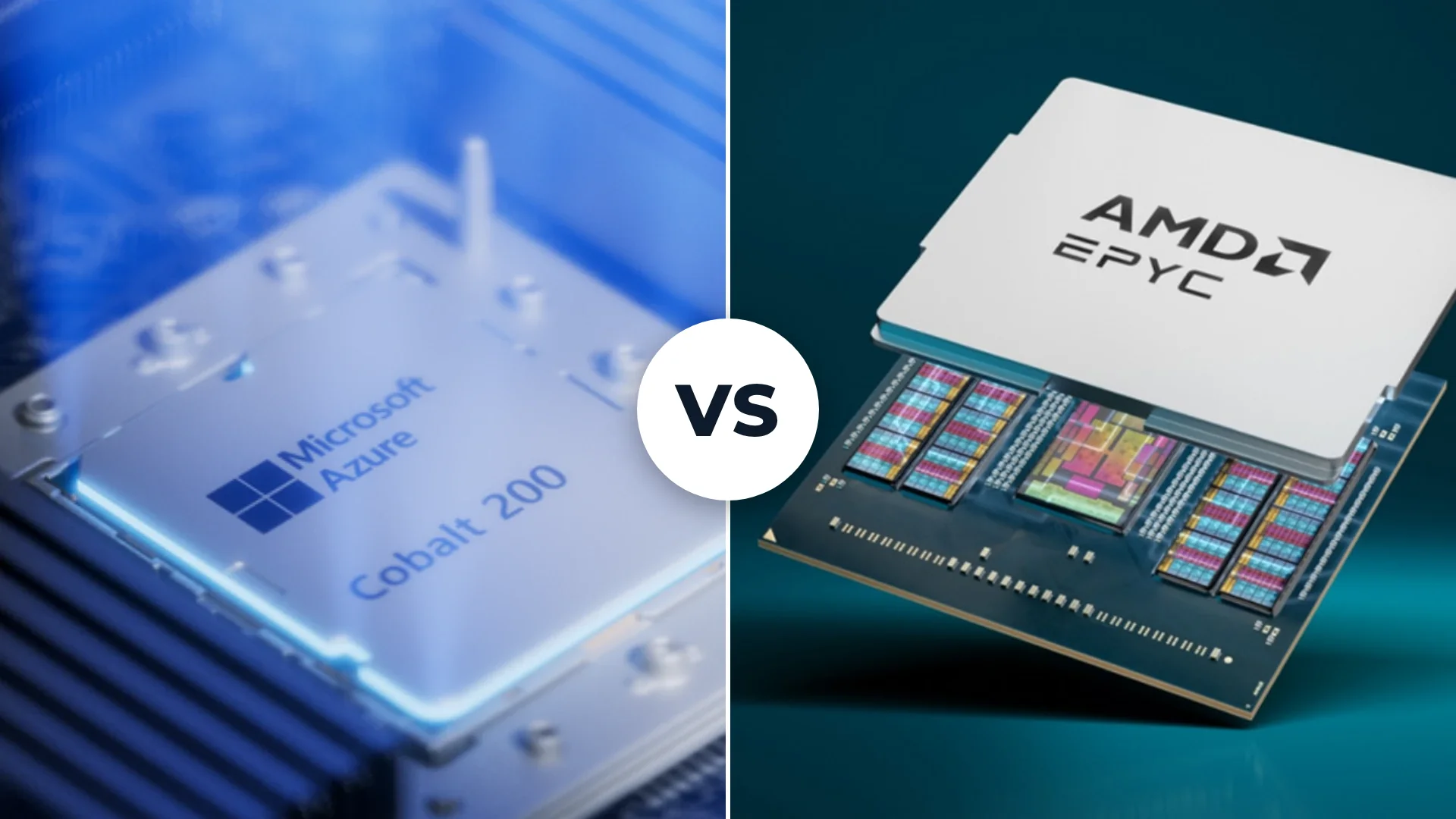
Microsoft says the new machines deliver up to 50% better performance than those running its first Cobalt chip. Separately, Arm Holdings (ARM), which designs Cobalt 200's cores, reported gains of up to 139% over Azure machines running Advanced Micro Devices (AMD) EPYC Turin processors.
The AMD comparison comes from Arm's own tests. Its methodology document says results may vary. The 139% figure is from a MySQL database test, but Arm doesn't specify whether it measures throughput or throughput per dollar.
Cobalt 200 is available in 14 Azure regions
Microsoft announced the launch on Nov. 17 at its Ignite 2026 conference. The machines are available in regions including East US and Korea Central. Microsoft's blog post says availability will reach 23 regions by the end of 2026, while its Ignite Book of News puts the figure at 24.
Each Cobalt 200 chip has 132 Arm Neoverse V3 cores and is built on TSMC's 3nm process. Customers can use virtual machines with up to 128 virtual CPUs, each of which Microsoft says is a full physical core. The chip uses Arm's Neoverse CSS V3, a pre-integrated design for companies building server processors, according to Arm's release.
Microsoft calls the new machines "the leading price-performance general-purpose VMs in the Microsoft Azure fleet," but its blog post doesn't give prices or price-performance figures.
Microsoft named Amadeus, Databricks, InMobi, OpenAI, and Snowflake as customers. Arm's release adds SAP. Amadeus said its own benchmark lab found that Cobalt 200 improved flight-search throughput by more than 30% compared with Cobalt 100.
Arm's tests put Cobalt 200 ahead of AMD's Turin
Arm compared Cobalt 200 machines with Azure machines running AMD's EPYC Turin chips. The number in each Azure machine name is its count of virtual CPUs, so most of these tests ran on machines with 4 to 16 of them. Those are small next to the largest Cobalt 200 machines, which run up to 128 virtual CPUs. The biggest Cobalt 200 machine in Arm's tests, used only for video encoding, had 64 virtual CPUs.
| Workload | What it is | Cobalt 200 vs. AMD Turin | Machines compared |
|---|---|---|---|
| MySQL | Database | Up to 139% higher* | E16ps_v7 vs. E16as_v7 |
| Redis | In-memory cache | 65% higher* | D4ps_v7 vs. D4as_v7 |
| fastText | Word-model training | Up to 57% higher | D8ps_v7 vs. D8ads_v7 |
| Milvus | Vector search for AI apps | Up to 56% higher | D8ps_v7 vs. D8ads_v7 |
| SWE-bench | AI coding-agent tasks | Up to 46% higher | D16ps_v7 vs. D16ads_v7 |
*Arm measured MySQL and Redis by both throughput and throughput per dollar, and it doesn't say which one these two figures describe.
Arm also reported a 56% gain on NGINX, a web server, and up to 56% faster 4K video encoding.
Arm's SWE-bench test timed the CPU work around an AI model
SWE-bench is a set of real software bug-fixing tasks that is widely used to score AI coding agents. Arm ran tasks from SWE-bench Verified, but "a separate replay server supplied prerecorded LLM responses with recorded tool calls," according to the methodology document. That setup compares "CPU-side agent orchestration, tool execution, and container overhead," and the result is counted in completed tasks per minute.
The 46% figure counts the tasks each server finished per minute while running 144 agent workers at once. The AI model's answers were recorded in advance.
Arm expects its share of hyperscaler servers to top 60%
Arm-based server market share at the top cloud companies rose from 15% in calendar 2024 to more than 50% in calendar 2025, Arm said in its Nov. 4 results. The company didn't say whether that counts new server shipments or all servers in use. If it means all servers in use, Arm-based machines went from about one in seven of those fleets to more than half in a single year. If it means new shipments, more than half the servers shipped to those companies in 2025 were Arm-based. Arm expects the share to exceed 60% by the end of calendar 2026, based on current ramps of Amazon's Graviton, Google's Axion, Microsoft's Cobalt, and Nvidia (NVDA) platforms.
Cobalt is Microsoft's general-purpose processor line. The company's AI accelerator is a separate chip, Maia 300, which Microsoft introduced in October. Both are part of a wider shift toward custom chips designed by the cloud companies themselves.
According to Arm's Nov. 17 release, Microsoft plans for Cobalt 200 to make up "a significant portion of new Azure Compute capacity in 2027 and beyond."