Key points
- A weekly AI/tech watchlist: five names, ranked by how confirmed each one's bounce actually is. It is a watchlist, not a buy list.
- Week of July 13: Nebius (NBIS), Kraken Robotics (KRKNF), Rocket Lab (RKLB), Intel (INTC), and Harmonic (HLIT).
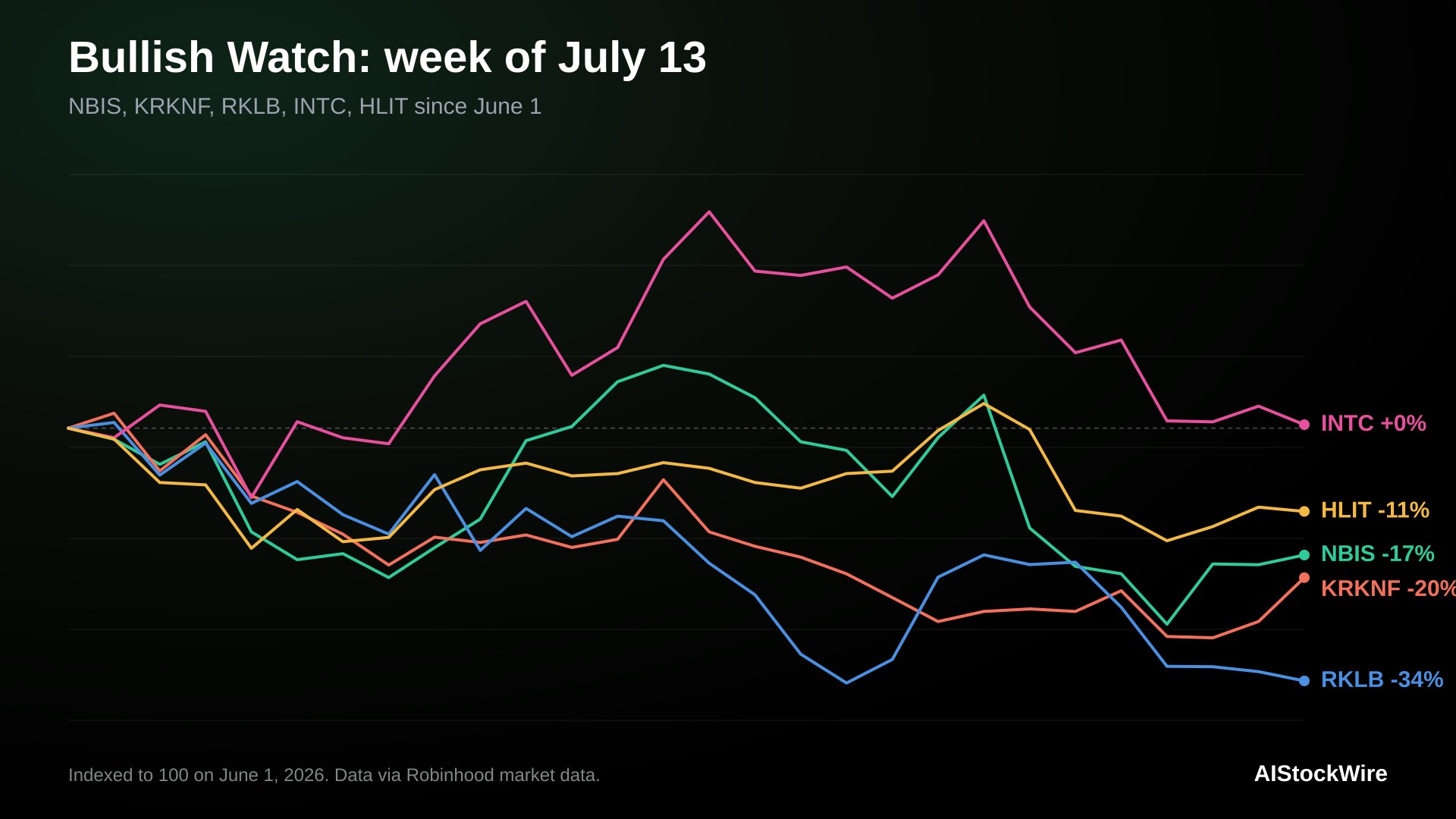
- Final tally: none of the five held on. Nebius (NBIS) finished the week down about 19% from the reference price, Rocket Lab (RKLB) about 17%, Harmonic (HLIT) about 15%, Intel (INTC) about 14%, and Kraken Robotics (KRKNF), the one that held up through Tuesday, about 12%.
- Wednesday through Friday brought a broad AI and chip selloff after Moonshot AI's Kimi K3 model revived fears that cheaper AI models mean less chip demand, plus a rough stretch for Nebius specifically before a Friday rebound on a new $775 million loan.
- Given how violently AI-adjacent stocks have been swinging, we are pausing new Bullish Watch editions for now rather than add a sixth speculative batch into this kind of volatility.
Back with the third edition of the Bullish Watch, our weekly look at AI-related names we're following into the week ahead. A Bullish Watch only earns its name if it stays current, so this week brings five new names, ranked by how confirmed each one's bounce actually is rather than grouped by theme.
This week's batch splits by conviction, not theme. Nebius already showed real buying after the market overreacted to a headline, and Kraken Robotics already has two green days behind a real acquisition catalyst. Rocket Lab is retesting a level that already held once. Intel and Harmonic are still building their case, each waiting on its own earnings date to confirm the story.
This week's scoreboard
Final scoreboard, updated through Friday, July 17 close, as promised when this list ran. "Close (Fri, Jul 10)" is the last official close before this list ran, our reference point for the week. "Open (Mon, Jul 13)" is Monday's 9:30 a.m. Eastern open; each close column after that is that day's official 4:00 p.m. close. "Week to date" tracks the move from Monday's open; "Since Friday's close" tracks the move from the reference price when this list first ran.
| Stock | Close (Fri, Jul 10) | Open (Mon, Jul 13) | Close (Mon, Jul 13) | Close (Tue, Jul 14) | Close (Wed, Jul 15) | Close (Thu, Jul 16) | Close (Fri, Jul 17) | Week to date | Since Friday's close |
|---|---|---|---|---|---|---|---|---|---|
| Nebius (NBIS) | $219.64 | $212.69 | $210.51 | $194.09 | $199.51 | $171.77 | $178.17 | -16.2% | -18.9% |
| Kraken Robotics (KRKNF) | $4.77 | $4.80 | $4.66 | $4.74 | $4.41 | $4.18 | $4.19 | -12.8% | -12.3% |
| Rocket Lab (RKLB) | $81.05 | $79.89 | $76.73 | $78.81 | $76.20 | $67.35 | $67.57 | -15.4% | -16.6% |
| Intel (INTC) | $109.81 | $105.98 | $103.12 | $107.77 | $102.99 | $96.98 | $95.03 | -10.3% | -13.5% |
| Harmonic (HLIT) | $14.04 | $13.75 | $13.67 | $13.67 | $12.99 | $12.20 | $12.01 | -12.7% | -14.5% |
Two-day read. Monday was a broad risk-off day, not anything specific to this list: President Trump announced a renewed blockade on Iranian shipping through the Strait of Hormuz, oil jumped more than 9%, and the Nasdaq fell 1.55%. Semiconductors took it hardest, which is most of why Intel fell 6.1% that day. Tuesday flipped: June's cooler-than-expected CPI report sent chips broadly higher, and Intel rallied 4.5% with them. Nebius kept falling anyway, on a New York data center moratorium headline that, as we covered the same day, doesn't actually apply to Nebius's real facilities, which are in New Jersey, not New York.
Three-day read. The rest of the week got worse before parts of it got better. A new worry hit chips directly on Thursday: Moonshot AI released an open model called Kimi K3, and traders ran with the idea that cheaper AI means less demand for chips, the same fear that hit Nvidia during the original DeepSeek moment in January 2025. The PHLX Semiconductor Index fell more than 3% and slipped into a bear market that day, and Intel fell with it. Nebius fell nearly 14% that same Thursday even after signing a $1 billion customer deal and unveiling a new capital-light partnership model, on lingering investor worry about how it funds its data center buildout. Friday brought a partial reversal: chip stocks staged a violent intraday rebound off Thursday's lows, and Nebius jumped more than 5% on a new $775 million secured loan that answered the cash-burn question in a way two prior announcements hadn't. It wasn't enough to undo the week for any of the five names.
1. Nebius (NBIS), the one that already turned
Price: $219.64, down about 26% from its June 18 high of $298.80. The catalyst: on June 26, reports emerged that Meta Platforms (META) was developing its own AI cloud business, a direct threat to neocloud providers like Nebius and CoreWeave since Meta is also one of their largest customers. We covered the initial reaction when it hit: the fear alone was enough to send Nebius down 17% in a single session on July 1, its worst day, wiping out roughly $11.9 billion in market value.
What the panic missed is that nothing in Nebius's actual March 2026 agreement with Meta changed. The $12 billion dedicated-capacity tranche and the up-to-$15-billion additional-capacity commitment both still stand, and the company's 2026 guidance is unchanged. Underneath that sits the multiyear, roughly $17 billion revenue agreement Nebius signed with Microsoft (MSFT) in late 2025, still the cornerstone of its growth story. We've covered this neocloud business model in detail before: renting out GPU compute to AI labs and hyperscalers rather than running general-purpose cloud infrastructure.
Why it's ranked first: since the July 7 low of $193.68, Nebius has put together three straight green days, closing higher each session including Friday. It's the only name on this list that has actually shown committed buying, not just a stop in the selling.
The risk: the stock is still up more than 150% year to date even after the pullback, so there's real room for more giveback if the Meta-cloud story turns out to be more than a scare, and neocloud valuations broadly assume the current AI capex boom keeps compounding.
Update, Monday, July 13: NBIS closed at $210.51, down about 4% from Friday, gapping down at the open and continuing lower through a broad, Iran-driven risk-off session that hit nearly every growth name.
Update, Tuesday, July 14: The slide got worse, not better. NBIS closed at $194.09, down almost 8% on the day and erasing the entire three-day bounce that earned it the top spot on this list. The trigger was New York's new one-year moratorium on hyperscale data centers, but as we wrote the same day, Nebius doesn't actually have New York exposure, its facilities are in New Jersey. It's the same pattern as the original Meta-cloud panic that put Nebius on this list in the first place: a headline hitting the stock harder than it hits the actual business.
Final tally, Friday, July 17: NBIS closed at $178.17, down about 19% from the reference price when this list ran. The week's real story became cash burn, not the Meta threat: Nebius fell nearly 14% Thursday even after a $1 billion Reflection AI deal and a new partnership model, then jumped more than 5% Friday when a $775 million secured loan gave investors a concrete answer on financing. The stock still finished the week the worst performer on this list.
2. Kraken Robotics (KRKNF), the drone supplier that just went shopping underwater
Price: $4.77, down about 30% from its April 17 high of $6.84. The catalyst: Kraken closed its $615 million acquisition of Covelya Group on July 2, adding Sonardyne, EIVA, Voyis, and three other underwater-technology firms under one roof. The combined company's 2026 revenue guidance now sits at $290 million to $320 million, with adjusted EBITDA of $65 million to $75 million, and management expects the deal to add double-digit earnings-per-share growth in 2027.
Kraken's own business supplies batteries and sensors to underwater drone builders, part of the same defense-robotics buildout we've covered before through Red Cat (RCAT) and AeroVironment (AVAV), just underwater instead of in the air. The stock kept falling for nearly a week after the deal closed, bottoming at $4.29 on July 8, before catching its first real bid since the announcement.
Why it's ranked second: two straight green sessions off that July 8 low, up about 11%, the first real buying since the acquisition closed rather than just a pause in the selling.
The risk: part of the $615 million purchase price was paid in newly issued shares, about $135 million worth, real dilution even though it funded a guidance-raising deal. Analysts have also flagged customer concentration, with roughly 45% of revenue tied to a single client, and integration risk as Kraken absorbs six new subsidiaries at once. And unlike every other name on this list, Kraken trades over the counter (OTCQB: KRKNF) with its primary listing on Canada's TSX Venture Exchange, not Nasdaq or the NYSE, so it's meaningfully less liquid than the rest of this week's picks.
Update, Monday-Tuesday, July 13-14: KRKNF held up best of the five this week, dipping to $4.66 Monday before bouncing back to $4.74 Tuesday, essentially flat since Friday's $4.77. No fresh company news either day; it's tracking the broader tape more calmly than the other four, notable given how thinly traded this one is.
Final tally, Friday, July 17: KRKNF closed at $4.19, down about 12% from the reference price. No fresh company news drove the Wednesday-Friday slide; it tracked the same broad risk-off pressure hitting speculative and thinly traded names across the market, including the Thursday chip-sector selloff. It still finished as the smallest decliner of the five.
3. Rocket Lab (RKLB), retesting a level that already held once
Price: $81.05, down about 27% from its June 17 high of $111.34, roughly a 30% pullback over the past month. The catalyst: Rocket Lab posted Q1 revenue of $200.3 million, up 63.5% year over year, with a $2.2 billion backlog and a smaller-than-expected adjusted EBITDA loss. It's also moving beyond launch: an $8 billion agreement to acquire Iridium Communications, expected to close in mid-2027, would add satellite communications to its business.
The swing factor is Neutron, Rocket Lab's medium-lift rocket, still in development, with each mission projected to generate $50 million to $55 million in revenue once it's flying. Analysts are still broadly bullish: Morgan Stanley carries an Overweight rating with a $105 base case and a $293 bull case. But the stock fell 10.4% on July 7 alone as the broader market's risk-off wave hit every speculative name at once, Rocket Lab included.
Why it's ranked third: it's sitting almost exactly at the $80-81 level that held during the June 25 low, a real retest of a level that's already proven it can hold once, rather than fresh, unproven ground.
The risk: a level holding once doesn't guarantee it holds twice. The primary risk analysts flag is a further Neutron slip past Q4 2026, and if the broader tape rolls over again, this floor isn't guaranteed to catch it.
Update, Monday, July 13: The $80-81 support level this pick was riding on gave way. RKLB closed at $76.73, its fifth straight losing session and a cumulative 19.3% slide over that stretch that's erased about $12 billion in market value, part of the same broad risk-off day that hit Intel and Nebius, not fresh Rocket Lab news.
Update, Tuesday, July 14: A partial bounce, up about 2.7% to $78.81 as the broader market recovered. Still below the support level that broke Monday, so this is a retest of a retest now, not a confirmed hold.
Final tally, Friday, July 17: RKLB closed at $67.57, down about 17% from the reference price, after an 11.6% drop Thursday alone as the broader risk-off wave and the Kimi K3-driven chip selloff hit speculative growth names hardest. Friday brought only a modest bounce, up about 0.3% on the day.
4. Intel (INTC), the one with the government as a shareholder
Price: $109.81, down about 22% from its June 22 high of $141.45. What sets Intel apart from everything else on this list: the U.S. government owns roughly 10% of the company, having bought 433.3 million shares at $20.47 each for about $8.9 billion, funded partly by CHIPS Act money. That's a real, unusual floor of political backing underneath the stock that none of the other four names have.
The drop itself came on sector-wide valuation concerns and reports that Intel's next-generation 18A manufacturing process may not hit profitable yields until 2026 or 2027, tempering the foundry turnaround story even as HSBC doubled its price target to $200 and reports circulated of foundry customer talks with Apple and Google. We've written before about what a chip foundry actually does, which is the business Intel is trying to build a second act around.
Why it's ranked fourth: it bounced off a $104.41 low on July 8 but has faded since, down to $109.81 today. That's still choppy, not confirmed.
The risk: Intel reports Q2 earnings on July 23. Management's read on 18A yields and foundry revenue that day will likely matter more than anything the chart does between now and then.
Update, Monday, July 13: INTC fell 6.1% to $103.12, testing the $100 level again as a broad semiconductor selloff hit chip names hardest, plus continued reports that Intel's 18A manufacturing yields may not turn profitable until late 2026 or 2027.
Update, Tuesday, July 14: The sharpest reversal on this list. INTC closed at $107.77, up 4.5% as June's cooler CPI print sent chip stocks broadly higher. Still below Friday's close, but the best single-day performance of anything on this week's watchlist.
Final tally, Friday, July 17: INTC closed at $95.03, down about 13% from the reference price. Thursday's Kimi K3-driven chip selloff, which pushed the PHLX Semiconductor Index into a bear market, hit Intel directly, and Friday's broader chip-sector rebound only partly reached it. Q2 earnings on July 23 are still the next real catalyst.
5. Harmonic (HLIT), a real beat-and-raise waiting on its own earnings date
Price: $14.04, down about 15% from its June 30 high of $16.49, the smallest drawdown on this list. The catalyst: Harmonic sold its video business to MediaKind for $145 million in cash in June, simplifying into a pure-play broadband company, and its Q1 broadband revenue was up 43% year over year with earnings per share beating estimates by 70%, prompting a raised full-year outlook.
Why it's ranked fifth: two green days off the July 7 low on relatively light volume (Harmonic trades a fraction of the shares the other names on this list do), with real fundamentals underneath but nothing dramatic yet in the chart itself.
The risk: earnings land July 27, and that date is the real event here, not the current price action. A thinly traded stock like this can gap hard in either direction on the print.
Update, Monday-Tuesday, July 13-14: HLIT eased to $13.67 Monday and closed exactly flat there Tuesday, a quiet couple of days on thin volume. Nothing new to report; July 27 earnings are still the actual event to watch here.
Final tally, Friday, July 17: HLIT closed at $12.01, down about 15% from the reference price, on continued light-volume drift with no fresh company news. July 27 earnings remain the actual event to watch.
Also on the radar
Two groups we looked at hard and left off this week's list. The quantum computing basket (QBTS, RGTI, IONQ, QUBT) has a real catalyst underneath it, the CHIPS Act's $100 million government equity stakes in D-Wave and Rigetti, but every name in the group was still red into Friday's close with no confirmed turn yet. Oracle (ORCL) is down about 25% since mid-June, a steep drop for a mega-cap, but it looks tied to a specific worry over the debt Oracle is taking on to fund its AI data center buildout rather than the broad, sentiment-driven selling that hit the five names above. Worth a second look if either group shows a real, confirmed bottom.
How to read this
This is a watchlist, not a buy list, and the final grade on this batch is honest: zero for five. All five names finished the week lower, from Kraken Robotics' roughly 12% decline to Nebius's roughly 19%, an average drop of about 15%. Wednesday through Friday brought a broad AI and chip selloff that had little to do with any single name's own story, but a bad week is still a bad week, and pretending otherwise would defeat the point of grading this honestly.
We're pausing new Bullish Watch editions for now. AI-adjacent and speculative names have been the most volatile corner of the market for weeks, swinging double digits within a single session on headlines that often turn out not to apply, and adding a fresh batch of oversold picks into that kind of volatility isn't a bet we want to keep making every week right now. We'll bring the format back when conditions settle down.
Sources
- TradingKey, Rocket Lab's backlog, launches, and Neutron timeline
- Yahoo Finance, Intel's next chapter: government backing, foundry ambitions, and AI partnerships
- SEC filing, Harmonic completes video business sale to MediaKind
- StockTitan, Kraken Robotics closes Covelya acquisition, lifts 2026 outlook
- Related coverage: Neoclouds drop on Meta cloud news
- Related coverage: Drone stocks rally: AVAV, ONDS, RCAT
- Related coverage: Bullish Watch, week of July 6
- Related coverage: What is a neocloud?
- Related coverage: What is a chip foundry?
- Related coverage: Nebius falls despite a $1 billion deal and a new partnership model
- Related coverage: Nebius jumps on a $775 million debt facility
- Related coverage: Kimi K3 gives Nvidia its second "DeepSeek moment"
- Related coverage: Chip stocks stage a violent rebound Friday
- Price data via Robinhood market data
This is general market commentary and opinion, not investment advice. Scoreboard prices are official closing prices, updated through Friday, July 17, 2026, the final scoreboard for this list. The watchlist writeups reflect Friday, July 10, 2026's close, the original reference price for this list, with dated update notes added where something changed. Markets can go down as well as up, and you can lose money. Always do your own research and consider speaking with a licensed financial professional before making any investment decision.