Key points
- The chip index had its worst week since September 2001
- Nvidia, Micron, and AMD each fell more than 20%
- What Dell’s earnings and PCE inflation bring in a short Thanksgiving week
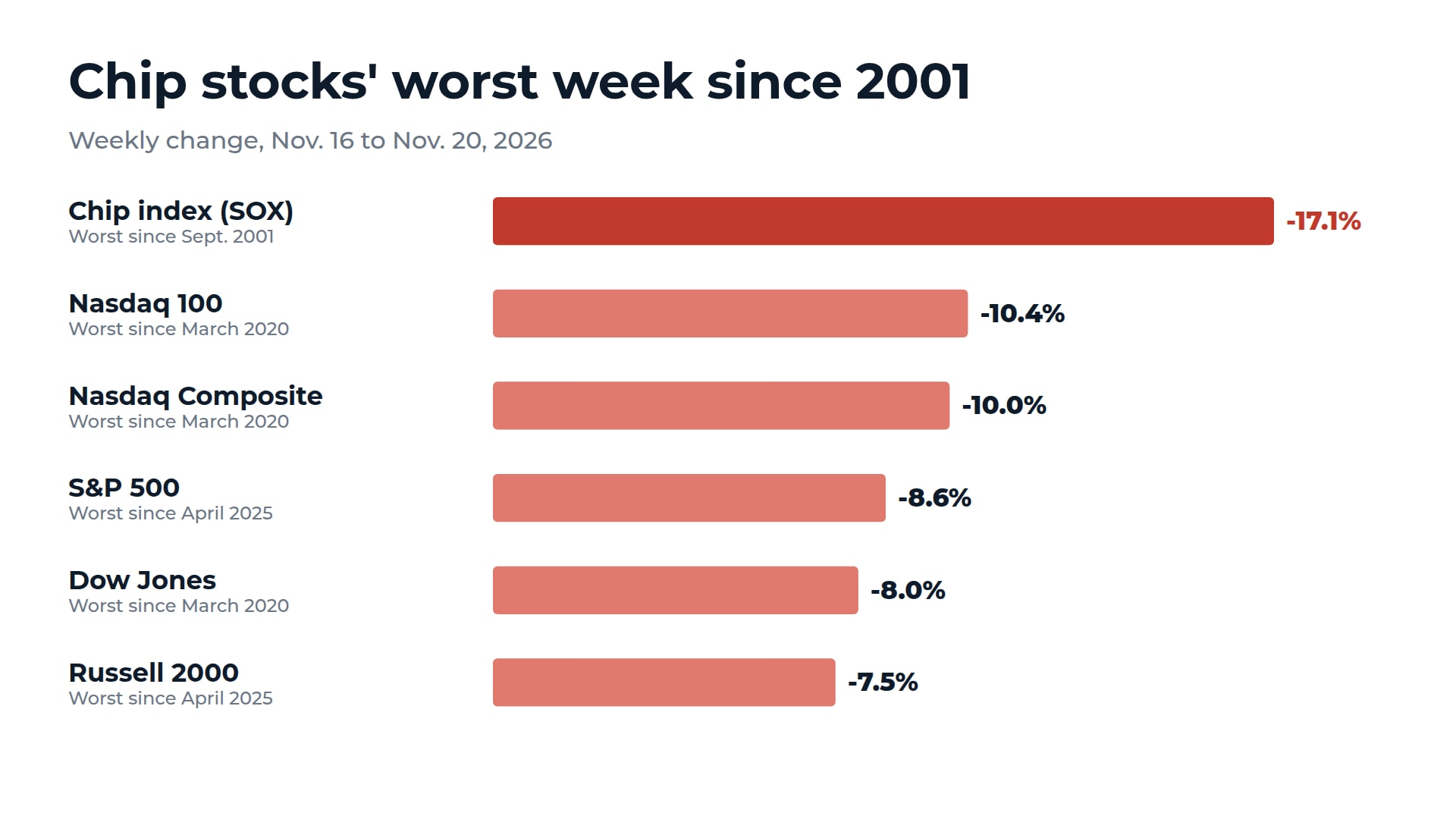
The Philadelphia Semiconductor Index fell 17.1% this week as a selloff in chip and AI stocks spread across the market. It was the index’s worst week since the one ending Sept. 21, 2001, when markets reopened after the Sept. 11 attacks.
The Nasdaq Composite lost 10.0% to close at 22,617.73, and the Nasdaq 100 fell 10.4%, its worst week since March 2020. The Composite’s loss edged past its decline in the week ending April 4, 2025, by less than 0.01 percentage point, making it the index’s worst week since March 2020.
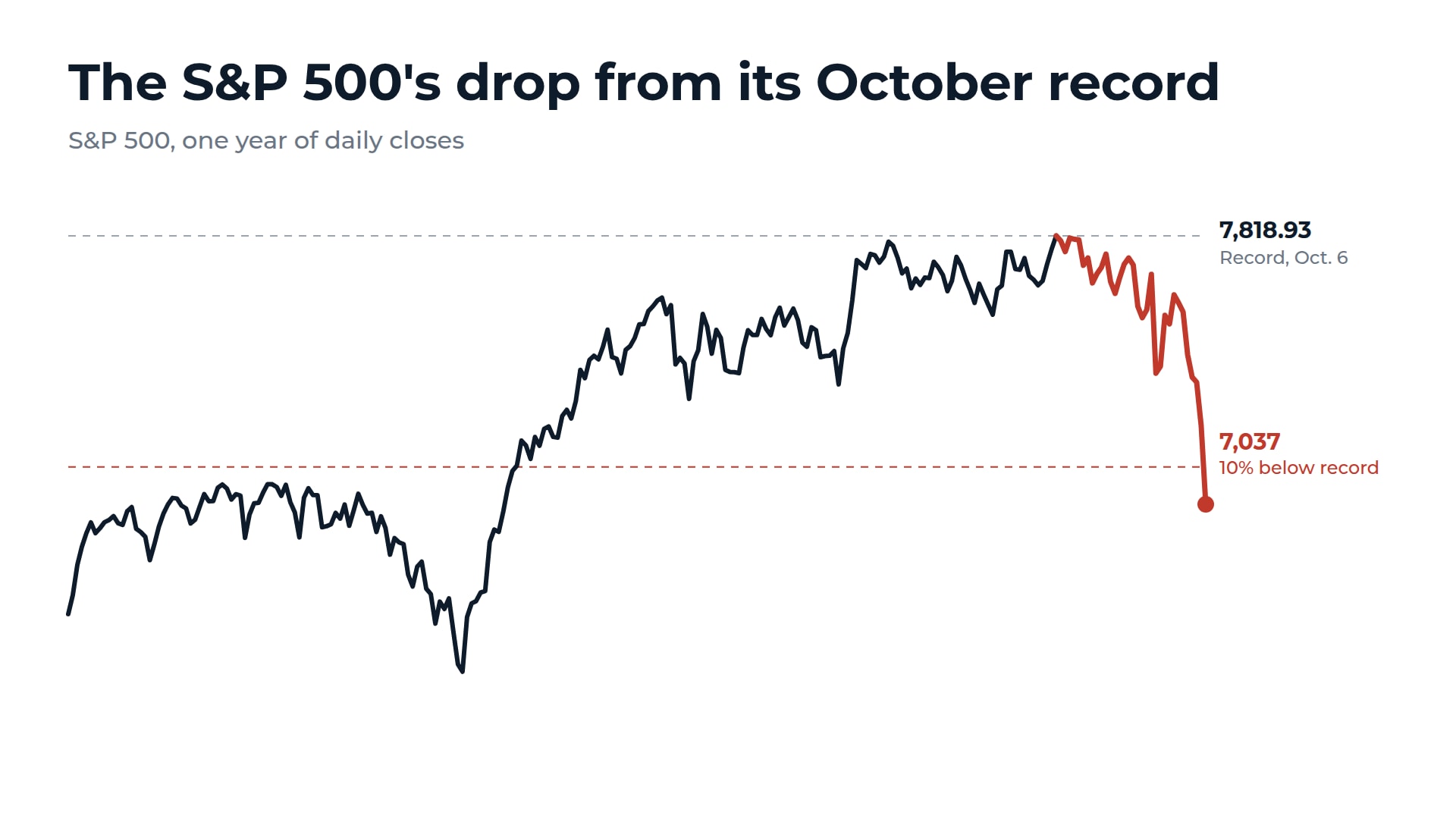
The S&P 500 fell 8.6%, its worst week since April 2025, while the Dow Jones Industrial Average lost 8.0%, its worst since March 2020. Both closed in a correction on Friday. The Cboe Volatility Index, often called Wall Street’s fear gauge, rose 86% for the week to 35.89.
| Index | Weekly change | Worst week since |
|---|---|---|
| Philadelphia Semiconductor Index | -17.1% | Sept. 2001 |
| Nasdaq 100 | -10.4% | March 2020 |
| Nasdaq Composite | -10.0% | March 2020 (narrowly) |
| S&P 500 | -8.6% | April 2025 |
| Dow Jones Industrial Average | -8.0% | March 2020 |
| Russell 2000 | -7.5% | April 2025 |
Sources: weekly closes from Federal Reserve Bank of St. Louis data and Nasdaq, with Nov. 20 closes from CNBC. Russell 2000 history from Yahoo Finance.
Nvidia, Micron, and AMD each fell more than 20%
Nvidia (NVDA) fell 22.9% this week to $125.53. The decline included a 14.0% drop on Friday, its worst day since January 2025, after Reuters reported that the Securities and Exchange Commission is examining potential accounting issues at the company. Nvidia was already down about 7% before the report.
It was Nvidia’s seventh straight weekly decline, and the stock now ranks fourth in the world by market value.
Micron (MU) lost 23.6% for the week, AMD fell 20.5%, and TSMC’s US shares (TSM) dropped 20.1%. Broadcom (AVGO) fell 12.3%. AI cloud provider CoreWeave (CRWV) lost 25.6%.
The losses were particularly deep among chipmakers. By comparison, Apple (AAPL) fell 3.8% and Amazon (AMZN) 7.4%.
Anthropic and Oracle also fell
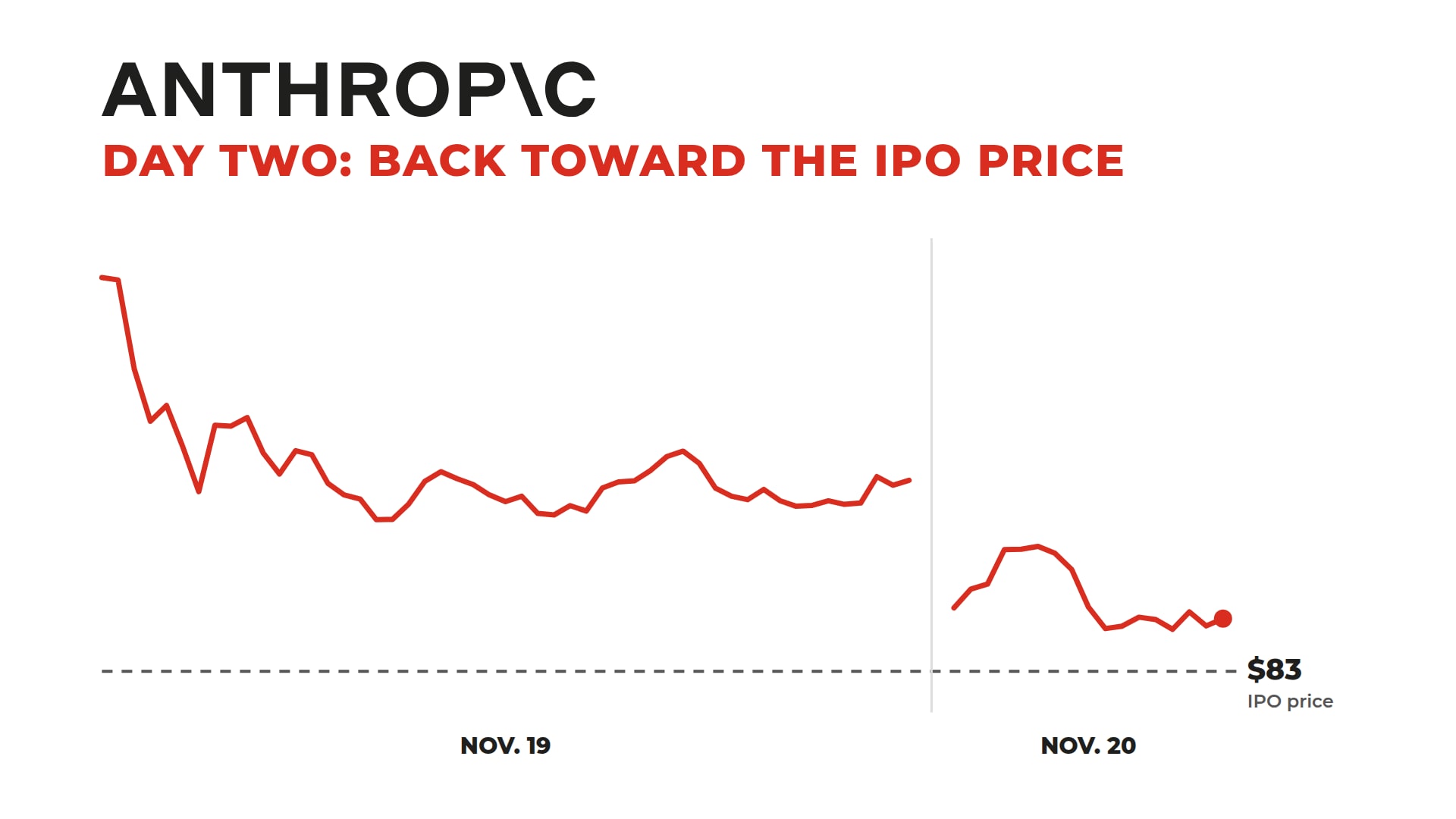
Anthropic (ANT) began trading on Thursday after pricing its IPO at $83 a share and closed its first day at $97.17. On Friday, Anthropic fell 8.5% to $88.91, after touching a low of $83.05.
Oracle (ORCL) fell 19.3% this week to $101.19, its lowest close since December 2023. After Friday's close, Oracle said its OpenAI contract is fully funded, and the shares rose in after-hours trading.
What to watch in a short Thanksgiving week
US stock markets are closed on Thursday, Nov. 26, for Thanksgiving and close early, at 1 p.m. ET, on Friday, Nov. 27.
Cboe expects Anthropic options to start trading on Monday, Nov. 23, pending industry readiness. On Wednesday, Nov. 25, at 8:30 a.m. ET, the Bureau of Economic Analysis releases its second estimate of third-quarter GDP and October personal income and spending, which includes the PCE price index, the Federal Reserve's preferred inflation gauge. The Fed's next rate decision comes after its Dec. 8-9 meeting.
Here are six reports to watch early in the week. The right column estimates the move in either direction suggested by options prices. It doesn't predict which way the stock will go. Each figure is the cost of an at-the-money straddle as a share of the stock's Friday close, using options that expire Nov. 27 and prices from just before Friday's 4 p.m. ET close. The figures cover moves through Nov. 27, not just the earnings announcement.
| Date | Company | Options-implied move |
|---|---|---|
| Mon., Nov. 23, after close | Hewlett Packard Enterprise (HPE) | 14.1% |
| Mon., Nov. 23, after close | Zoom Communications (ZM) | 10.8% |
| Tue., Nov. 24, before open | Analog Devices (ADI) | 9.8% |
| Tue., Nov. 24, after close | Dell Technologies (DELL) | 16.4% |
| Tue., Nov. 24, after close | Workday (WDAY) | 10.0% |
| Tue., Nov. 24, after close | Autodesk (ADSK) | 9.2% |
Sources: company announcements and Nasdaq's earnings calendar; option prices from Robinhood.
Dell is the report I'm watching most. The company sells AI servers built with Nvidia chips, and its stock fell 19.3% this week to $278.02. Hewlett Packard Enterprise, which also sells AI servers, fell 15.3%.