Key points
- SpaceX's largest chip debt portion tops $25 billion
- How the SpaceX notes' yield compares with October's estimates
- SpaceX lenders reportedly sought limits on orbital chips
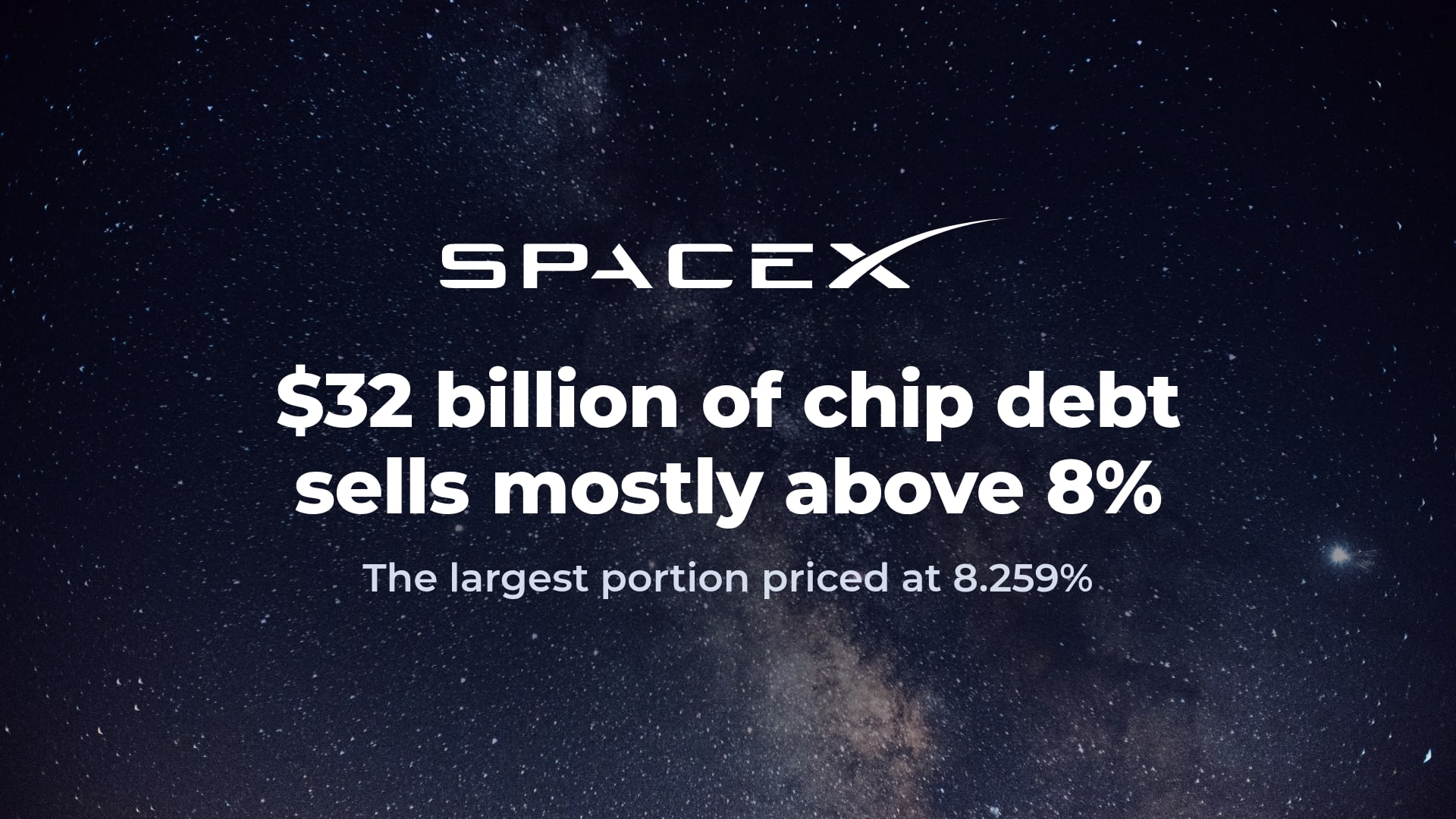
A financing vehicle has sold $32 billion of debt to buy Nvidia (NVDA) AI chips that SpaceX (SPCX) will lease, Bloomberg reported. Most of the debt sold on Nov. 19 carried yields above 8%.
The largest portion, about $25.2 billion of Class A-3 notes, was priced to yield 8.259%. That compares with an average yield of 5.95% on US investment-grade bonds. The two aren't a matched comparison: the average covers bonds from many borrowers and maturities.
SpaceX shares closed down 3.5% at $138.43 on Nov. 19. They were at $131.60 in premarket trading at 9:28 a.m. ET on Nov. 20, down 4.9%.
The debt was sold by Saturn Funding Trust, a special purpose vehicle managed by an Apollo entity. It is part of a financing package of more than $40 billion that also includes bank loans and covers about $47.3 billion of GPU equipment, mostly Nvidia's Rubin chips. Deliveries are expected to begin in January.
SpaceX will lease the hardware for about five years and must keep paying even if it breaks down or an event outside the company's control, such as a natural disaster, gets in the way.
The debt belongs to the trust. The report described the structure as designed to keep the borrowing off SpaceX's balance sheet and help the company retain its investment-grade credit ratings. SpaceX hasn't said how it will account for the lease. Both KBRA and SpaceX's October 8-K describe it as a finance lease, a type that companies generally record as an asset and a liability on their own balance sheets under US accounting rules.
KBRA assigned preliminary A-minus ratings to about $27.2 billion of the trust's senior Class A-2 and Class A-3 notes and $2.4 billion of subordinated Class B notes. Moody's rating on the largest portion is A3.
Goldman Sachs (GS) and Apollo Global Management (APO) ran the sale. About $6 billion of the Class A-3 notes went to institutional buyers on Nov. 19; the rest had been placed earlier. Accounts at BlackRock (BLK), Goldman Sachs Asset Management, and KKR (KKR) were among the cornerstone buyers.
Davis Hebert, head of technology, media, and telecom at CreditSights, said the pricing was set generously to attract more conventional buyers. He said clients had been skeptical after losses on SpaceX's unsecured bonds this year. Those bonds came from a $25 billion sale in June at rates of 5.35% to 6.65%, according to our AI debt tracker.
The yield is close to a figure reported in October
The plan first surfaced on Oct. 6 as about $10 billion of bank loans and $30 billion of investment-grade debt. On Oct. 22, Semafor said the lowest-rated portion was expected to yield about 8.3%, with a safer portion near 7.75%. A day later, turmoil in AI credit markets had reopened talks over pricing. The 8.259% on the Class A-3 notes is close to that 8.3% figure. The October figure was for the lowest-rated portion, and KBRA lists the Class A-3 notes among the trust's senior notes, so the two numbers may describe different portions.
The gap between 8.259% and the 5.95% investment-grade average is about 2.3 percentage points. KBRA says SpaceX's quarterly lease payments are intended to fully pay down the trust's debt over the lease.
SpaceX signed a binding commitment on Oct. 24 to lease the equipment from an Apollo-managed entity, with principal payments expected to total about $40 billion. The company's 8-K filing said the fixed rate on the lease would be determined at pricing, before the final lease is signed, and we went through the payment terms on Oct. 26. SpaceX hasn't filed an 8-K on the lease since then. The 8.259% is the yield investors earn on the notes, and the rate on SpaceX's own lease payments hasn't been disclosed.
SpaceX shares have fallen 19.5% from their Oct. 6 close of $171.92 through Nov. 19.
Lenders reportedly sought to keep the chips on Earth
Lenders in the financing sought to bar SpaceX from launching the chips into orbit, the Financial Times reported on Nov. 19. The lenders were concerned that chips in orbital data centers would be hard to repossess and sell if SpaceX defaulted. It isn't clear whether the restriction made it into the final loan documents. SpaceX has said the chips will be used in data centers on Earth.
The newspaper put the full package, called Project Saturn, at $43 billion. The new notes yield about 8.3%, compared with about 7.2% on SpaceX's existing debt maturing in 2031.
SpaceX and Nvidia aim to launch AI data centers into orbit in 2027. SpaceX said in October that the lease was expected to close before year-end, with leases starting in the first half of 2027 as equipment arrives.