Key points
- The Fed's market contacts rank AI as the top financial risk
- The Fed tallies tech companies' borrowing for data centers
- Why the Fed says Big Tech's exposure runs past its debt
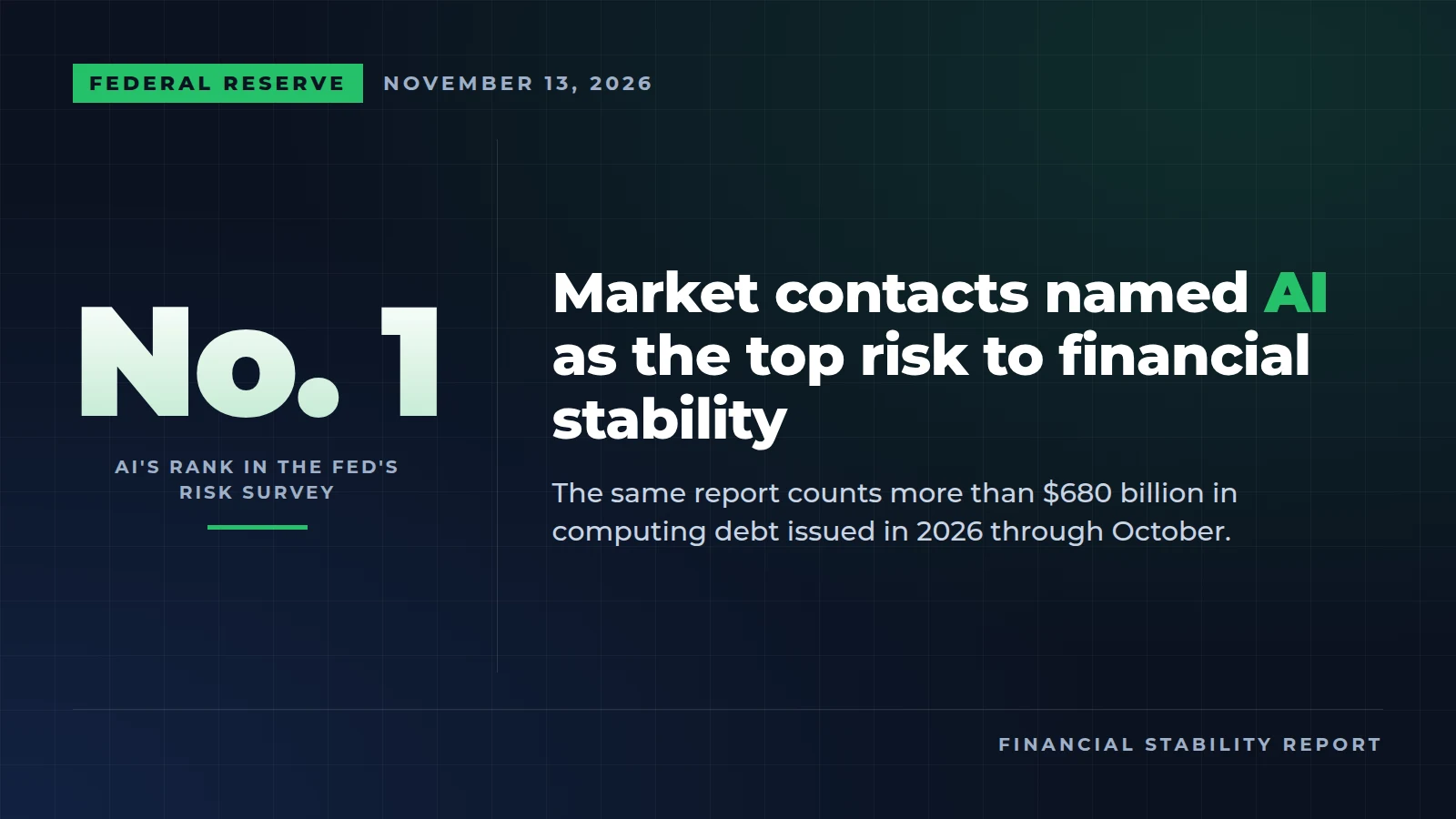
The Federal Reserve's Financial Stability Report, released on Friday, Nov. 13, has a short survey box near the back, and it's the part I went to first. This time AI sits at the top of it. Staff at the New York Fed asked 23 market contacts at banks, broker-dealers, investment funds, and advisory firms about risks to US financial stability in September and October. AI was the risk they cited most.
The Fed shows the percentages only in a chart, and by our reading of it, about 20 of the 23 contacts, or roughly 87%, named AI. In the spring survey of 20 contacts, AI was cited by half of them, behind geopolitical risks and an oil shock. The Fed says the survey summarizes what respondents told it and shouldn't be read as the view of the Fed or the New York Fed.
What did the Fed's contacts say about AI?
Respondents pointed to three separate worries, according to the report. The first is stock valuations, and the chance that weaker-than-expected earnings lead to a market correction. The second is cybersecurity, whether from attacks by sophisticated state actors or from "damage caused by frontier AI models themselves." The third is "complex forms of AI-related financing."
AI also turned up under other headings. The second-most-cited risk was a correction in risky assets, and the report says respondents "widely cited the risk of a sharp correction in AI-related equities, driven by uncertain returns on large capital expenditures." Many also said advances in AI are making sophisticated cyberattacks easier to carry out.
The Fed's own read on stock prices includes an unusual phrase for a Fed report. Equity valuations have stayed high, "partly driven by market enthusiasm for super intelligence (SI)," it says.
How much are tech companies borrowing for AI infrastructure?
Companies issued more than $680 billion in debt for advanced computing infrastructure in 2026 through October, according to the Fed. That's about five times the $130 billion issued in all of 2023. The count includes public deals and some private securities, though not every private placement.
Most of the debt came from investment-grade tech companies. The Fed says borrowing for advanced computing rose from less than 6% of investment-grade debt issued by nonfinancial companies in 2023 to about 31% in 2026.
Outstanding public debt tied to advanced computing has passed $1.1 trillion, the Fed estimates. Private credit deals make the full amount harder to pin down.
The Fed also compared the current buildout with the telecom boom that began in 1995. Spending by five hyperscalers, Amazon (AMZN), Alphabet (GOOGL), Meta Platforms (META), Microsoft (MSFT), and Oracle (ORCL), has tracked the telecom industry's pace as a share of GDP. The report says the current cycle may pass it "relatively soon."
Why does the Fed look past the debt?
Debt is only part of the exposure. The Fed counted more than $1 trillion in undiscounted lease commitments that haven't started yet, plus more than $2 trillion in take-or-pay contracts, residual value guarantees, and similar commitments. The figures cover the five hyperscalers, Broadcom (AVGO), and Nvidia (NVDA). Because they are undiscounted contract values, the Fed says they aren't directly comparable with debt on a balance sheet.
Those commitments can help weaker companies borrow. A hyperscaler can sign a long lease with a data center developer, which then uses the contract to obtain financing. GPU makers can guarantee what their chips will be worth later, helping customers finance purchases. The Fed says these financings are often paired with equity investments from the same hyperscalers and GPU designers, creating a "circular financing" dynamic.
That cuts both ways. The largest tech companies could absorb losses in a downturn, cushioning the impact on the rest of the financial system. But their exposure "may be substantially larger than suggested by their on-balance-sheet liabilities," the report says.
Separately, the largest US bank holding companies have close to $1 trillion of exposure to large tech firms, data center developers, related financing vehicles, and utilities. The Fed says it evaluates those exposures in its annual stress test.
How does that line up with what we track?
Our AI debt tracker lists 148 disclosed financings behind the buildout as of Nov. 11, from bonds and loans to chipmaker guarantees on customers' obligations.
Our AI Bubble Index read 59 out of 100 at 2:35 p.m. ET on Nov. 13. Its most extreme component tracks something close to what the Fed flagged: loans, guarantees, and lease backstops that AI chipmakers have provided to their customers.