Key points
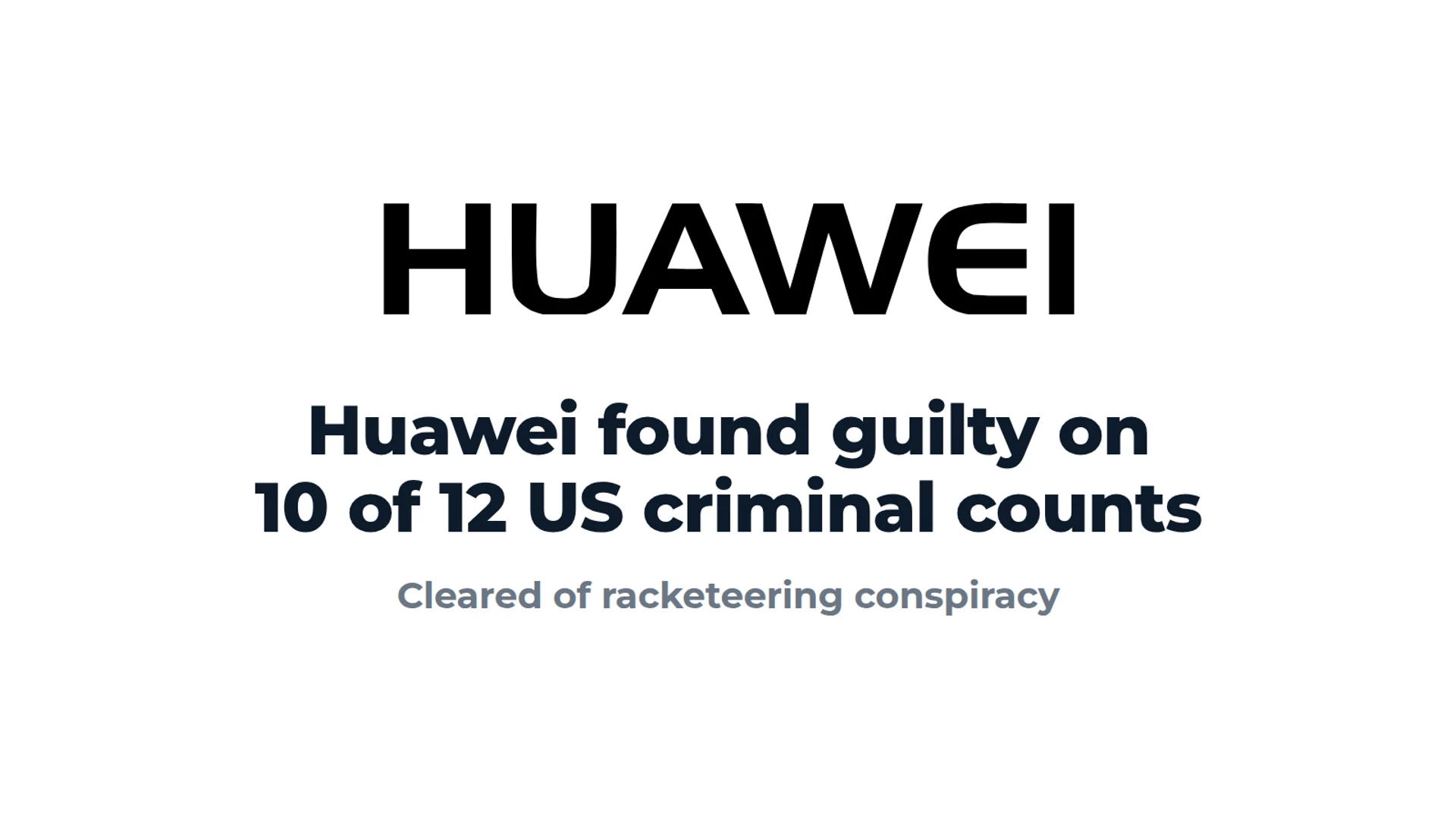
- A Brooklyn jury returned guilty verdicts on 10 of 12 counts in the Huawei case
- Huawei was acquitted of racketeering conspiracy, the most serious charge
- Trade-secret evidence involved Cisco and T-Mobile
A federal jury in Brooklyn returned guilty verdicts on Tuesday on 10 of the 12 criminal counts against Huawei Technologies and three of its subsidiaries, including bank fraud, wire fraud, conspiracy to steal trade secrets, and evading sanctions. Jurors found the company not guilty of racketeering conspiracy and conspiracy to obstruct justice, the South China Morning Post reported.
The jury deliberated for about four days and also returned a guilty verdict on money laundering, Bloomberg reported. The Justice Department unsealed the original charges against Huawei in January 2019. Racketeering conspiracy was the most serious charge in the case. The initial reports on the verdict didn't break it down by defendant.
The case began with Huawei's business in Iran
The original indictment accused Huawei of misleading HSBC, Standard Chartered, and BNP Paribas about its business in Iran, Reuters reported. The trial lasted more than two months. Prosecutors called more than 60 witnesses, and the defense called 15.
"After the media started questioning Huawei's operations in Iran, so did Huawei's banks," prosecutor Meredith Arfa told jurors. The defense argued that the banks knew about Huawei's Iran business and competed for it.
Meng Wanzhou, Huawei's chief financial officer and the daughter of its founder, was detained in Canada in December 2018 on a US warrant. She fought extradition for nearly three years, then entered a deferred prosecution agreement and returned to China, and the charges against her were dropped. Prosecutors showed jurors a statement attached to her agreement. She did not testify.
Cisco and T-Mobile were among the companies in the trade-secret evidence
Prosecutors added the trade-secret charges in 2020, alleging that Huawei conspired over two decades to steal technology from US companies. The evidence at trial included source code for Cisco Systems (CSCO) routers, antenna technology from Quintel, and a circuit board from the chip company CNEX, which prosecutors said Huawei sought through a professor it hired. Jurors also saw a video that prosecutors said showed a Huawei employee putting a piece of a T-Mobile US (TMUS) testing robot into his backpack.
Court records also name Motorola Solutions (MSI) and Fujitsu among the companies whose technology prosecutors said Huawei targeted, the Associated Press reported. Prosecutors said a person working for Huawei photographed the circuits inside another company's networking device at a Chicago trade show.
Huawei's lawyer, Brian Heberlig, told jurors in his closing argument that "Huawei didn't steal its way to success." He also said, "You can't steal a secret that isn't a secret," and that Huawei has paid billions of dollars in licensing fees, with 75% of that money going to US companies.
Huawei has been on the US entity list since 2019
The Commerce Department put Huawei on its trade blacklist in 2019. The company has more than 200,000 employees and operates in about 170 countries. In September, Huawei laid out an 11-chip AI portfolio and said domestic demand for its Ascend chips exceeds supply.