Key points
- Analog Devices beat fourth-quarter earnings and revenue estimates
- Analog Devices' first-quarter profit forecast fell below expectations
- Analog Devices shares fell 13% in premarket trading
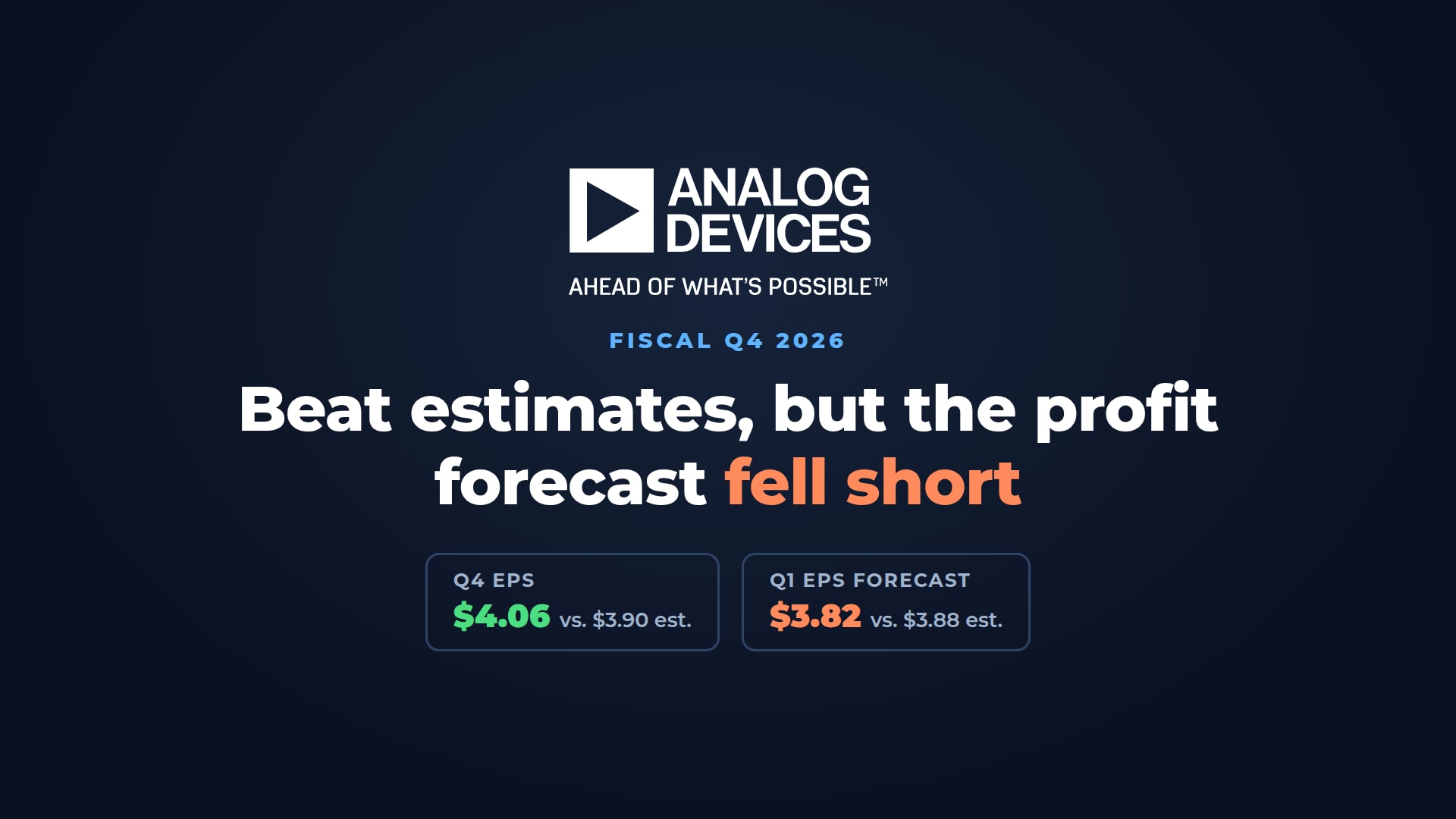
Analog Devices (ADI) reported record fiscal fourth-quarter revenue and earnings on Nov. 24 that beat Wall Street's estimates, but its profit forecast for the current quarter fell short.
Adjusted earnings were $4.06 a share on revenue of $4.37 billion. Revenue rose 42% from a year earlier. Analysts surveyed by FactSet had expected $3.90 a share on $4.33 billion in sales, Investor's Business Daily reported.
For the first quarter of fiscal 2027, Analog Devices forecast adjusted earnings of $3.82 a share, plus or minus 20 cents, on revenue of $4.4 billion, plus or minus $150 million. Analysts had expected $3.88 a share on $4.36 billion in revenue. At the midpoint, the revenue forecast topped estimates, while the profit forecast fell short.
Analog Devices shares were down 13.2% at $328.60 in premarket trading at 9:23 a.m. ET, after closing at $378.75 on Nov. 23. The stock rose 9.5% that day as chip stocks rallied following Nvidia's reinstatement of Jensen Huang as CEO.
Analog Devices expects its profit margin to narrow
The fourth quarter ended Oct. 31. Adjusted operating margin was 52.3%, up from 43.5% a year earlier, according to the company's earnings release. For the first quarter, the company expects an adjusted operating margin of about 50.5%, plus or minus 1 percentage point, at the midpoint of its revenue forecast. GAAP earnings, which include costs like amortization of acquired intangibles and stock-based pay, were $3.40 a share in the fourth quarter.
Inventories rose to $2.08 billion at the end of the quarter, from $1.66 billion a year earlier. Days of inventory, a measure of how long it takes to sell through stock on hand, rose to 141 from 134 the quarter before, StockStory reported, citing the higher inventory as one reason for the drop.
Industrial and communications chips led Analog Devices' growth
Industrial revenue, about half of the total, rose 55% from a year earlier. Communications revenue rose 81%. Chief Executive Vincent Roche said that AI infrastructure is driving "tremendous growth" in the company's data center and automated test equipment businesses, but that "more than two-thirds of our growth in fiscal 2026 came from non-AI-centric market opportunities."
| Market | Q4 revenue | Change from a year earlier |
|---|---|---|
| Industrial | $2.19B | +55% |
| Automotive | $1.04B | +21% |
| Communications | $707M | +81% |
| Consumer | $429M | +7% |
| Total | $4.37B | +42% |
Source: Analog Devices fourth-quarter fiscal 2026 earnings release, Nov. 24, 2026.
For the full fiscal year, revenue rose 38% to $15.2 billion. Analog Devices returned $5.4 billion to shareholders through dividends and buybacks and declared a quarterly dividend of $1.10 a share. The company holds its earnings call at 10 a.m. ET.