Key points
- AAOI signs a $2.2 billion supply deal with a hyperscaler
- The $1.5 billion committed for 2027 exceeds AAOI's expected 2026 revenue
- Why AAOI's $10 billion demand figure isn't guaranteed
- AAOI's US-made shipments are due in early 2027
Applied Optoelectronics (AAOI) has signed a four-year supply agreement with an existing hyperscale data center customer that commits the buyer to purchase about $2.2 billion of its products. AAOI didn't name the customer.
The agreement includes a minimum purchase commitment of about $1.5 billion of 800G transceivers in 2027 and about $700 million of laser diodes in 2028 and 2029, according to AAOI's Nov. 24 release. The 800G transceivers are optical modules that move data between data center equipment at 800 gigabits a second.
The agreement runs from December 2026 through December 2030, and other products may be added later. AAOI shares were up 0.4% at $38.87 at 10:45 a.m. ET on Nov. 24.
The 2027 commitment tops AAOI's expected 2026 revenue
The $1.5 billion commitment for 2027 is larger than AAOI's expected revenue for all of 2026. The company reported $612.9 million in revenue for the first nine months of the year in its quarterly report and forecast $385 million to $420 million for the fourth quarter. That puts expected full-year revenue at about $998 million to $1.03 billion.
Data center products accounted for $344.7 million of revenue in the first nine months. Cable TV equipment made up most of the rest.
AAOI says demand could top $10 billion
Chief financial officer Stefan Murry said in the release that the customer's forecast shows demand well beyond the purchase commitments. "While not guaranteed, the current level of demand based on long-term discussions with the customer exceeds $10 billion over the four years of the LTA," he said.
Sales beyond the $2.2 billion depend on AAOI bringing more production capacity online and getting more purchase commitments, Murry said. The release says the demand estimates aren't purchase orders, binding commitments, or revenue guidance.
AAOI will incur a one-time $2 million expense to speed up qualification, the testing a customer runs before it approves a supplier's parts. The release says the customer made no capital commitment as part of the agreement. AAOI has committed to supply the agreed volumes.
AAOI's second deal of this kind
Chief executive Thompson Lin called the agreement AAOI's second long-term agreement with a hyperscale customer. AAOI disclosed the first one in its Nov. 5 quarterly report. That three-year deal, signed after Sept. 30, covers June 2026 through May 2029. Under it, the 10-Q says, a "major hyperscale data center customer" is obligated, "with certain conditions, to purchase 10% of certain 1.6 Tb data center transceiver products from us." The filing doesn't say what total the 10% is measured against. The report gave no dollar value for that deal and said AAOI hadn't been a party to an agreement of this type before.
Lin said some of the laser diodes in the new agreement are expected to power co-packaged optics starting in 2028. Co-packaged optics place the optical parts right next to the chip instead of in a separate module. Lin said AAOI plans to expand its laser manufacturing capacity in Texas.
The US factory timeline
Under the agreement, AAOI has committed to ship an agreed-upon quantity of US-made products starting in the first quarter of 2027, with volumes ramping through the year, Murry said.
When AAOI reported third-quarter results on Nov. 5, Murry said the company expects its 2027 US expansion "to take longer to complete due to longer than expected time to obtain necessary electrical power among other construction related issues."
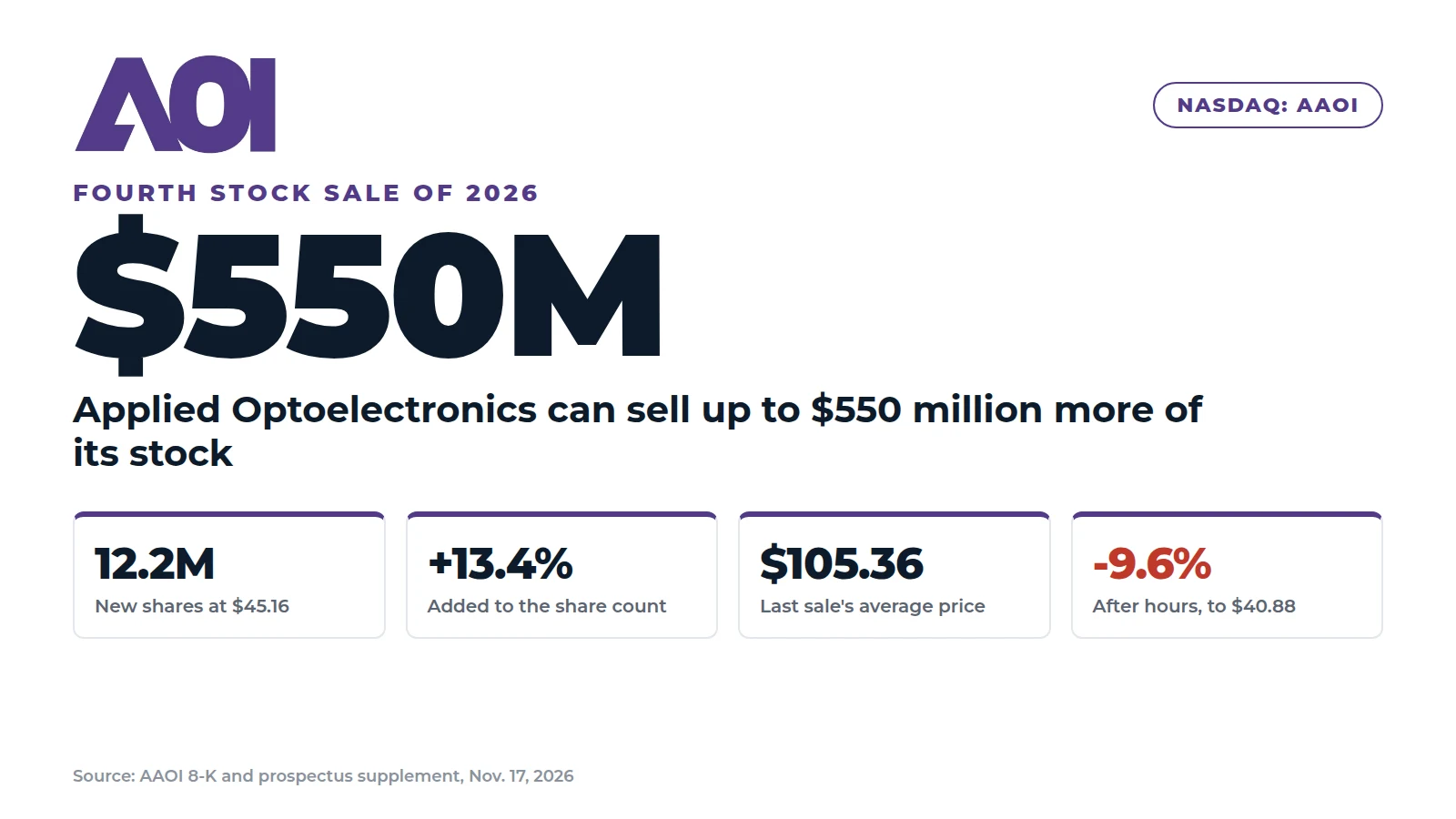
On Nov. 17, AAOI opened a program to sell up to $550 million of new stock, its fourth this year. The prospectus says the money is for general corporate purposes, which may include buying equipment and buildings.
AAOI's stock closed at $38.70 on Nov. 23, down from $130.16 on Oct. 6. Rival Lumentum (LITE) said on Oct. 9 that its capacity for AI data center optical parts is sold out through early 2029.