Key points
- Intel trailed the chip ETF by 16 points before earnings
- Why Intel is pulling 18A wafers in Oregon
- The customer news Intel's CEO promised
Intel (INTC) shares fell 45.3% in October, their worst month on record, according to FactSet data cited by CNBC. They fell another 8.8% on Nov. 2, closing at $59.97.
The PC slowdown explains part of the damage. Intel fell 28.6% on Oct. 30 after its fourth-quarter forecast missed estimates, largely because the company expects PC chip sales to decline.
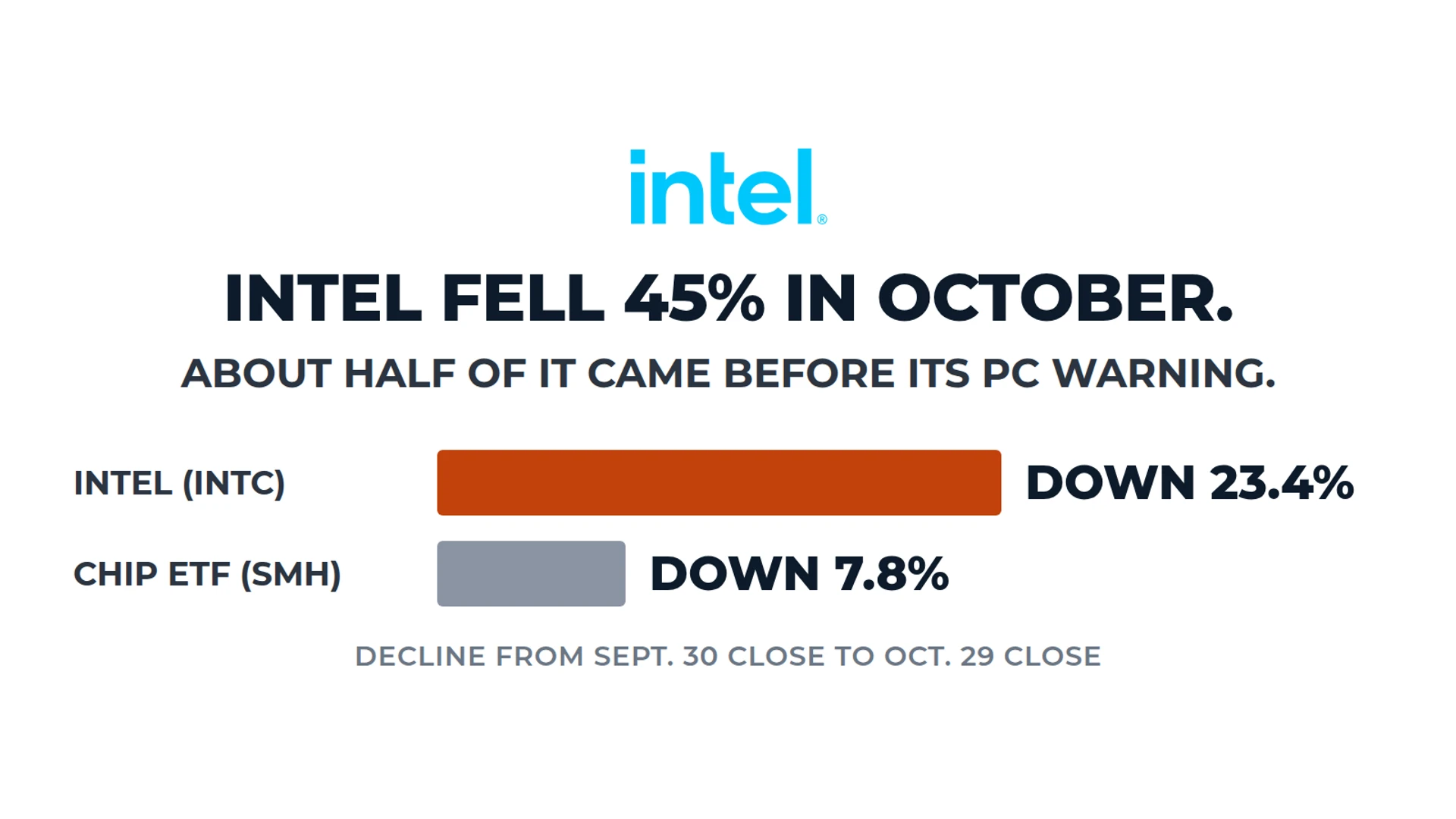
But the stock was already struggling before that forecast. Intel fell 23.4% from its Sept. 30 close through Oct. 29, accounting for about half its October decline in dollars. The VanEck Semiconductor ETF (SMH) fell 7.8% over the same stretch, by our calculations. Intel trailed it by roughly 16 percentage points.
I think investor doubts about Intel's factories help explain that gap. Intel's earnings call shows how the PC slowdown feeds into its manufacturing problems.
| Stock | Sept. 30 to Oct. 29 | Oct. 30 | October |
|---|---|---|---|
| Intel (INTC) | -23.4% | -28.6% | -45.3% |
| VanEck Semiconductor ETF (SMH) | -7.8% | -7.0% | -14.2% |
| Advanced Micro Devices (AMD) | -7.4% | -10.9% | -17.5% |
| Nvidia (NVDA) | -6.4% | -4.2% | -10.4% |
| TSMC (TSM) | -5.3% | -5.9% | -11.0% |
Source: daily closing prices, by our calculations. Oct. 29 was Intel's last close before its third-quarter report.
Intel slid after Musk confirmed TSMC talks on Terafab
On Oct. 2, the newsletter Culpium reported that Taiwan Semiconductor Manufacturing Co. (TSM) was exploring ways to help run Terafab, the chip factory SpaceX (SPCX) is building in Texas. Intel signed on as Terafab's development partner in April. Elon Musk confirmed the talks on Oct. 3.
From its Oct. 1 close through Oct. 6, Intel fell 6.3% while SMH rose 2.4%. "That's hurt investor sentiment around Intel," Bloomberg wrote on Oct. 7. That morning Musk said TSMC could at most sublease part of the fab, and Intel CEO Lip-Bu Tan told Bloomberg Intel would stay on. The stock rose 0.6% that day.
Terafab is one project. But the timing suggests investor concern about Intel's factory role.
The PC slump is leaving Intel's 18A line underused
Intel's newest manufacturing process, 18A, is the one it's pitching to outside chip designers. For now it mostly makes Intel's own chips. Intel "still has no marquee customer for its most advanced chips," CNBC reported, and its 18A chips for its own use are in high-volume production in Arizona.
That makes the PC slump a foundry problem too. On the Oct. 29 call, Morgan Stanley's Joseph Moore asked whether PC weakness lets Intel move wafers around. Chief Financial Officer David Zinsner said Intel is adding its older Intel 3 process, which makes server chips, in Oregon. "What we're taking offline to put Intel 3 into Oregon is 18A wafers," he said. Intel had planned to use most of those wafers for its Panther Lake PC chips, he added. Tan said the Intel 3 production there should start in the second half of next year.
When Bernstein's Stacy Rasgon asked about margins, Zinsner agreed with him. "You're right on 18A, the loading isn't going to be where we want it," he said, according to a call transcript published by The Motley Fool. Loading is how full a production line runs.
The main user of 18A is Intel, and Intel just cut back. Shifting toward server chips makes sense for revenue. Data center revenue rose 78% to $7.3 billion in the third quarter, and Zinsner said demand "continues to meaningfully exceed available supply." It also leaves the process Intel wants to sell to other companies running below plan, with no large outside customer yet to fill it.
Intel Foundry still loses money
Intel Foundry lost $1.85 billion in the third quarter on $6.7 billion of revenue, according to Intel's earnings release. That was smaller than the $2.32 billion loss a year earlier, and the revenue includes sales to Intel's own product groups. Zinsner said 18A costs have fallen about 40% since the first quarter, but "we still have considerable work ahead of us to deliver a sustainably profitable Foundry business."
Tan said Intel is "engaged with a couple of highly strategic customers." Asked by Bank of America's Vivek Arya about outside customers, he said Intel would have "a couple of customers ready to announce in the next 2 quarters."
David Yoffie, a Harvard Business School professor who spent nearly three decades on Intel's board, told CNBC that customers may doubt Intel has capacity to spare beyond its own needs. If that's the case, he said, "they're just not a very credible supplier." He also said that if Intel doesn't land a large foundry customer within a year, "then the stress on Intel's economics are going to start to show even more dramatically."
Put all of that together, and October looks like two problems that feed each other. PCs explain Friday. The three weeks before it, and the 18A wafers coming out of Oregon, point at the foundry. Zinsner also said it's "probably not a dynamic where we're going to have positive free cash flow next year," and he expects 2027 gross capital spending to be "up strongly." That makes Tan's customer announcement the number to watch. If it lands within his two quarters and names a large outside customer for 18A, the foundry case gets a lot easier to make.