Key points
- Intuit agrees to sell Mailchimp for $3.68 billion
- What Intuit said about its lower revenue outlook
- What Bending Spoons owns
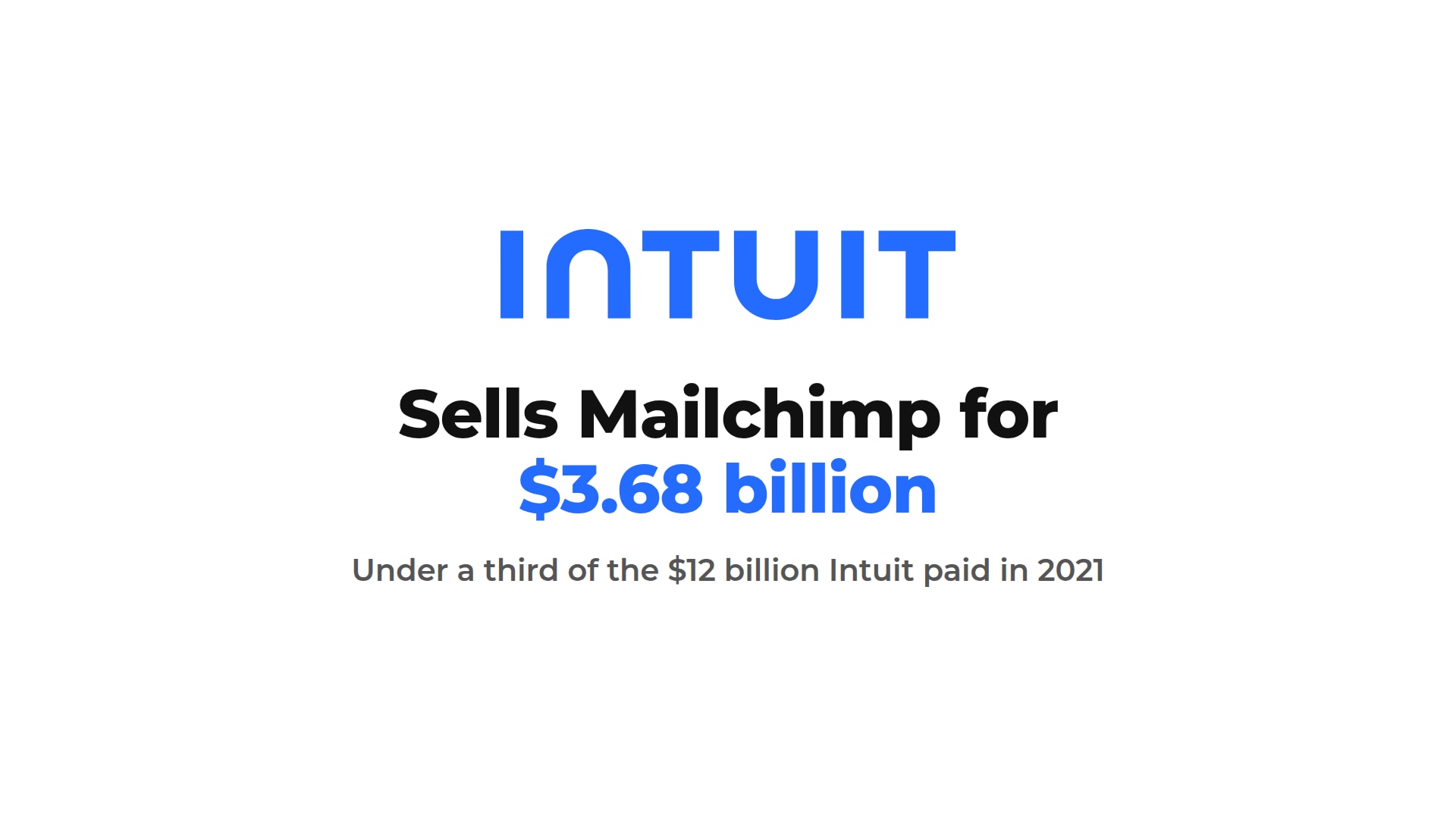
Intuit (INTU) has agreed to sell Mailchimp to Bending Spoons (BSP) for $3.68 billion, less than a third of the roughly $12 billion Intuit paid for the email marketing company in 2021.
Intuit announced the deal on Nov. 19 alongside first-quarter results that beat analysts' estimates. It also lowered its full-year revenue outlook, citing a change at Credit Karma that it didn't explain in the release.
Intuit shares fell 11% in after-hours trading to $275.50 as of 4:35 p.m. ET, from a regular-session close of $310.02.
Intuit beat estimates and its own forecast
Revenue rose 12% to $4.35 billion in the quarter ended Oct. 31, and adjusted earnings came to $2.91 a share. Analysts polled by LSEG expected $2.70 a share on revenue of $4.31 billion, CNBC reported. Intuit had guided to revenue of $4.29 billion to $4.31 billion and adjusted earnings of $2.44 to $2.48 a share.
| First quarter, fiscal 2027 | Revenue | Change from a year earlier |
|---|---|---|
| Total | $4.35 billion | +12% |
| Global Business Solutions | $3.1 billion | +15% |
| QuickBooks Online Accounting | $1.4 billion | +19% |
| Credit Karma | $708 million | +9% |
| Mailchimp | $313 million | -1% |
| TurboTax | $199 million | +1% |
Source: Intuit's Nov. 19 earnings release. QuickBooks Online Accounting is part of Global Business Solutions.
GAAP net income rose to $695 million, or $2.59 a share, from $446 million, or $1.59 a share. Intuit bought back $1.5 billion of stock in the quarter. It declared a quarterly dividend of $1.38 a share, up 15% from a year earlier, payable Jan. 15, 2027.
Credit Karma pulled down the full-year forecast
Intuit now expects fiscal 2027 revenue of $23.08 billion to $23.37 billion, growth of 8% to 9%. In August, it forecast $23.28 billion to $23.51 billion, or 9% to 10%. Analysts polled by LSEG expected $23.43 billion.
The whole cut came from Credit Karma, which Intuit now expects to bring in $2.72 billion to $2.83 billion this fiscal year, growth of 3% to 7%. Intuit had forecast $2.92 billion to $2.97 billion, or 11% to 13%. The release says only that the new outlook reflects "a change to Credit Karma" and doesn't describe the change.
| Fiscal 2027 forecast | August | Nov. 19 |
|---|---|---|
| Total revenue | $23.28 billion to $23.51 billion | $23.08 billion to $23.37 billion |
| Credit Karma revenue | $2.92 billion to $2.97 billion | $2.72 billion to $2.83 billion |
| Adjusted earnings per share | $22.88 to $23.12 | $22.88 to $23.12 |
Source: Intuit's August and Nov. 19 earnings releases. Forecasts leave out the Mailchimp sale.
Intuit kept its adjusted earnings forecast at $22.88 to $23.12 a share, below the $23.62 analysts expected. For the second quarter, it forecast revenue of $4.93 billion to $4.95 billion and adjusted earnings of $3.17 to $3.22 a share. None of the forecasts include the Mailchimp sale, and Intuit said it will update them when the deal closes.
Mailchimp's agreed sale price is less than a third of its 2021 price
Bending Spoons will pay $3.31 billion in cash and $368 million in Bending Spoons stock. The deal is expected to close in early 2027, subject to regulatory approvals. Intuit plans to use the cash to buy back Intuit stock within fiscal 2027, after the sale closes.
Mailchimp's revenue fell 1% in the quarter, and Intuit expects $1.26 billion to $1.27 billion from the unit this fiscal year, down 1% to flat. By our calculations, the sale price is about 2.9 times that forecast. Intuit began reporting Mailchimp as a separate segment in August.
Intuit said the sale sharpens its focus on AI tools that help businesses find customers and get paid. Mailchimp competes with Klaviyo (KVYO).
Bending Spoons owns AOL, Evernote, and Vimeo
Bending Spoons, based in Milan, went public on the Nasdaq in July. Berkshire Hathaway bought $600 million of Bending Spoons stock in the IPO and agreed in October to buy another $330 million in a private placement expected to close this quarter. The company's portfolio includes AOL, Eventbrite, Evernote, Vimeo, and WeTransfer, and it bought Airtable in September.