Key points
- Record 8,994 applications to company-sponsored programs
- SK Hynix programs up 27%, battery down 36%
- Sogang's SK Hynix program took 1,323 for 20 seats
- Medical-school applications moved the other way
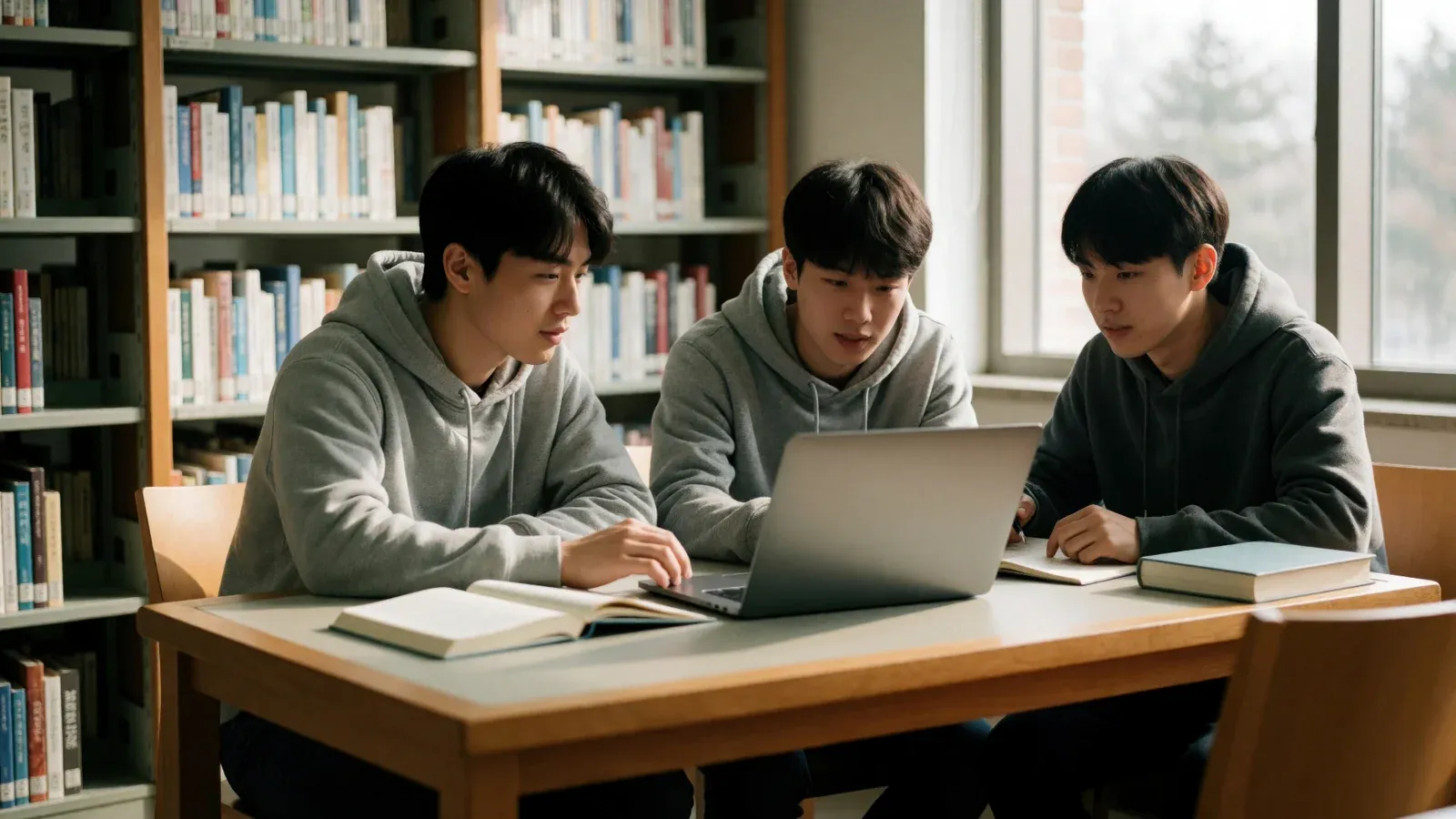
South Korean students submitted a record number of applications to university programs sponsored by large companies this year.
Seven companies operate 13 of these programs, with Samsung Electronics and SK Hynix sponsoring the largest semiconductor programs. They received 8,994 applications for the 2027 school year, up 18.2 percent from last year, Korea Economic Daily (한국경제) reported on September 15. The average competition rate increased to 23.48 applications per seat from 20.67 a year earlier.
In Korea, these programs are called employment-conditional contract departments. A company and a university operate the department together. Students who graduate and meet the required conditions receive jobs with the sponsoring company. The application figures were compiled by Jongno Academy (종로학원), an admissions consultancy that tracks them each year.
The direction was different for each industry. Applications to semiconductor departments increased 19.4 percent, while applications to battery departments fell 36.2 percent. Information security rose 15.1 percent and automotive rose 10.3 percent. Mobile fell 21.3 percent, telecommunications fell 11.0 percent and display fell 1.1 percent. The results followed conditions in those industries. Semiconductor companies are expanding because of AI demand, while battery companies are dealing with slower electric-vehicle demand. Students' choices moved in the same direction, Korea Economic Daily reported.
Among the seven companies, SK Hynix recorded the largest increase. Applications to its three departments rose 27.3 percent from last year. LG Uplus increased 15.1 percent, Hyundai Motor 10.3 percent and Samsung Electronics 4.2 percent. Samsung SDI's battery department fell 36.2 percent, while LG Display declined 1.1 percent.
Competition was highest at Sogang University (서강대). Its system semiconductor engineering department, operated with SK Hynix, received 1,323 applications for 20 seats. That was 66.15 applications for each place. Hanyang University (한양대) followed with 44.41 applications per seat. Sungkyunkwan University (성균관대) recorded 36.84, Korea University (고려대) 14.57 and Yonsei University (연세대) 10.85, Newsis reported.
Medical-school applications moved the other way
Applications to the medical schools at Seoul National University, Yonsei and Korea University came to 2,903, down 11.3 percent from 3,271 a year earlier, Newsis (뉴시스) reported, citing the same Jongno Academy tally. The chip departments at Yonsei and Korea University rose 5.2 percent to 1,223 over the same period.
Im Sung-ho, the head of Jongno Academy, said the industry is what changed. "A sharp preference for semiconductor contract departments is appearing because the industry is booming," Im said. "Entrance scores could form at a level not far behind medical school."
The figures narrow a gap that historically favored medicine, though the two totals cover different universities and are not directly comparable. Students used to enter these departments and then leave partway through to transfer to medical school, and the chip industry struggled to hold on to the strongest science students, Newsis reported. The shift comes as Samsung and SK Hynix post record results and pay accordingly, and the industry expects large bonuses to continue for several years.
The same pattern turned up at the four national science institutes, which recruit separately from ordinary universities. UNIST took 11,211 applications for 565 places, the first time it has passed 10,000 since it opened, and its Samsung-linked semiconductor engineering department took 3,940 applications for 35 places, or 112.57 per seat, against 70.51 last year, Seoul Economic Daily (서울경제) reported on September 16 in Korea. DGIST took 9,208 applications for 322 places, 49 percent more than last year. At GIST, the Samsung-linked department took 11.56 applications per seat.
For the two companies this is an early sign that the engineering pipeline may be improving. SK Hynix and Samsung are competing directly on high bandwidth memory, and both need engineers for it. Chonnam National University (전남대) is working with Samsung to open a 40-seat contract department of its own, Newsis reported.
Meanwhile, the competition for those engineers is no longer only domestic. SanDisk has been advertising for engineers to work in Korea, which is unusual for a company whose Korean business has been sales and marketing, and Micron has been approaching engineers at Korean companies with offers, Newsis reported.
The squeeze is regional, not just Korean. Taiwan's chip industry now has more than two openings for every job seeker.