Key points
- Amazon came up $34.8 billion short in its latest quarter
- Oracle's new bonds pay 2.4 to 3.35 points over Treasuries
- Meta is selling bonds for the first time since S&P's warning
Amazon (AMZN) spent $34.8 billion more on property and equipment than its operations generated in the third quarter. Oracle (ORCL) came up $5.4 billion short in its latest quarter. Yet Oracle paid much more to borrow.
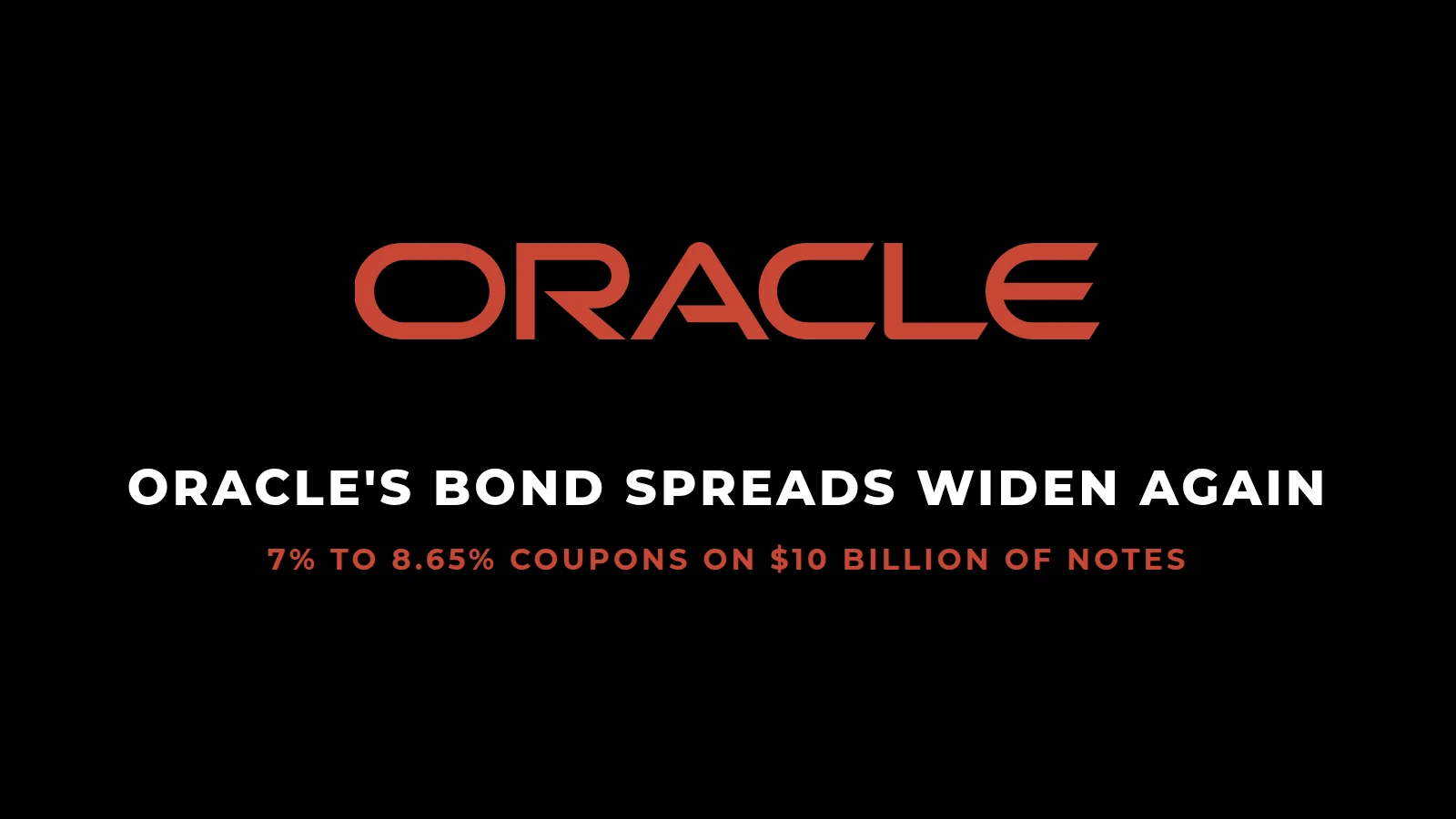
Oracle's new bonds due in 2037 priced at 3.10 percentage points over Treasuries on November 2. Amazon's 2036 notes priced at 0.80 point over in July.
That gap caught my attention after the Financial Times wrote about "a chill wind in the AI credit market" on November 3. I wanted to see which companies were actually paying more, so I compared the latest dollar bond sales from five big tech borrowers on our AI debt tracker with their latest quarterly cash flow.
The result: the extra yield investors demand isn't rising evenly, and one quarter's spending gap doesn't explain who pays the most.
The spreads line up more closely with credit ratings
A spread is the extra yield a company pays over a Treasury with a similar maturity. To compare the borrowers, I used each company's notes due around 2036 and its 2046 notes, based on the final term sheets filed with the SEC.
| Company | S&P rating at sale | Sale date | 2036 notes, points over Treasuries | 2046 notes, points over Treasuries | Latest quarter, cash after equipment spending |
|---|---|---|---|---|---|
| Microsoft | AAA | Oct. 29, 2026 | +0.65 | +0.85 | +$18.6B |
| Alphabet | AA+ | Aug. 6, 2026 | +0.85 | +1.05 | −$9.1B |
| Amazon | AA | July 7, 2026 | +0.80 | +1.00 | −$34.8B |
| Meta | AA- | April 30, 2026 | +0.90 | +1.22 | −$1.2B |
| Oracle | BBB- | Nov. 2, 2026 | +3.10* | +3.35 | −$5.4B |
The four companies rated AA or higher priced their 10-year notes within a quarter of a percentage point of one another. Oracle's 2037 notes priced about 2.2 points above the closest of them. If lenders looked only at the latest quarterly spending gap, Amazon would be the one paying more.
The comparison isn't exact. The sales ran from April to November, so market conditions changed, and three came before or during the quarters in the table's last column. Spreads also depend on maturity and what investors expect next. Still, they line up more closely with the ratings than with the quarterly cash figures.
Amazon's spending gap was the biggest by a mile. Its own free cash flow measure counts $1.4 billion of proceeds from equipment sales and incentives against that spending, putting its quarterly shortfall at $33.5 billion. Over the past 12 months, its free cash flow was negative $42.4 billion.
"The free cash flow looks like the ugly part of the report," Dave Wagner, a portfolio manager at Aptus Capital Advisors, told Reuters. Amazon has also set up a secured loan facility of up to $80 billion, backed by equipment it buys. S&P rated its July bonds AA, and they priced within a few hundredths of a point of Alphabet's.
Microsoft (MSFT) is the only one of the five whose operations covered its equipment spending in the latest quarter. It paid the lowest spreads in its first U.S. bond sale since 2017. Finance chief Amy Hood said Microsoft expects "to continue to remain free cash flow positive" in the fiscal year ending June 2027.
Oracle's rating changed as its spreads widened
Oracle's own history makes the same point. Its notes due in 2046 priced at 1.70 points over Treasuries in February and at 3.35 points on November 2, as we covered on November 2. In between, S&P lowered Oracle one notch, from BBB to BBB-, its lowest investment-grade rating, according to the two term sheets.
Oracle's quarterly gap isn't the whole picture. Analysts expect negative free cash flow of about $35 billion this fiscal year, according to FactSet data cited in our Investor Day coverage, and Oracle doesn't expect free cash flow to turn positive until the second half of fiscal 2028. A BBB- company that's still borrowing heavily is a different credit from an AA company with a bad quarter, and the spreads are consistent with that.
Meta is the next test
Meta Platforms (META) is selling bonds on November 3, aiming for $20 billion to $25 billion in dollars and euros, we reported. It's Meta's first bond sale since S&P changed its outlook on Meta to negative on October 30. Meta's own free cash flow figure for July to September was negative $2.1 billion, because Meta counts about $1 billion of finance lease payments as capital spending, which the table leaves out. S&P kept the AA- rating, but the new outlook means it may lower it. S&P expects Meta's free operating cash flow to be negative by $22 billion this year and $71 billion in 2027, according to Investing.com's account of the report.
Meta's own filing says its forecasts show a need to raise "hundreds of billions of dollars over a period of several years beginning as early as fall 2026."
So Meta's pricing is a chance to see whether a warning alone shows up in the price. In April, Meta's 2036 notes priced at 0.90 point over Treasuries and its 2046 notes at 1.22 points. If the new notes land well above those levels, that would be consistent with investors demanding more yield after S&P's warning, before any downgrade. I'll add the result here once Meta files its term sheet.
Spreads are from each company's final term sheet. *Oracle's closest new series matures in 2037 and was priced against the Treasury due in 2036. Cash after equipment spending is operating cash flow minus cash purchases of property and equipment, from each company's latest 10-Q; Oracle's quarter ended August 31, and the others ended September 30.