Key points
- Korea could use a stabilization fund to buy stocks for the first time since 2008
- The Kospi closed 46.6% below its June record on November 20
- Daily buyback limits for SK Hynix and other companies ease on November 24
On November 22, South Korea's government said it's getting its stock market stabilization fund ready to buy shares if the market needs it. The Kospi had fallen 5.21% on Friday. If money goes in, it'll be the first time a stabilization fund has bought Korean stocks since the 2008 global financial crisis, Seoul Economic Daily (서울경제) reported.
The announcement came after an emergency meeting in Seoul on Sunday. The government also said it will loosen the daily limit on how many of their own shares companies can buy, and regulators will step up monitoring for illegal short selling. It hasn't decided when money from the fund would go in or how much, Bizwatch (비즈워치) reported.
Deputy Prime Minister and Finance Minister Lee Hyoung-il led the meeting. Bank of Korea Governor Shin Hyun-song, Financial Services Commission Chairman Lee Eog-weon, and Financial Supervisory Service Governor Lee Chan-jin also attended.
The announcement comes ahead of Monday's trading session. The Kospi closed at 4,869.96 on Friday, November 20. That was its lowest close in about 10 months and 46.6% below its June 22 record of 9,114.55. The index had more than doubled from the end of 2025 to that record. After Seoul closed, the Philadelphia Semiconductor Index fell more than 10% in New York, and Korean outlets started calling the next session a possible "Black Monday." The Kospi opens at 9 a.m. Korea time on November 23, which is 7 p.m. on Sunday in New York.
It's the second emergency package this month. After the Kospi's trading halt on November 6, authorities suspended for three months the rule that makes brokerages keep 140% collateral on margin loans.
The fund has 10.76 trillion won lined up, but no money has gone in
The fund works on promises made ahead of time. In 2020, when Covid-19 sent stocks down, 23 policy banks and financial companies agreed to put in 10 trillion won ($7.43B), and four market institutions including the Korea Exchange agreed to put in 760 billion won ($564M). That's 10.76 trillion won ($7.99B) in all, and the commitments were renewed in 2022, Kookmin Ilbo (국민일보) reported.
Members pay in only when the fund asks for the money, which is called a capital call. The fund then buys exchange-traded funds, or ETFs, such as ones that track the Kospi 200 and Kosdaq 150 indexes. Because of that, buying is unlikely to start early this week, the paper said.
The full amount is also small next to the market. It equals 0.24% of the Kospi's total market value as of November 18. "For the size of today's market, 10 trillion won has become too small," said Kim Jin-wook, chief economist at Citibank Korea.
Lee Eog-weon said on November 13 that the fund was already set up so it could be used, but that it should be kept for urgent and exceptional situations when the financial system is at risk. At the same meeting, President Lee Jae-myung asked for a review. "We need to check whether there's a way for it to work effectively, and what size would be right," he said.
A separate, smaller fund last bought stocks in 2008
Korea has set up a stabilization fund or lined up commitments for one five times, in 1990, 2003, 2008, 2020, and 2022. The 10.76 trillion won now lined up dates to 2020 and hasn't bought anything. The last time money actually went into stocks was 2008, through a separate fund that was much smaller.
That year, after Lehman Brothers collapsed and the Kospi fell from around 2,000 to below 1,000, Korea's market institutions pooled 515 billion won ($382M at today's rate) and put it into index funds. That fund ended with a return of about 57%. In 2003, during Korea's credit card debt crisis, a 400 billion won ($297M) fund returned about 30%.
In 2020 and 2022, the market recovered quickly after the fund was announced, and the fund didn't start buying. In December 2024, during the martial law crisis, financial authorities said they would keep a 10 trillion won fund ready to be put to work at any time, but no money went in.
The Kospi rose after both of the last two rounds of buying
Kiwoom Securities analyst Han Ji-young went back through the earlier cases. After the 2003 fund was put to work in February that year, the Kospi rose 41.3% over the next year. After the 2008 fund was put to work in November, it rose 42.0%. In March 2020, September 2022, and December 2024, the market made a short-term low around the time the fund was announced, without any money going in, Han's analysis showed.
"There's been a tendency for the market to rebound not only when the fund was put to work, but even when there was only news that it was being set up," Han said. Han also expects this announcement to help calm the panic, even though it's only advance preparation for now.
Han didn't give the fund all the credit, though. "Other factors, like changes in monetary policy and easing uncertainty overseas, also played a part in the recoveries back then," Han said. Still, when buyers had disappeared from the market, knowing the fund was there as a possible buyer probably helped the rebounds to some extent, Han added.
Companies can buy more of their own shares each day
The government announced two other steps. Korea limits how many of its own shares a listed company can order in a single day, and that limit will be loosened for three months starting November 24. The Financial Services Commission is set to approve it on November 23.
That matters for companies already in the middle of a buyback. SK Hynix (000660) started a 20 trillion won ($14.9B) buyback on October 29, and it bought about 380 billion won ($282M) of its own shares on November 20, Maeil Business (매일경제) reported. The shares closed at 1,113,000 won ($827) that day.
The third step is about short selling, which means selling borrowed shares and buying them back later in the hope that the price falls. The Financial Supervisory Service and the Korea Exchange will run three months of special monitoring for illegal short selling. Authorities will also watch margin loans and forced selling, which happens when a brokerage sells a borrower's shares because the account no longer has enough collateral.
Korea didn't add a short-selling limit like Taiwan's
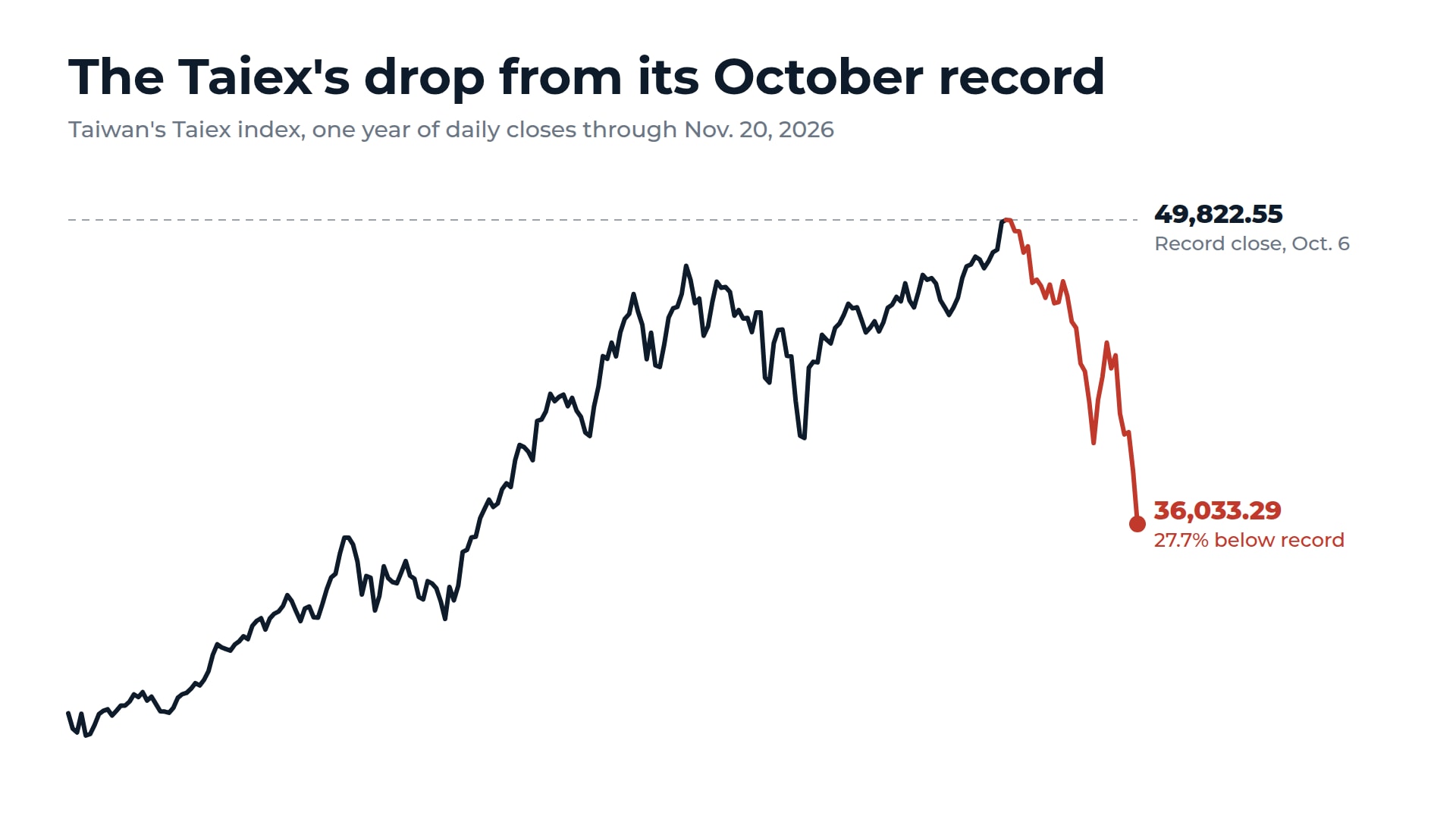
There's no new limit on legal short selling in the package. Taiwan, another market led by chip stocks, went further. On November 21, it banned short sales priced below the previous close for all listed stocks, starting November 23. In Korea, investors had criticized the government for doing too little while Taiwan acted.
Kim Tae-hong, CEO of Growth Hill Asset Management, explained why a ban is a hard choice. "If short selling is suddenly banned outright, foreign investors lose their way to hedge, and they could leave the Korean market," Kim Tae-hong said.
Quotes are translated from Korean. Won figures, including the 2003 and 2008 amounts, are converted at 1,346.5 won to the dollar, the Naver Finance rate on November 20, 2026.