Key points
- Musk warns of an AI cash crunch in 2027
- Why Musk says compute delays cost money
- What AI borrowers' bonds yield, per our debt tracker
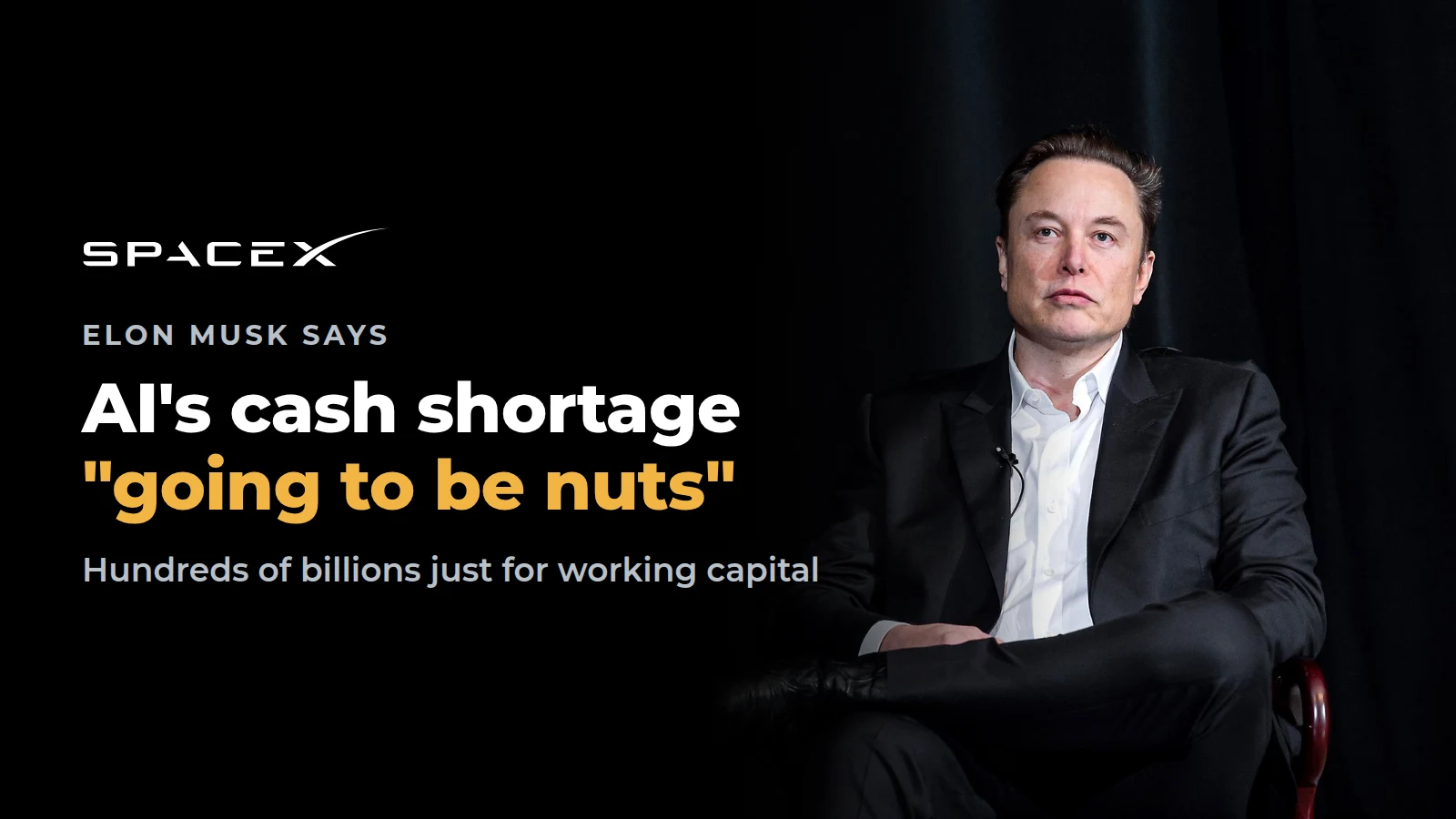
Elon Musk warned that the AI industry could face a cash shortage in 2027 as companies pay for computing hardware before it's ready to generate revenue. Delays of a few months across the industry could require "hundreds of billions of incremental dollars just for working capital," he wrote on X on Nov. 21.
Musk didn't name any companies or show how he calculated the figure. He ended the post with a question: "Where will that come from?"
Musk says the delay between paying and earning is the problem
Musk opened the post with the engineering side. "Getting this amount of compute turned on, cooled and working reliably is incredibly hard," he wrote. "The cash shortage is also going to be nuts next year."
Musk wrote that "even cumulative industry delays of a few months between paying for compute and getting it reliable enough to generate revenue will mean hundreds of billions of incremental dollars just for working capital."
Working capital is the cash a business needs to cover its costs before customers pay it. A company building AI capacity may have to pay for chips and construction well before the new capacity starts generating revenue. The longer the delay, the more cash the company needs to cover its costs.
Musk is selling computing capacity himself. SpaceX (SPCX), which he runs, rents AI compute to Anthropic (ANT). Anthropic's IPO filing puts the cost of those contracts at about $3.1 billion a month once all of the capacity is delivered, which Anthropic expects in December 2026. Musk said on Nov. 18 that Anthropic wants 10 more gigawatts of SpaceX compute.
Musk was replying to an argument that AI demand is still growing
Musk posted the warning as a reply to François Chollet, the AI researcher who created the Keras software library. About 100 minutes earlier, Chollet argued on X that AI investors either believe the build-out is over or are looking at "a rare buying opportunity."
Chollet wrote that GPU spot prices keep rising and that "HBM and DRAM production is effectively sold out through 2029." He also wrote that "inference is profitable with 70-85% margins, and demand is growing geometrically." His post didn't say where those figures came from.
Musk warned about AI debt markets in October
Saturday's post follows an Oct. 25 post in which Musk wrote that "debt markets have almost entirely shut off access to money for any company that doesn't have substantial revenue independent of AI data centers." In the same post, he wrote, "SpaceX closed $40B of debt for GPUs, but we're investment grade and have Starlink & launch revenue." He predicted that most of the more than 200 neoclouds, the companies that rent out AI computing power, would fail or be acquired.
SpaceX's 8-K filed Oct. 26 describes the deal differently. SpaceX signed a binding commitment on Oct. 24 to lease GPU pods from an entity managed by Apollo Global Management (APO), with principal payments expected to total about $40 billion. SpaceX said it expected the lease to close before year-end, subject to closing conditions. We covered the filing in our story on Musk's October post.
On Nov. 19, Saturn Funding Trust, a vehicle managed by an Apollo entity, sold $32 billion of debt to buy equipment that SpaceX will lease, Bloomberg reported. We covered the sale on Nov. 20. The debt belongs to the trust, not to SpaceX. The debt sale didn't itself establish that SpaceX's lease had closed. Our debt tracker still listed the lease as signed on Nov. 20.
On Nov. 19, the median AI borrower's bonds yielded 437 basis points more than Treasuries of the same maturity, according to our AI debt tracker. The median junk bond in the SPDR Bloomberg High Yield Bond ETF (JNK) yielded 248 basis points more. The gap of 189 basis points was up from 103 on Oct. 8, our first reading. A basis point is one hundredth of a percentage point.
CoreWeave (CRWV) bonds carry the highest yields among the borrowers we price daily. At Nov. 19 market prices, its four bonds had a median yield of 15.37%, or 1,051 basis points over Treasuries. Yield reflects the annualized return a buyer would earn at those prices if the bonds are held to maturity and the promised payments are made. The four bonds carry coupons of 9% to 9.75%.
Our AI compute commitments tracker counts $1,566 billion in signed compute contracts as of Nov. 19. That total covers contracts running over many years, so it isn't a bill due in 2027 or an estimate of the cash gap Musk described. Anthropic alone reported about $900.9 billion in total committed spending as of Sept. 30, according to its Nov. 10 IPO filing.
Musk didn't say who he expects to run short, or whether SpaceX would need more financing of its own.