Key points
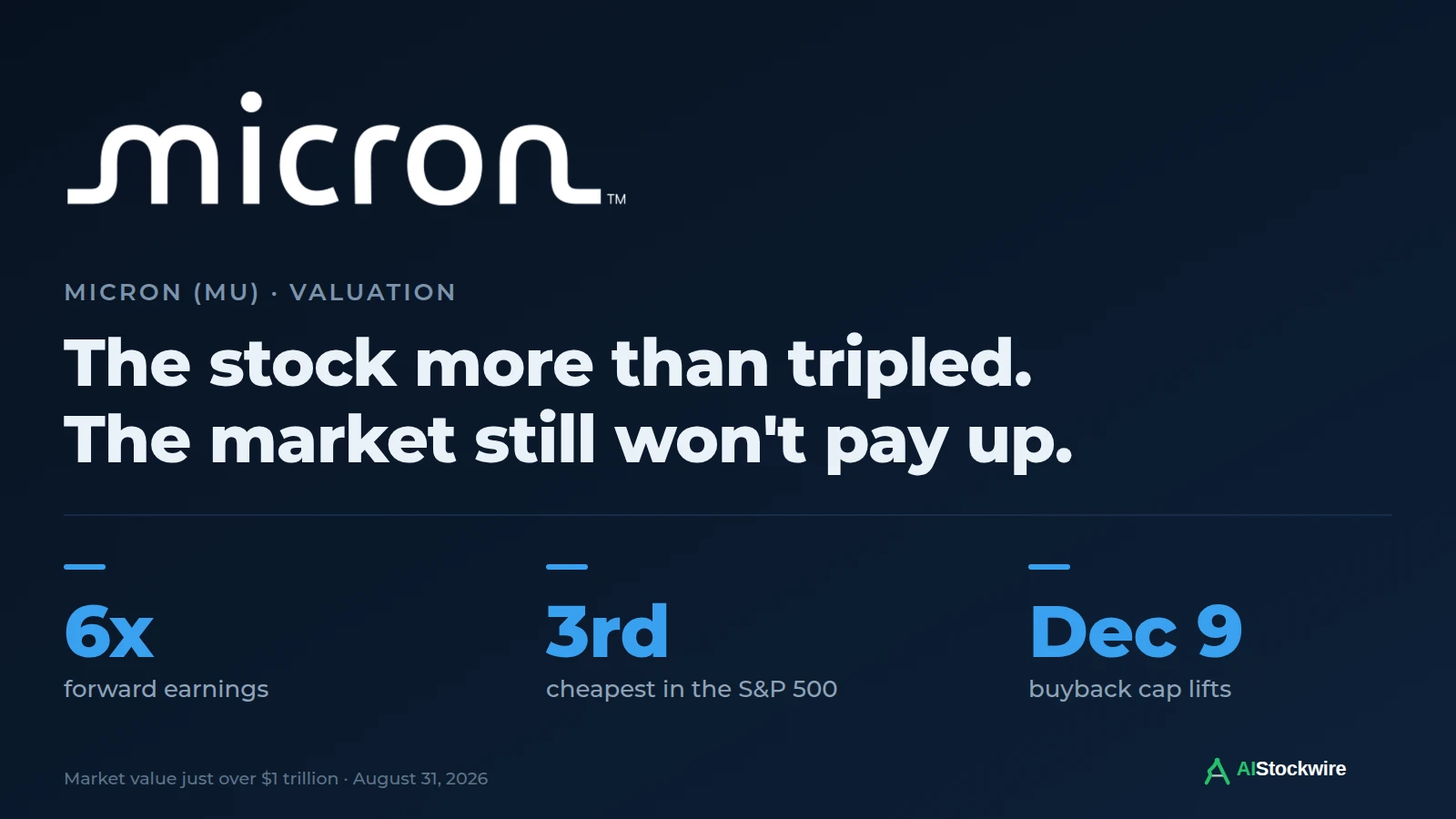
- Micron (MU) trades near 6 times forward earnings, making it the S&P 500's third-cheapest stock by that measure after Charter (CHTR) and General Motors (GM).
- The stock has more than tripled this year and still sits roughly 25% under its June record.
- Goldman Sachs raised its target to $1,100 and stayed Neutral, arguing that the balance of risk and reward remains even after the rally.
On Monday, August 31, Micron (MU) traded near $948 midday. The stock closed last year at $285.41. It has more than tripled, to a market value just over $1 trillion, which makes it one of the best performers of the entire AI trade.
It's also, per CNBC's screen, the third-cheapest stock in the S&P 500 at just above six times forward earnings. The only two names trading lower are Charter Communications (CHTR) and General Motors (GM), a cable company losing subscribers and a car company.
Something in that sentence doesn't add up, and figuring out which part is the whole argument over this stock.
Why is Micron so cheap?
Memory has always been the part of the chip business that ends badly. Prices spike when supply gets tight, every manufacturer on earth breaks ground at once, and the new capacity shows up right as demand cools. Record profits become losses in about two years. Anyone who's owned this sector for a decade has lived through it twice, so nobody wants to pay 20 times earnings for a number they think is the top.
So the multiple isn't the market saying Micron is doing badly. It's the market saying this won't last.
Micron's response has been to sell the next several years before they happen. The company has signed 16 strategic customer agreements carrying roughly $100 billion in minimum contracted revenue, plus about $22 billion in upfront deposits and related commitments from those customers, and it expects half or more of total revenue to eventually sit under those deals. Goldman Sachs puts the coverage at about 20% of expected DRAM volume and 30% of NAND.
That's the bull case in one line. A business that's pre-sold half its revenue isn't the same animal the market keeps pricing, and the floor underneath it is a lot harder to fall through than it used to be.
Demand isn't the issue either. CEO Sanjay Mehrotra has said data center customers want roughly 50% more memory than Micron can actually ship, and the company guided fiscal 2027 capital spending to about $45 billion chasing it.
So why won't Wall Street pay up?
Goldman Sachs analyst James Schneider raised his price target to $1,100 from $900 and kept a Neutral rating on it. His reasoning: fundamentals, supply tightness and visibility have all improved, but the rally already collected most of the good news.
Read that again, because it's the tell. Goldman didn't cut numbers. Goldman raised the target by more than 20% and still wouldn't say buy. The argument on this stock isn't about earnings anymore, it's about what multiple those earnings deserve, and that's a much harder thing for an analyst to defend either way.
Here's the part I keep coming back to. Every one of those contracts got negotiated at some point in the past, and HBM pricing in particular was locked in before this year's squeeze. Micron traded some of the peak for predictability, and that trade has a cost that shows up right now. We wrote earlier today about how buyers shut out of the Korean long-term deals are paying up to five times contract price on the spot market. Every dollar of that gap is money the contracted suppliers agreed not to make.
Visibility cuts both ways. That's the deal Micron signed, and it's a defensible one, but you can't ask for the safety and the spot price at the same time.
The chart's been saying something too. Micron topped at $1,255 on June 25 and has spent the summer about 25% below it, which fits the pattern we flagged in August, where memory prices kept setting records while the memory stocks rolled over. The stock peaked before the news did. It usually does.
What happens on December 9?
Micron finalized about $6.1 billion in CHIPS Act funding in December 2024, and that agreement caps large share buybacks for two years. The cap expires December 9, 2026.
Management hasn't been coy about it. "From December 9, 2026, the second anniversary of the signature of our definitive CHIPS agreements, we intend to increase our capital return," CFO Mark Murphy has said, and he's added that "over time, we expect to return 100% of our excess cash to shareholders." Mehrotra has put the order plainly: invest in the business first, return what's left over.
At six times earnings, a buyback does unusual work. Micron's market cap is about $1.06 trillion, so every $10 billion it spends retires close to 1% of the company, and it retires a lot more of the earnings per share than the same $10 billion would at a normal multiple. Cheap stock plus real cash flow plus a lifted restriction is the setup people are circling on the calendar.
I'd just point at Murphy's actual words before penciling in a number. "Over time" isn't a date and "increase our capital return" isn't an amount. Companies that plan a headline buyback usually announce a headline buyback, and Micron hasn't. December 9 is when it becomes legal, not when it becomes announced, and those are different things that the market has a habit of treating as the same thing.
Micron reports fiscal fourth-quarter results on September 30. The restriction lifts ten weeks after that.