Key points
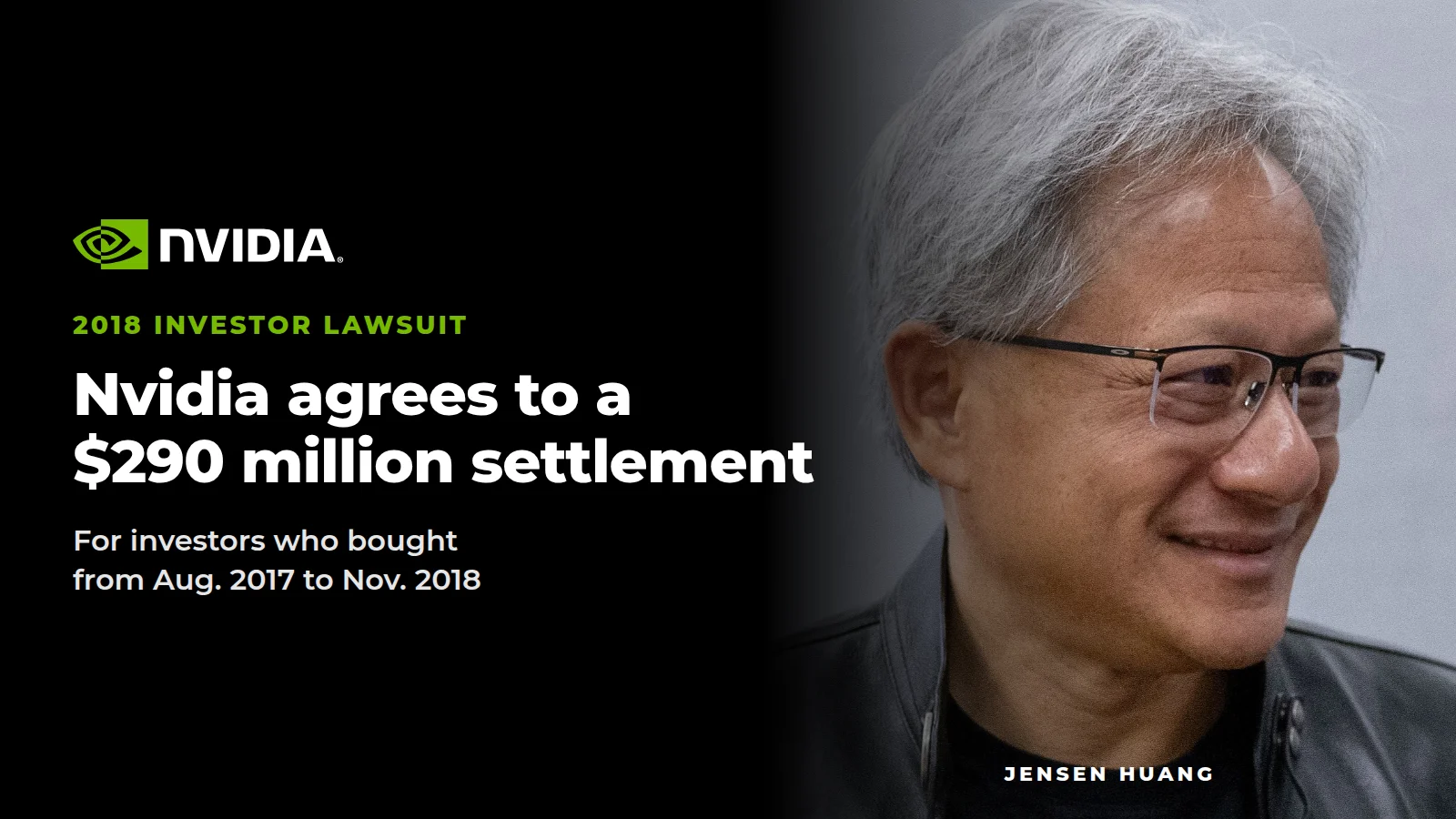
- Nvidia agrees to pay $290 million to settle a 2018 investor lawsuit
- The class covers eligible Nvidia stock buyers from Aug. 2017 to Nov. 2018
- The Nvidia settlement still needs a judge's approval
Nvidia (NVDA) agreed to pay $290 million in cash to settle a shareholder lawsuit that accused the company of misleading investors about how much of its gaming chip sales came from cryptocurrency miners in 2017 and 2018. Lawyers for the investors asked US District Judge Haywood Gilliam Jr. of the Northern District of California to preliminarily approve the deal on Nov. 24, according to the court filing.
The class covers investors who bought or otherwise acquired Nvidia stock between Aug. 10, 2017, and Nov. 15, 2018, with some exclusions, such as the company's officers and directors and their families. The settlement equals about 14% of the class's total claimed damages, according to the filing, which puts those claims at roughly $2.1 billion, by our calculations. If approved, it would be the seventh-largest securities class action settlement in the Northern District of California since a 1995 federal law tightened the rules for such suits, the investors' lawyers wrote.
The lawsuit isn't connected to the current scrutiny of Nvidia and Chief Executive Jensen Huang, and Nvidia denied any wrongdoing in agreeing to settle, Reuters reported. The defendants had "vigorously denied the claims" throughout the case, according to the filing.
The Nvidia lawsuit reached the Supreme Court
The suit was filed in 2018 and named Nvidia, Huang, Colette Kress, who was chief financial officer at the time, and Nvidia executive Jeff Fisher. It accused the company of telling investors that its fast-growing gaming revenue came from gamers rather than from crypto miners. A district court dismissed the case in 2021. The Ninth Circuit revived it in 2023 against Nvidia and Huang, while upholding the dismissal for Kress and Fisher.
Nvidia asked the Supreme Court to step in. The court heard the case but dismissed Nvidia's petition as improvidently granted on Dec. 11, 2024, which let the suit go forward. Gilliam certified the class on March 25, 2026, and the Ninth Circuit declined to hear Nvidia's appeal of that ruling on May 26.
Mediator Layn Phillips, a former federal judge, recommended the $290 million figure, and both sides accepted it on Sept. 24, 2026. They signed the settlement agreement on Nov. 24. The investors' lawyers plan to ask for fees of up to 21.4% of the fund, about $62 million.
A judge still has to approve the Nvidia settlement
Gilliam must first grant preliminary approval, after which class members will be notified and the court will hold a hearing on final approval. Class members who file valid claims would share what's left after legal fees and other costs. None of the money goes back to Nvidia based on how many claims are filed, according to the filing.
The settlement doesn't touch the newer inquiries. California Attorney General Rob Bonta is examining whether Nvidia misled investors about the risk of its chips reaching China, and Huang is scheduled to face Congress on Dec. 1 and Dec. 3.
Nvidia shares were down 8.2% at $142.64 at 11:04 a.m. ET on Nov. 25.