Key points
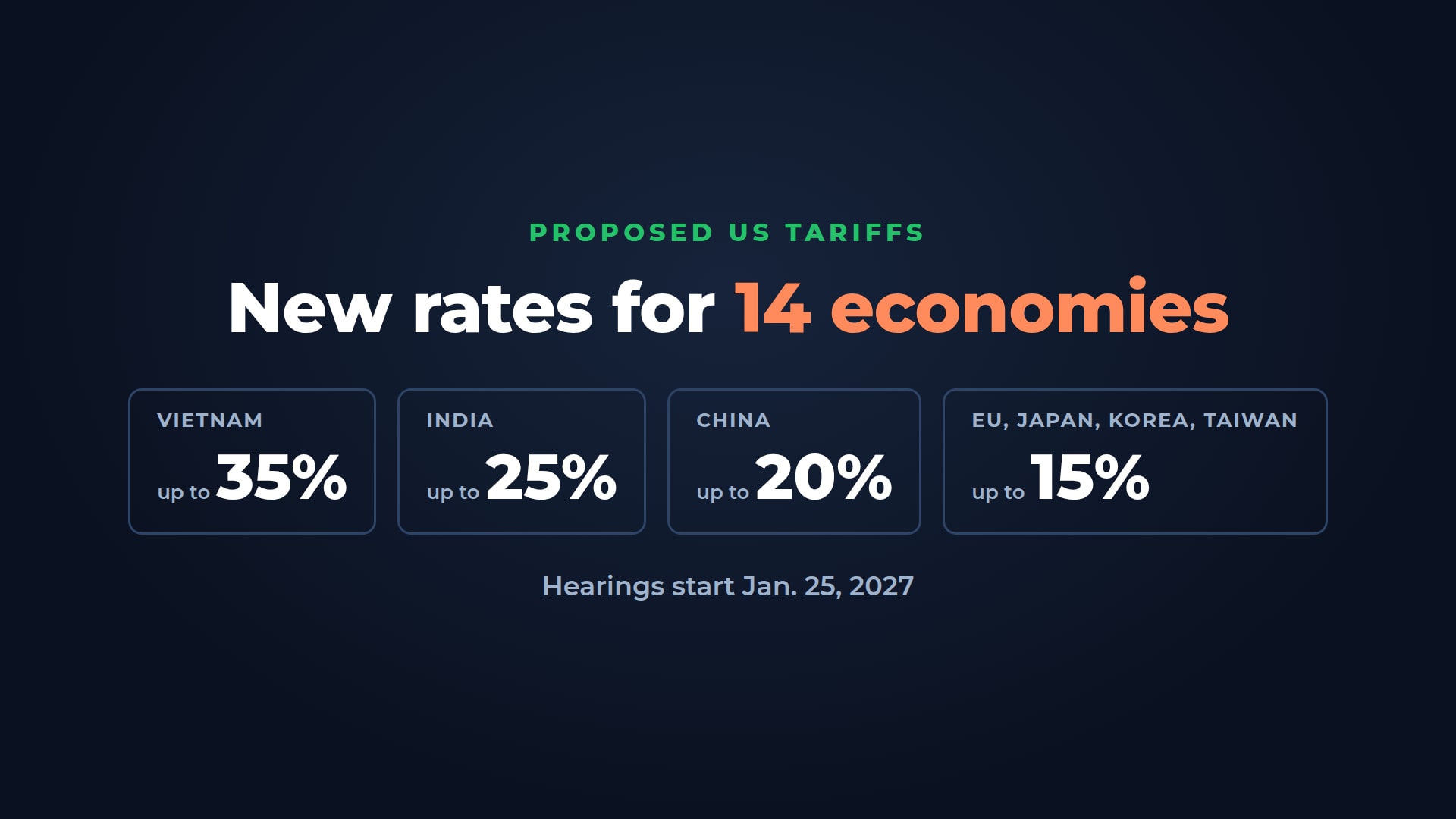
- Vietnam has the highest proposed headline US tariff, up to 35%
- Korea and Taiwan could face up to 25% if the US finds talks unsatisfactory
- Hearings on the new US tariffs start Jan. 25, 2027
The US proposed new tariffs on 14 economies on Nov. 25, after Trade Representative Jamieson Greer found that their policies feed "structural excess capacity" in manufacturing and burden US commerce. The proposals include a 15% rate for the European Union, rates of up to 15% for Japan, South Korea, Switzerland, and Taiwan, and as much as 35% for Vietnam, according to the trade representative's office.
The Federal Register notices for 10 of the 14 economies also set higher fallback rates, of up to 20% or 25%, if the trade representative finds ongoing consultations and commitments unsatisfactory. None of the tariffs takes effect yet. Written comments and requests to testify are due Jan. 5, 2027, and hearings start Jan. 25, 2027. Mexico and Norway were also investigated, but the office hasn't made a decision on either.
The proposed tariff for each economy
| Economy | Proposed tariff | Alternative rate |
|---|---|---|
| Vietnam | Up to 35% | 20% with a trade agreement |
| India | Up to 25% | 17% with a trade agreement |
| China | Up to 20%; up to 10% on goods in one annex | None; goods in another annex exempt |
| Singapore | Up to 20% | 10% with a trade agreement |
| Bangladesh | Up to 18% | Up to 20% if talks unsatisfactory |
| Cambodia | Up to 18% | Up to 25% if talks unsatisfactory |
| Indonesia | Up to 18% | Up to 25% if talks unsatisfactory |
| Malaysia | Up to 18% | Up to 25% if talks unsatisfactory |
| Thailand | Up to 18% | Up to 25% if talks unsatisfactory |
| European Union | 15% | Up to 20% if talks unsatisfactory |
| Japan | Up to 15% | Up to 20% if talks unsatisfactory |
| Switzerland | Up to 15% | Up to 20% if talks unsatisfactory |
| South Korea | Up to 15% | Up to 25% if talks unsatisfactory |
| Taiwan | Up to 15% | Up to 25% if talks unsatisfactory |
| Mexico, Norway | None yet | No determination made |
Source: Office of the US Trade Representative press release and Federal Register notices, Nov. 25, 2026. Every rate has exemptions for certain goods.
How the proposed rates interact with existing tariffs
Most of the proposed rates are "net of" existing Section 301 tariffs, so those duties count toward the new rate instead of being added on top. That includes the tariffs that took effect in July at 10% or 12.5%, depending on whether a country bans imports made with forced labor. US importers would pay the higher of the two rates, not the sum of both, a senior official told reporters, Politico reported.
That doesn't cover every tariff already in place. China's proposed rate is net only of the forced-labor tariff, and it would come on top of the tariffs of roughly 25% imposed during President Donald Trump's first term, keeping China's combined rate the highest of the 14, a senior official said, Reuters reported. China's rate also accounts for the 20% rate announced in the trade truce Trump and Chinese President Xi Jinping reached on Oct. 30, 2025. Goods on the US import list of the new US-China Board of Trade would be exempt.
For the EU, Japan, South Korea, Switzerland, and Taiwan, the proposed rates also include regular import duties, in line with each economy's trade deal with the US. South Korea's tariff was cut to 15% from 25% under its deal with the US last year.
Ten economies face higher fallback rates
The Federal Register notices for the EU, Japan, Switzerland, and Bangladesh propose an alternative rate of up to 20%, and those for South Korea, Taiwan, Cambodia, Indonesia, Malaysia, and Thailand propose up to 25%. Each would apply if the trade representative finds ongoing consultations and commitments unsatisfactory.
Three economies could see lower rates instead. Vietnam's rate would fall to 20% from up to 35%, India's to 17% from up to 25%, and Singapore's to 10% from up to 20% if each reaches a trade agreement with the US that responds to the findings.