Key points
- Rigetti's third-quarter revenue fell 28% to $1.4 million
- Rigetti needs about $9 million in Q4 to reach its forecast
- Rigetti's small net loss came from a warrant gain
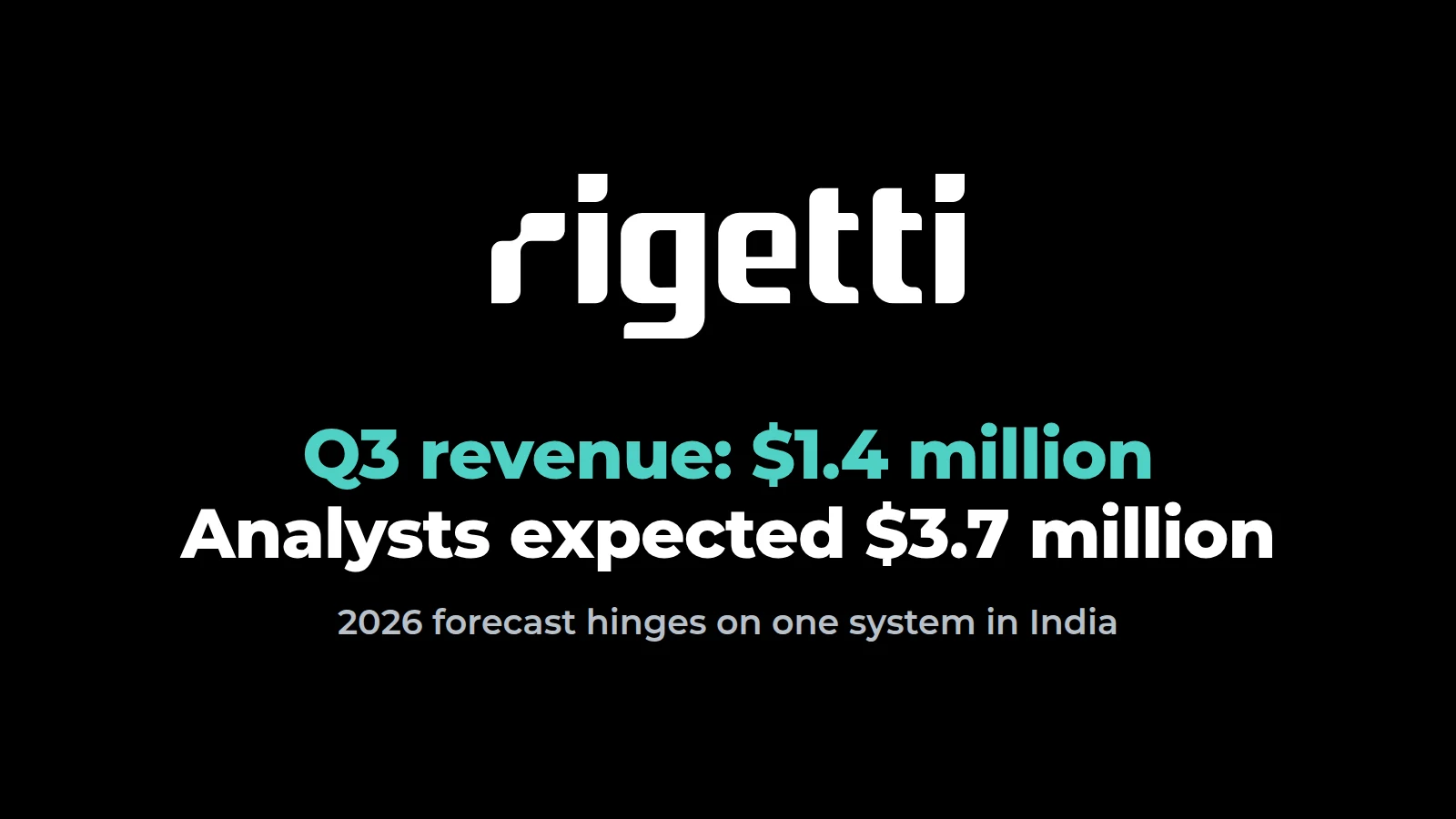
Rigetti Computing (RGTI) reported third-quarter revenue of $1.4 million on Tuesday, down 28% from $1.9 million a year earlier and well below the $3.7 million analysts expected, according to Investing.com. The company still expects about $20 million of revenue for 2026, but that forecast assumes a customer in India formally accepts a Rigetti system in the fourth quarter.
Rigetti shares closed at $12.15 on Tuesday, down 6.4%, before the report. They were at $11.58 in after-hours trading as of 9:32 p.m. ET, down another 4.7%.
The forecast leaves about $9 million for the fourth quarter
Revenue for the first nine months was $10.9 million, up from $5.2 million a year earlier, according to Rigetti's earnings release. Reaching $20 million would take about $9 million in the fourth quarter, more than six times the third quarter's total. Analysts had expected $22.9 million for the full year, Investing.com reported.
The customer is C-DAC, the Centre for Development of Advanced Computing, which chief executive Subodh Kulkarni called India's national lab on the conference call. The release says the forecast includes "the expected customer acceptance of the C-DAC system and associated revenue recognition in the fourth quarter of 2026."
Chief financial officer Jeff Bertelsen said the drop from a year earlier reflected "the timing of system deliveries, customer acceptance milestones, and government-funded development programs." Quarterly revenue can vary a lot because it is tied to a small number of system deliveries and contracts, he said.
A warrant gain shrank the net loss
Rigetti's operating loss widened to $33.2 million from $20.5 million a year earlier. Research and development spending rose to $25.5 million from $15.0 million.
The net loss was only $3.1 million because Rigetti booked a $25.3 million gain on its warrant liabilities. Those liabilities are carried at fair value, and Rigetti records a gain when they fall in value. Excluding stock compensation and fair-value changes in warrant and earn-out liabilities, the adjusted loss was $20.5 million, or 6 cents a share. Before its second-quarter report in August, we noted that Rigetti's last profit came from a warrant revaluation.
Rigetti ended September with $497.1 million in cash and investments and no debt, down from $541.3 million at the end of June.
Rigetti says quantum computing is still mostly research
Asked about the sales pipeline, Kulkarni said quantum computing "still is very much in R&D phase." He said no quantum company can yet show data center managers a return on investment over classical computers, and that commercial sales won't take off until one can. "We believe we are roughly about three years from that point."
The company's 108-qubit Cepheus-1-108Q system reached 99.5% median two-qubit gate fidelity, a goal Rigetti had set. Two-qubit gate fidelity is a measure of how accurately an operation between two qubits is performed, and the 99.5% figure is a median across the system. Rigetti now targets a system with more than 300 qubits by mid-2028 and one with about 1,000 qubits in roughly three years.
In September, Rigetti signed a deal for up to $100 million in Commerce Department funding. The department received about 7.7 million Rigetti shares in return, Bertelsen said. We covered the government's stakes in Rigetti and two other quantum companies in early September. Our quantum stocks comparison shows how Rigetti stacks up against IonQ (IONQ) and D-Wave (QBTS).