Key points
- SoftBank posts a $7 billion quarterly loss
- Why SoftBank booked a $3.7 billion equipment-related loss
- SoftBank's CFO answers Elon Musk's turbine claim
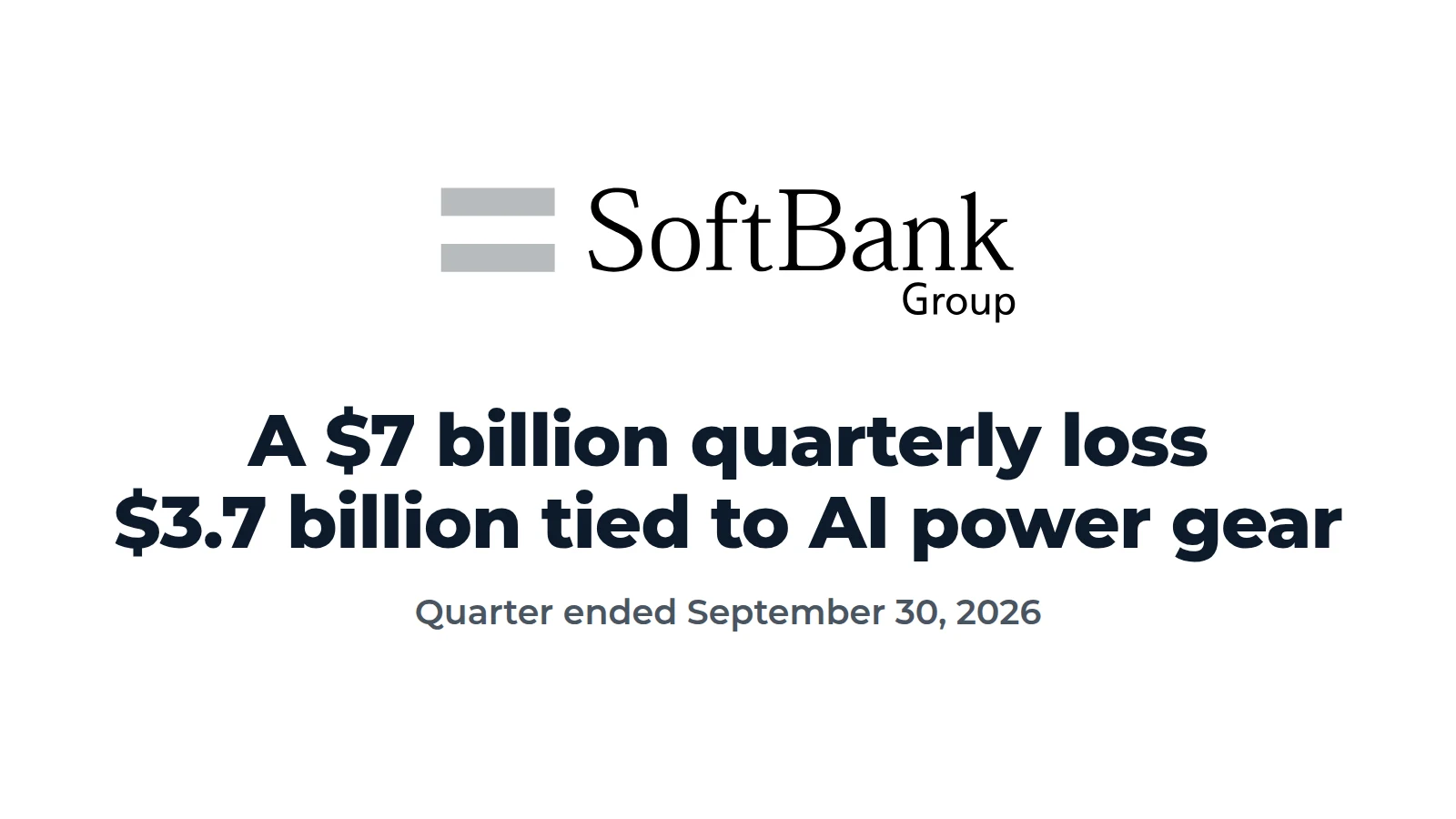
SoftBank Group (SFTBY) reported a net loss of 1.12 trillion yen, or about $7.0 billion, for the July-to-September quarter on Tuesday. A year earlier, it earned 2.5 trillion yen. Revenue came to 2.22 trillion yen, above the 2.02 trillion yen analysts expected, according to LSEG estimates cited by CNBC.
The quarter included a 597.2 billion yen loss, about $3.73 billion, tied to power equipment SoftBank had lined up for AI data centers in the US, according to its financial report. SoftBank's earnings presentation puts the whole charge in the July-to-September quarter.
SoftBank's Tokyo shares closed up 13.9% at 3,872 yen on Tuesday. The results came out at 3:30 p.m. Tokyo time, when the market closes. The shares had fallen 44.8% between Sept. 30 and Nov. 6.
What did SoftBank pay for, and what did it lose?
A SoftBank unit called Silver Bands 7 paid 1.50 trillion yen, or $9.48 billion, over the 18 months through September. The money reserved factory capacity and bought power generation equipment for AI data centers in the US, including the PORTS-Pike Technology Campus in Pike County, Ohio. SoftBank Group and its second Vision Fund have both invested in Silver Bands 7, and SoftBank says the unit is separate from SB Energy.
Then the plan changed. "SB7 revised its equipment procurement strategy given the evolving requirements of its existing and planned projects," the report says.
The loss has two parts. About 457.0 billion yen, or $2.85 billion, is advance payments SoftBank can't get back. Another 140.2 billion yen, or $0.88 billion, covers changes to contracts and settlements with suppliers. Add the two, and you get the 597.2 billion yen total.
SoftBank's earnings presentation rounds those figures. Take its $2.9 billion of lost advance payments out of the $9.5 billion paid, and $6.6 billion is left. The presentation says that money is still assigned to PORTS-Pike and other projects. SoftBank can also earn rebates of up to $2.1 billion on future equipment purchases over the next 10 years, if certain conditions are met. It didn't count those rebates as an asset, and it didn't name the equipment makers.
Did SoftBank default on turbine orders?
Elon Musk wrote on X on Nov. 6 that "SoftBank is defaulting on their turbine orders." He didn't name a supplier.
At Tuesday's briefing, a Bloomberg reporter asked Chief Financial Officer Yoshimitsu Goto about the post. "This is simply not correct at all. There is no such default," Goto said, according to an English transcript of the briefing published by Investing.com.
Goto said SoftBank isn't discussing downsizing PORTS-Pike. He said the loss covers reservation fees that "will not be coming back," plus the cost of revising contracts.
PORTS-Pike is the Ohio campus where OpenAI has a 20-year lease and Nvidia (NVDA) agreed to provide credit support for 4.25 gigawatts of it. SoftBank said it paid early because it expected shortages. New gas turbines in the US can take about six years to deliver, according to Wood Mackenzie.
What else hit SoftBank's results?
In August, SoftBank raised $7.4 billion through prepaid forward contracts backed by its Intel (INTC) shares. In that kind of deal, SoftBank gets cash up front and settles later with Intel shares or their value. Intel's stock rose after the contracts were signed, which led to a 321.9 billion yen derivative loss. SoftBank also booked a 270.1 billion yen loss on the value of its Intel stake for the quarter.
At the end of September, SoftBank had invested $54.6 billion in OpenAI, and the stake had a fair value of $99.6 billion. It put in another $10 billion in October, completing a $30.0 billion follow-on commitment. SoftBank hasn't yet counted OpenAI's new funding round, which reportedly values the company at $1.25 trillion. Goto said the new value will likely show up in the October-to-December quarter, once OpenAI makes an official announcement.
Dollar figures for the 597.2 billion yen charge and its two parts are SoftBank's own conversions, at its average rate for the July-to-September quarter of 160.12 yen per dollar. The $7.0 billion figure for the quarterly loss and the rounded $9.5 billion, $2.9 billion, and $6.6 billion figures are from SoftBank's earnings presentation.