Key points
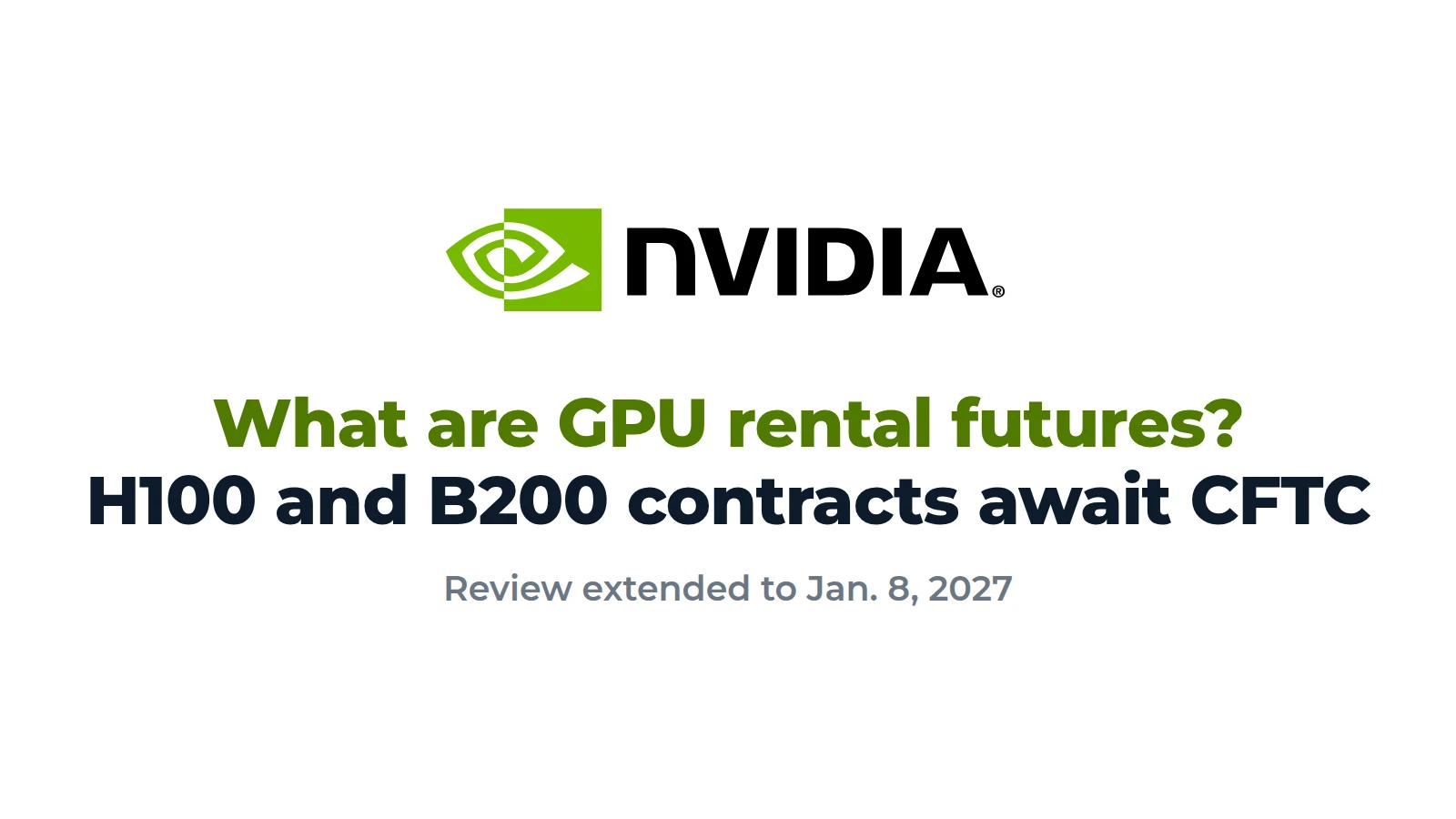
- CME's NYMEX filed futures on Nvidia H100 and B200 rental prices
- The CFTC's review of the NYMEX contracts is extended to Jan. 8, 2027, subject to conditions
- The CFTC flagged manipulation risk in compute markets
The US regulator reviewing futures contracts tied to the cost of renting Nvidia (NVDA) AI chips has more time to decide whether to approve them. NYMEX, an exchange owned by CME Group (CME), agreed to extend the Commodity Futures Trading Commission's review to Jan. 8, 2027, subject to conditions, according to a Nov. 4 letter.
The Financial Times reported the delay on Tuesday, saying the regulator had raised concerns about price manipulation. NYMEX sought approval for the contracts on Aug. 11 and had planned to start trading on Oct. 5. Nvidia isn't a party to the filing.
A GPU rental future tracks an hourly chip price
The two contracts would track the US hourly rental prices of Nvidia's H100 and B200 GPUs, chips used to train and run AI models. Many AI companies rent those chips from cloud providers instead of buying them.
A futures contract lets traders take a position on a future index price. A GPU renter could use one to offset some of the cost if rental prices rise, though its actual rental price may move differently from the index.
The contracts would follow the Silicon Data H100 Rental Index and the Silicon Data B200 Rental Index. The H100 is from Nvidia's Hopper generation; the B200 is from its newer Blackwell line.
Each contract covers 730 GPU-hours, or about one chip running for a month. A one-cent move in the price per GPU-hour is worth $7.30 per contract. No chips change hands: the contracts settle in cash against the average of the index's daily prices for the month. NYMEX planned to list 36 consecutive months.
For a sense of scale, Nebius (NBIS) raised its pay-as-you-go price on Oct. 1 to $4.50 per H100 GPU-hour and $8.50 per B200 GPU-hour. At those rates, 730 hours would cost about $3,285 for an H100 and $6,205 for a B200. Those are one provider's list prices, not the index levels, which Silicon Data distributes to paying clients and through Bloomberg and Refinitiv.
The CFTC extended its review twice
NYMEX asked for formal approval rather than certifying the contracts itself, which starts a 45-day review. On Sept. 21, the CFTC's Division of Market Oversight added another 45 days, citing "the need for additional time to analyze the Products in light of novel or complex issues." That set a Nov. 9 deadline.
On Nov. 4, NYMEX agreed at the CFTC's request to 60 more days. NYMEX made its consent conditional on other CFTC registrants not self-certifying, winning approval for, or listing comparable contracts during the extension. If one of those events occurs, or if the CFTC agrees to a shorter review, the letter says "such earlier date shall control."
The CFTC questioned how compute is priced
In August, the CFTC asked the public how exchanges should handle these contracts, in a request for comment that closed Oct. 20. The agency said compute markets "are fragmented and price formation primarily occurs in opaque bilateral transactions." It also said "dominant market participants may wield significant pricing power that may lead to manipulability."
The CFTC said compute may not yet have the fungibility, standardization, and liquidity of commodities that usually back futures markets. One of its questions asked whether a contract should be allowed to settle on a price built from data the agency "may not be able to observe, verify, or surveil."
NYMEX took the opposite view in its filing. It said the indexes are "sufficiently broad in definition and scope and supported by a robust level of trading in the underlying cash market" to resist manipulation. The market data behind that claim was filed confidentially.
Rental prices drive AI cloud revenue
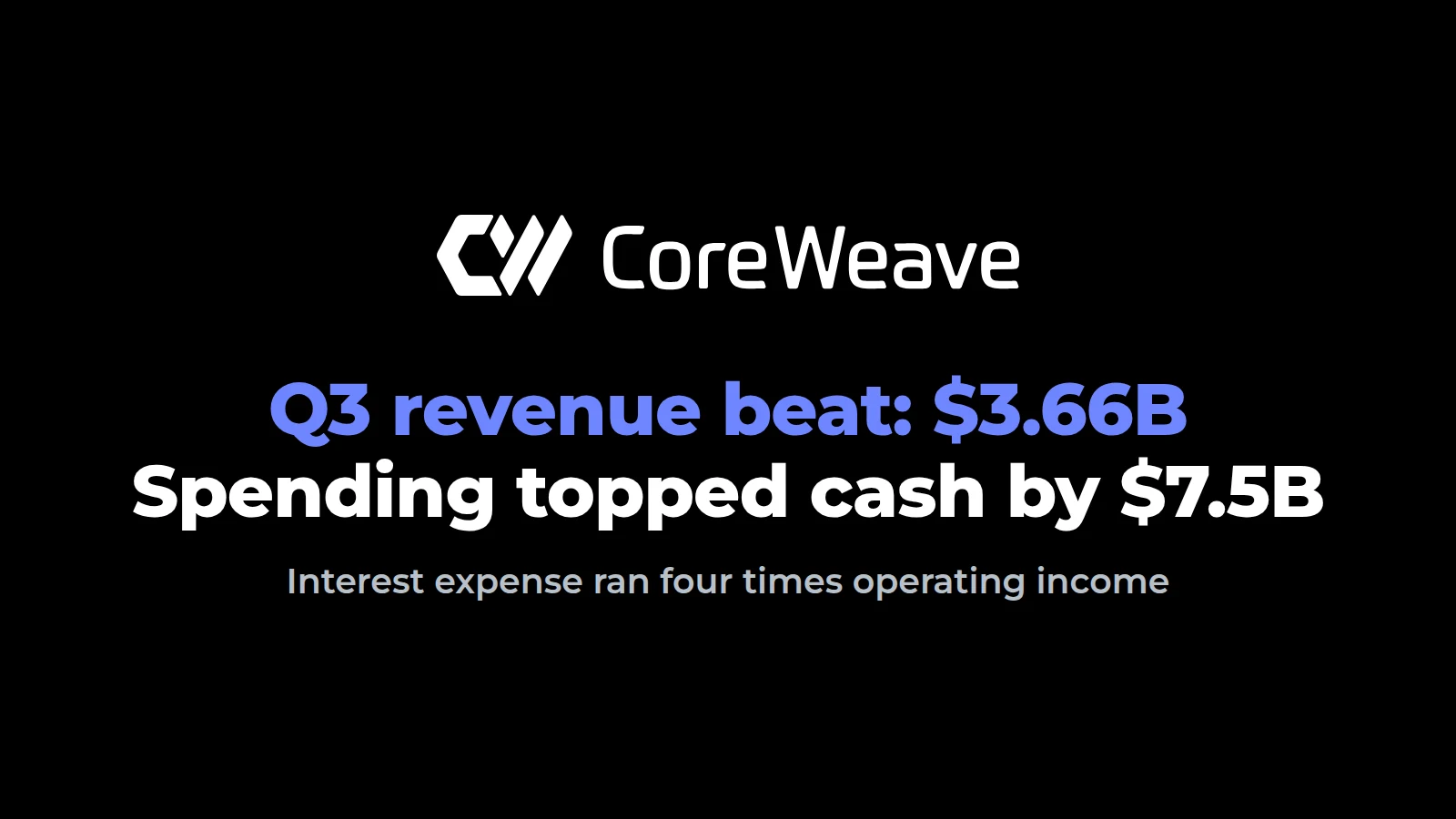
AI cloud companies such as CoreWeave (CRWV) and Nebius make their money renting out GPUs. CoreWeave reported on Tuesday that its equipment spending topped its operating cash by $7.5 billion in the third quarter. Our AI compute commitments tracker counts $1.57 trillion of signed compute deals at face value.
A paper by Federico M. Bandi and Yinan Su, cited in the CFTC's request, estimated that the AI computing hardware installed by the end of 2025 implies a gross flow of compute services worth about $430 billion to $1.3 trillion a year. That figure is the authors' estimate, not reported revenue.