Key points
- CoreWeave rules out new unsecured bonds through 2027 at current yields
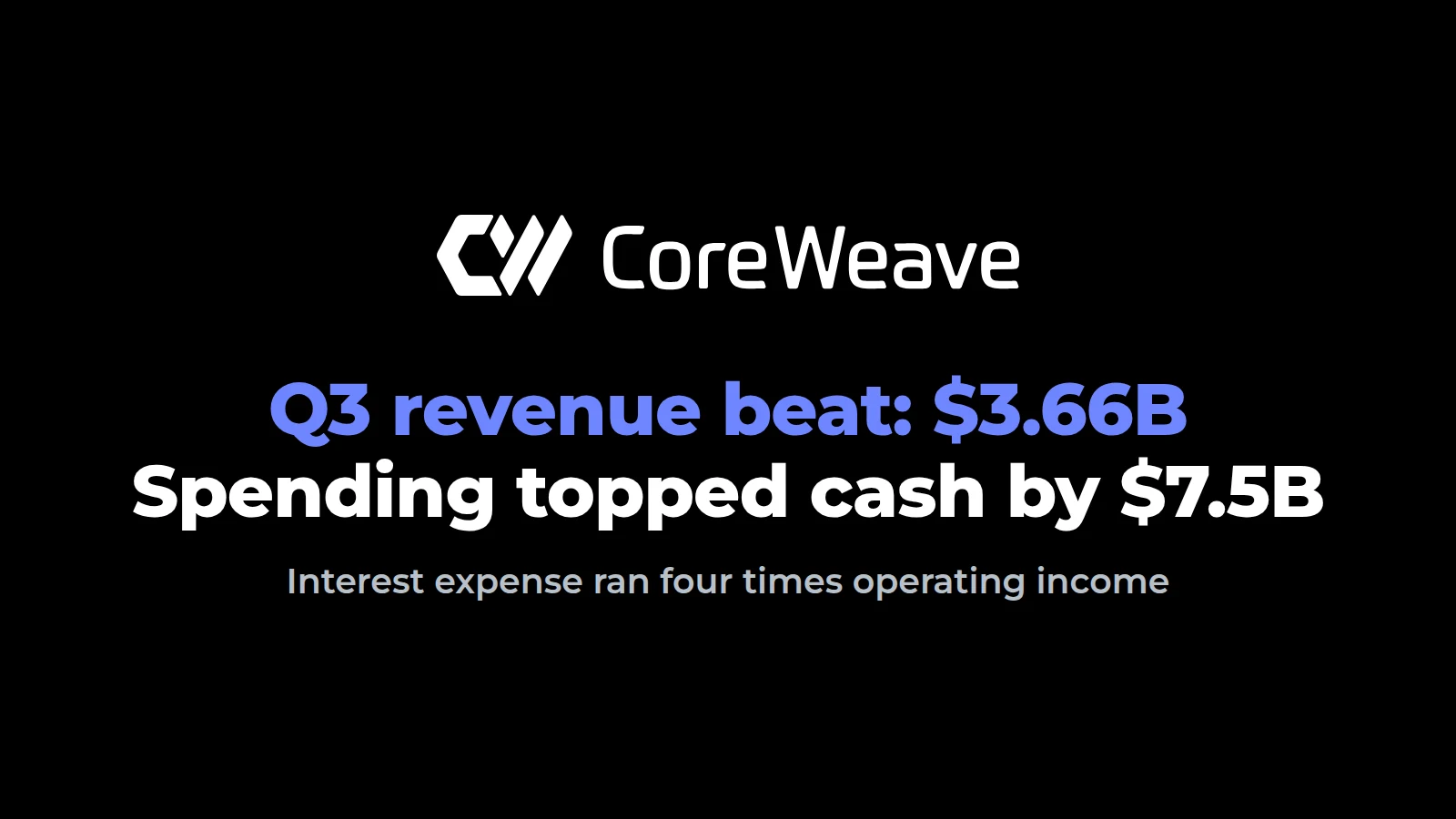
- CoreWeave's equipment spending topped its operating cash by $7.5 billion
- CoreWeave's interest bill was four times its operating income
CoreWeave (CRWV) reported third-quarter revenue of $3.66 billion on Tuesday, up 168% from a year earlier and above the $3.55 billion analysts expected, according to LSEG data cited by CNBC. That was also above the top of CoreWeave's own $3.45 billion to $3.60 billion forecast. The company raised its 2026 revenue forecast to $13.0 billion to $13.3 billion, from $12.4 billion to $13.2 billion in August, and lifted its adjusted operating income forecast to $1.275 billion to $1.375 billion.
The same earnings release shows what that growth costs. CoreWeave's operations brought in $1.98 billion of cash in the quarter, and the company spent $9.44 billion on equipment. That leaves a gap of about $7.5 billion, up from about $1.6 billion a year earlier. CoreWeave doesn't report free cash flow, so that's our subtraction from its cash flow statement.
The net loss widened to $709 million, or $1.27 a share, from $110 million a year earlier. CoreWeave shares ended regular trading at $48.73, down 0.5%, before the report. In after-hours trading, they moved between about $47 and $50 and were at $49.41 as of 5:35 p.m. ET.
How much is CoreWeave spending for each dollar of revenue?
It depends on which capex number you use, and CoreWeave's investor presentation uses the bigger one. The deck puts third-quarter capital expenditures at $14.5 billion. That figure counts equipment added during the quarter, including gear CoreWeave acquired under finance leases, and leaves out construction still in progress. Against $3.66 billion of revenue, that's nearly $4 of capex for every $1 of sales.
The cash version is smaller. The $9.44 billion that actually left the bank for equipment works out to $2.58 per dollar of revenue. Either way, the company is building far faster than it's billing, and the deck says that's on purpose: "$14.5 billion as we execute ahead of schedule."
CoreWeave raised the low end of its full-year capex range to $37 billion, keeping the top at $39 billion, because it now expects to deliver infrastructure to customers sooner than planned. Through nine months, operating cash flow was $5.64 billion and cash spent on equipment was $23.56 billion.
What does the debt cost now?
Interest expense was $846 million in the third quarter, almost triple the $310 million a year earlier and about four times operating income of $207 million. That was below the $860 million to $940 million CoreWeave had forecast in August. CoreWeave expects fourth-quarter interest of $1.05 billion to $1.15 billion.
The balance sheet shows why. Debt reached $46.9 billion on Sept. 30, up from $21.4 billion at the end of 2025. Add $19.3 billion of lease liabilities, and the total is about $66.2 billion.
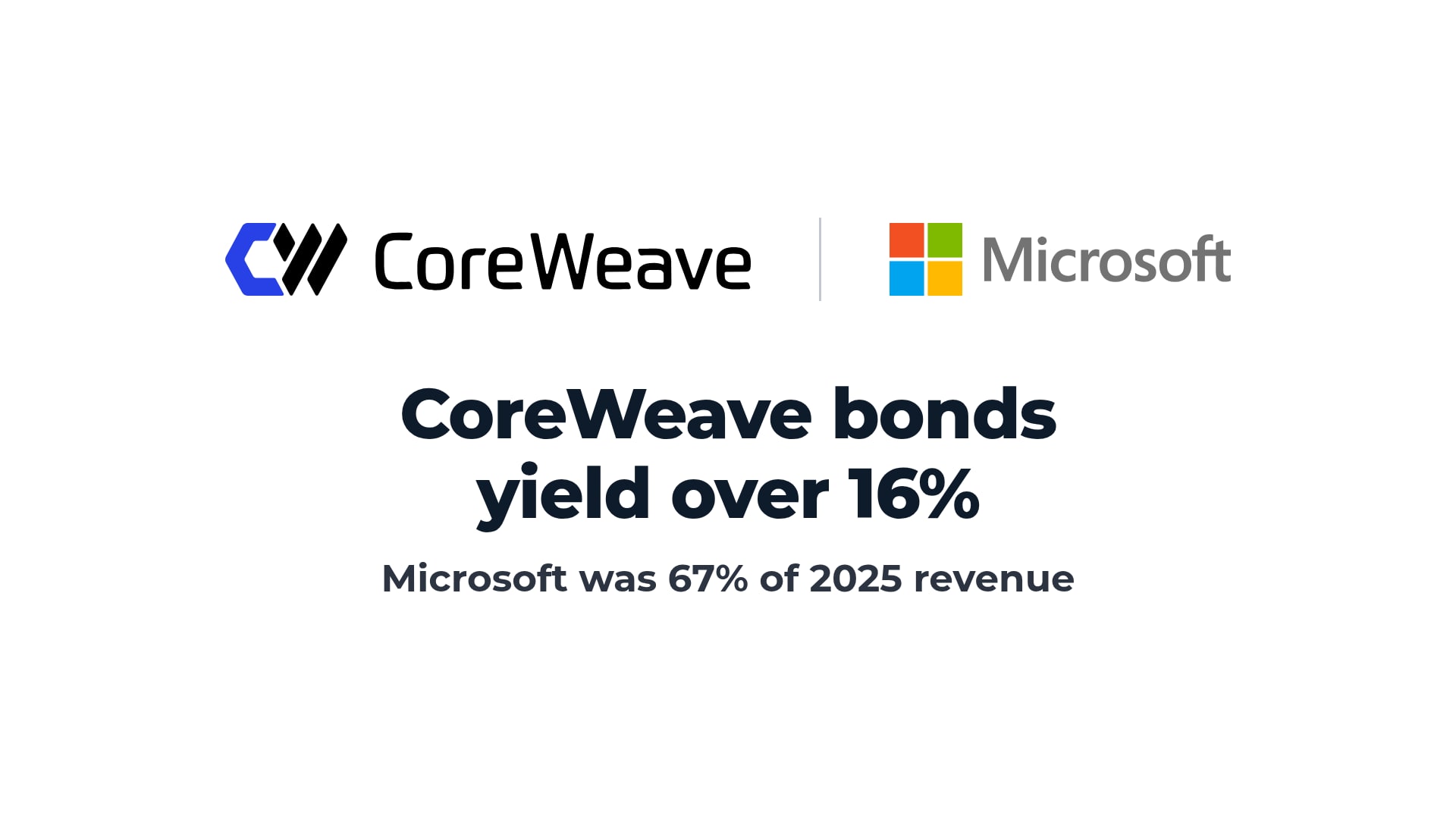
The bond market is charging for it. CoreWeave's 9.25% notes due 2030 traded at about 84 cents on the dollar in the Nov. 9 holdings of the SPDR high-yield bond fund, a yield of 15.2%, according to our AI debt tracker. We wrote last week about CoreWeave bond yields topping 16%.
Chief financial officer Nitin Agrawal said on the call that CoreWeave plans to raise new debt tied to a set of customer contracts in the coming weeks. "At current yields, we do not intend to issue additional parent-level unsecured debt through 2027," he said. He added that the company's secured, asset-level loans have been trading around face value, CNBC reported.
Where is the next round of money coming from?
Mostly from customers and suppliers. Chief executive Michael Intrator said in the release that the company has "approximately $9 billion in customer prepayments and deposits expected in the next three months alone." On the conference call, he told analysts that most of the capital needed for 2027 would come from customer prepayments and financing from hardware partners, with the company raising "a limited amount" itself, CNBC reported.
Deferred revenue also contributed to operating cash flow this quarter. Deferred revenue counts amounts customers have paid or been billed for service CoreWeave hasn't delivered yet, and it rose by $2.13 billion. Subtract that contribution from the reported $1.98 billion in operating cash flow, and the total would have been about $150 million negative.
The quarter also brought fresh borrowing. CoreWeave raised $10.3 billion of debt, including about $4.2 billion from convertible notes sold in September, and repaid $2.34 billion. The convertible deal, upsized from $3 billion, also came with a program to sell up to 35 million new shares. CoreWeave also closed a $2.6 billion loan facility meant for shorter customer contracts.
What's in the backlog?
Revenue backlog, the contracted business CoreWeave hasn't delivered yet, rose to about $132.5 billion from $104.2 billion at the end of June. Active power passed 1.7 gigawatts after the company added more than 200 megawatts, and contracted power grew to more than 4.6 gigawatts. Our backlog explainer covers what that number does and doesn't promise.
CoreWeave still expects more than 1.85 gigawatts of active power at year-end and annualized run-rate revenue of $20 billion to $21 billion as it exits 2026.