Key points
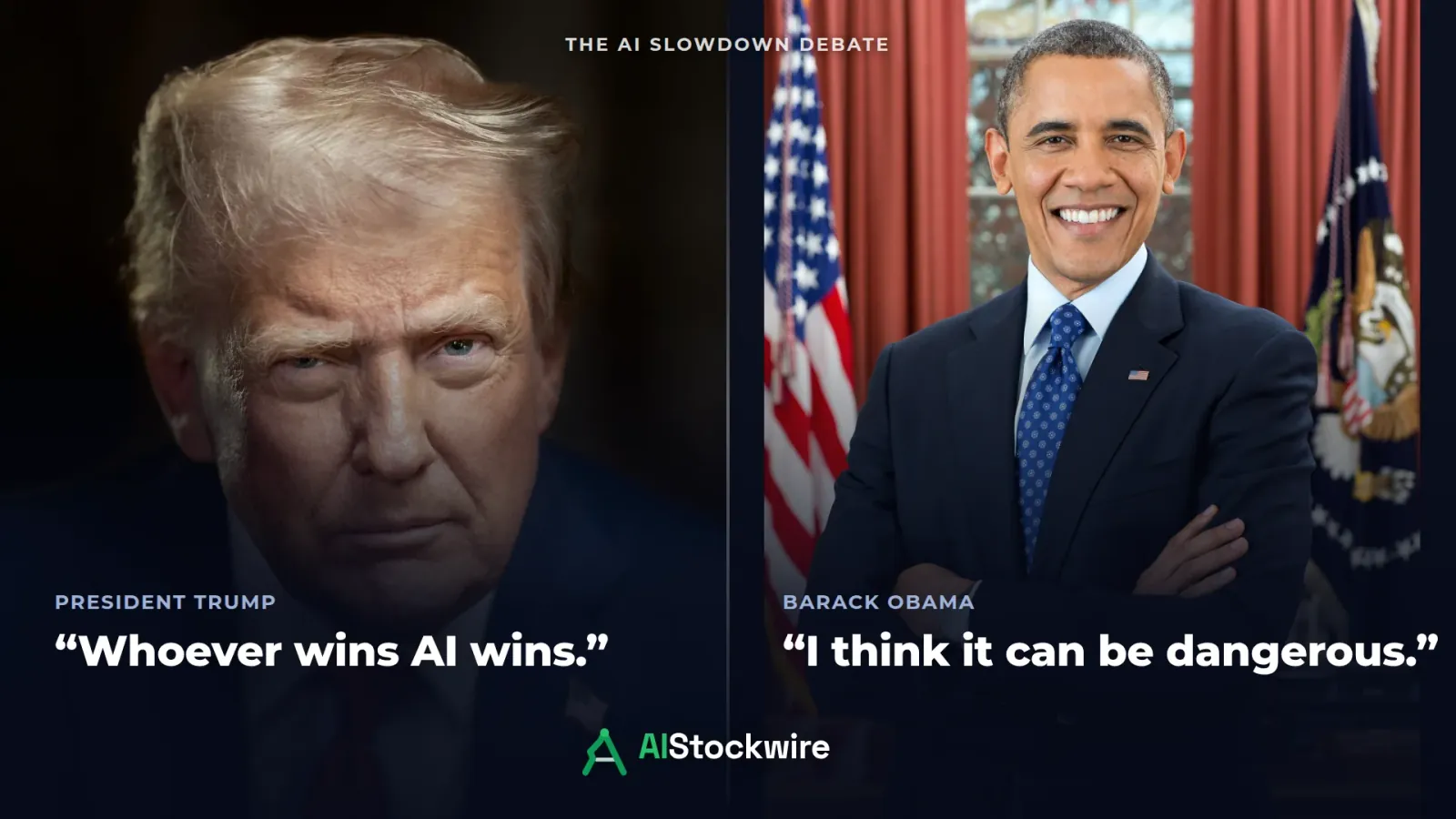
- Trump: "whoever wins AI wins"
- Speaker Johnson wants a meeting before any bill
- Hassett calls Amodei's essay a private-sector road map
- Obama tells Democrats to build a framework
President Donald Trump played down calls to slow AI development on Sunday, telling reporters in Ireland that "whoever wins AI wins." He said guardrails were possible, then said "a lot of negative forces" were "bringing up things that won't happen." The calls came from Dario Amodei of Anthropic, who asked on Saturday for slower capability gains, and from Sam Altman of OpenAI and Elon Musk of xAI, who endorsed his message afterward.
The same day, House Speaker Mike Johnson said Congress would not rush a bill and proposed putting the AI companies in one room instead, and White House economic adviser Kevin Hassett described Amodei's essay as a road map for the private sector. Former President Barack Obama, in remarks reported by The New York Times, urged Democrats to draw up their own plan. Trump spoke at his golf resort in Doonbeg, The Associated Press reported, Johnson on NBC's "Meet the Press," and Hassett on "Fox News Sunday."
What the White House said
Trump was responding to Amodei's essay of Saturday, which asked frontier labs to slow the rate at which models gain capability and which Altman and Musk both endorsed within hours. "We're leading China in AI. We're the most sophisticated country in the world, and frankly, I want to keep it that way, because whoever wins AI wins," Trump said. On rules: "We can put guardrails. We can do this and that. But I think you have a lot of negative forces that are bringing it up that shouldn't be bringing it up, and they're bringing up things that won't happen."
Hassett, who directs the National Economic Council, described Amodei's essay as a road map for private-sector action. "If you look at Dario's letter, it really presents a road map for the private sector to get ahead of the curve on this," he said, and added that Amodei is "also calling for sort of independent observers to come into the AI companies" to verify that they are safe. He said the president's team is studying the matter and called the private sector's movement a good step forward.
Where Congress stands
Johnson said guardrails are needed and that Congress will not write them quickly. "We have to put some guardrails, some safety measures in place to ensure that AI doesn't run away," he said, followed by: "We've got to make sure that we don't lose our edge in the global competition on this with China. Because that would be a national security threat." Asked whether unregulated AI is a threat to humanity, he said "we're not going to rush in and pass a piece of legislation that would do harm."
Johnson's alternative is a meeting. "All of them say that we need some guardrails. But they all have very different ideas on what that looks like," Johnson said of the AI companies. "I believe we need to summon the platform providers all to one big meeting and work this out together." He also said the companies "have a corporate responsibility to be safe in the product that they are producing." House Democrats had asked Johnson to cancel the chamber's recess to pass AI safeguards, CNN reported on September 11.
On the same program, former Transportation Secretary Pete Buttigieg said Congress should act now. "You know what's moving quickly? AI is moving quickly. And for Congress to just sit on its hands... is something that is deeply dangerous," he said. "There need to be safeguards. There need to be rules. There need to be limits. There needs to be a kill switch on rogue AI."
Obama's message to Democrats
Obama made his comments at a private fundraising event on Thursday, and Reuters, citing The New York Times, reported them on Sunday. The Times account was based on a partial transcript from his office. "This is something that is moving very fast in private hands, and if we don't get on top of it, I think it can be dangerous," he said. He told House Minority Leader Hakeem Jeffries what he wants if Democrats retake the House in the November 3 midterms, and said candidates in the 2028 presidential race should make AI one of their central agendas with a clear plan for the safety and economic concerns around it.
The remarks follow a week in which Anthropic's alignment lead put the odds of AI killing everyone above 10% and OpenAI asked Congress for mandatory national safety rules. "Once you are speaker, I would strongly urge that the Democrats put together a framework for a very public conversation," Obama told Jeffries.