Key points
- What AST SpaceMobile's Blacklift rocket is
- How AST pays Firefly for engines and a license
- Why AST SpaceMobile wants its own launches
- Firefly's Miranda engine still hasn't flown
AST SpaceMobile (ASTS) said on November 6 that it will build its own reusable rocket, named Blacklift, to carry its BlueBird satellites into orbit starting in late 2028. The company signed a deal with Firefly Aerospace (FLY) worth more than $1.3 billion for rocket engines, a license to manufacture them, and three years of engineering support.
Firefly shares rose 13.3% to $17.19 in premarket trading at 8:51 a.m. Eastern on November 6, while AST shares rose 2.1% to $30.82 at 8:52 a.m.
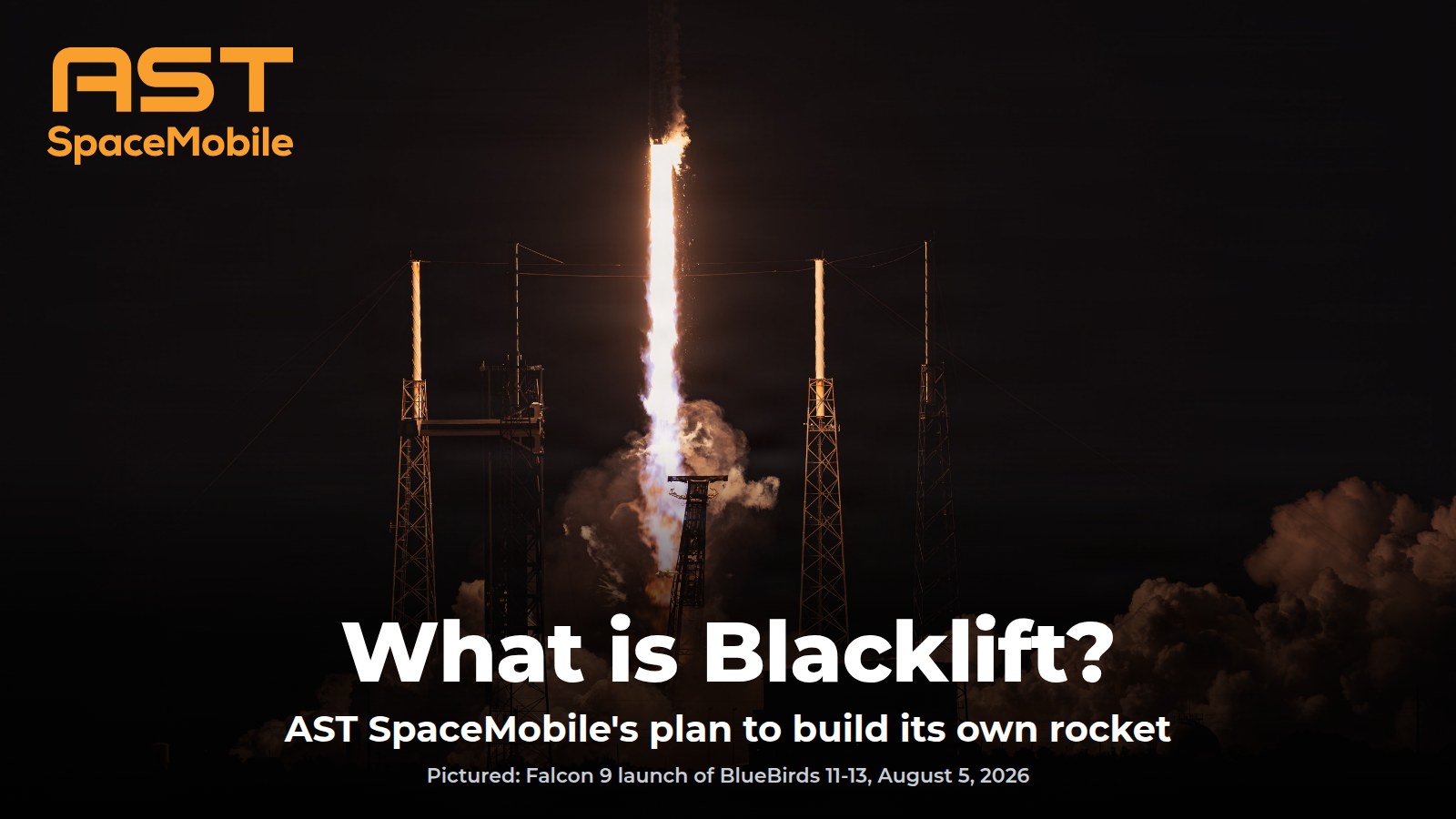
What is Blacklift?
Blacklift is the rocket AST says it will custom-build, designed for reusability. A reusable rocket is built so that some of its hardware can return and fly again instead of being discarded.
AST calls Blacklift a 20-ton rocket, but its release doesn't define the figure. It doesn't say whether the 20 tons is payload capacity, which orbit the number applies to, or whether it assumes the rocket is reused. Firefly's release calls Blacklift a heavy-lift rocket and gives no tonnage.
AST says Blacklift will carry up to five BlueBird satellites per launch. The company's June and August missions carried three each. BlueBird 6 weighed about 6,100 kilograms, so five satellites of that size would total about 30,500 kilograms, by our calculations. The release gives no weight for the satellites Blacklift would carry.
AST's release gives no development budget or launch site, and it doesn't say which parts of Blacklift would be reused or how they would return.
Firefly says it will deliver 27 Miranda engines and nine Vira engines, a vacuum version, for AST's first three rockets. Split evenly, that would be nine Miranda and three Vira engines per rocket, but the companies haven't published a final configuration for each. AST plans to unveil Blacklift at an event in New York City on November 12 and will webcast it on its investor website.
What AST will pay Firefly
The payments fall under two agreements, a license agreement and a supply and services agreement.
| What AST gets | Price |
|---|---|
| Perpetual license to make Miranda and Vira engines | About $800 million upfront: $400 million in cash, plus 10 million to 14 million Class A shares |
| Engines for the first three rockets | $250 million |
| Engineering support over three years | $250 million |
| Total | More than $1.3 billion |
The stock portion isn't fixed yet. The release gives a range of shares but no dollar value for them. The share count depends on a forward VWAP calculation. VWAP stands for volume-weighted average price, the average price of a stock weighted by how many shares traded at each level. AST hasn't disclosed the measuring period.
AST says the upfront total of approximately $800 million is made up of the $400 million in cash and the shares. That leaves an estimated $400 million for the shares, by our calculations, since the total is approximate. At that value, 14 million shares implies about $28.57 each, and 10 million implies $40. AST closed at $30.20 on November 5. Firefly says the shares carry various lock-up periods.
Firefly's market value was about $2.54 billion at the November 5 close. The deal is worth more than $1.3 billion and covers work Firefly still has to do. About $800 million is described as upfront, with roughly half in stock subject to lock-ups. Another $250 million is for engine deliveries, and $250 million is for engineering support over three years. The companies haven't disclosed the engine payment schedule or what the work will cost Firefly.
Firefly keeps ownership of its engine intellectual property and will continue to serve other government and commercial launch customers. AST plans to make the engines at a new US plant, and it hasn't named the location. Firefly says the money will go toward hiring, long-lead materials, and new test bays in Briggs, Texas, to increase its own rocket production.
Jason Kim, Firefly's CEO, said, "When a company sets out to build its own rocket, the engine is the hardest, highest-stakes decision they make."
AST reported more than $3.7 billion in pro forma cash as of June 30, after a July convertible note sale. It also said on August 10 that it expected 2026 revenue of $150 million to $200 million.
Why AST wants its own rocket
On March 2, AST's goal was 45 to 60 satellites in orbit by the end of 2026, with launches every one to two months on average. In April, a New Glenn rocket from Blue Origin left BlueBird 7 in a lower-than-planned orbit. The satellite couldn't sustain operations at that altitude, and AST expected insurance to recover its cost.
AST's next two missions flew on Falcon 9 rockets from SpaceX (SPCX), on June 17 and August 5. SpaceX also has its own satellite-to-phone service, Starlink Direct to Cell. AST said on August 10 that it had 13 spacecraft in orbit.
In a July 15 SEC filing, AST moved its target for 45 satellites to early 2027. The filing said money from the capital raise could fund "partnerships and/or acquisitions to further vertically integrate its business and mitigate risks associated with third-party launch providers." AST said at the time that nothing specific was signed.
Abel Avellan, AST's founder, chairman, and CEO, said on November 6 that Blacklift provides "regular unconstrained access to orbit."
AST will keep using outside launch companies. It says its agreements now cover more than 100 BlueBird satellites to be deployed cumulatively in 2027 and 2028.
How Blacklift's schedule compares
AST president Scott Wisniewski said, "The Miranda engine will allow us to leapfrog the traditional five-to-ten-year development cycle as we build Blacklift."
| Rocket | Developer | Stated payload to low Earth orbit | First launch target |
|---|---|---|---|
| Blacklift | AST SpaceMobile | Not stated; AST calls it a 20-ton rocket | Late 2028 |
| Eclipse | Firefly, Northrop Grumman | 16,300 kg | No earlier than 2027 |
| Neutron | Rocket Lab | 13,000 kg | 2027, after an original 2024 target |
Miranda hasn't flown on a rocket yet. Eclipse, a rocket that uses it, is designed with seven Miranda engines and one Vira engine. Firefly says Miranda has completed more than 175 hot fire tests totaling over 4,200 seconds, including a flight-like test at 110% of its 230,000 pounds of thrust. Firefly also says Miranda and Vira use flight-proven technology scaled from its Reaver and Lightning engines.
Firefly said in August that its next two launches of its smaller Alpha rocket were expected in the fourth quarter of 2026.
What comes next
AST holds its third-quarter business update call on November 9. Firefly will discuss the deal on its earnings call at 5 p.m. Eastern on November 10. The Blacklift unveiling follows on November 12.
AST shares fell 15.2% to $30.20 on November 5, during a selloff in AI stocks, after touching a 52-week low of $28.98. Firefly closed at $15.18 that day, after setting a 52-week low of $14.45.