Oracle (ORCL) booked $30 billion of new AI contracts and burned $5.4 billion of cash in the same quarter
Oracle beat estimates in its fiscal first quarter, with cloud infrastructure revenue up 121% to $7.4 billion and a backlog of $664 billion. Free cash flow was negative $5.4 billion, and the guidance footnote shows Q2 adjusted earnings falling against a year-ago figure inflated by a one-time gain.
Oracle (ORCL) and Nebius (NBIS) pivot data center projects to Bloom Energy (BE) after gas permitting delays
SemiAnalysis reported Thursday that permitting delays forced two high-profile data center projects, Oracle's Project Jupiter and Nebius New Jersey, to pivot to Bloom Energy fuel cells. Nebius New Jersey is the Vineland site we reported on in August.
OpenAI may pause new Pro signups as GPT-6 Astra demand surges
OpenAI may stop selling new Pro subscriptions if demand for GPT-6 Astra keeps climbing, according to Thibault Sottiaux, who leads Codex at the company. He wrote on X early Wednesday that demand is unprecedented. It follows a rollout in which paying users waited days for the model.
OpenAI says its AI agents log 3.1 hours of runtime for every hour its researchers work
OpenAI's Sunday post puts numbers on AI building AI: 3.1 agent runtime hours per human hour, agent usage worth $600 to $7,000 a day per researcher at API prices, and a target of an automated AI researcher by March 2028. All self-measured, and OpenAI calls them preliminary.
HPE gave Oracle (ORCL) a warrant for 4.16 million shares at a penny each. Two months later, it announced the deal.
The September 2 press release said only that HPE had issued Oracle warrants. The 10-Q filed the next day has the number of shares, the penny strike, the vesting trigger, the expiry date, and a July 2 issue date.
OpenAI's GPT-6 Astra beats Claude Fable 5.1 at 39% lower cost per correct task in Signal65 test
The first two scorecards from outside OpenAI put GPT-6 Astra ahead of Anthropic's Claude Fable 5.1 on web coding and on multi-step business jobs. Both tests are two days old and come with fine print.
OpenAI launches GPT-6 Astra with higher prices and critical cyber capabilities
OpenAI began rolling out GPT-6 Astra on September 3 and president Greg Brockman closed the press briefing with 'welcome to the AGI era.' The model costs $10 per million input tokens and $50 per million output, was trained on more than 100,000 GPUs at Stargate in Texas, and is the first OpenAI model rated Critical for cyber capability. Its most powerful cyber features are gated. Two hours earlier, Sen. Bernie Sanders announced a bill to ban superintelligent AI.
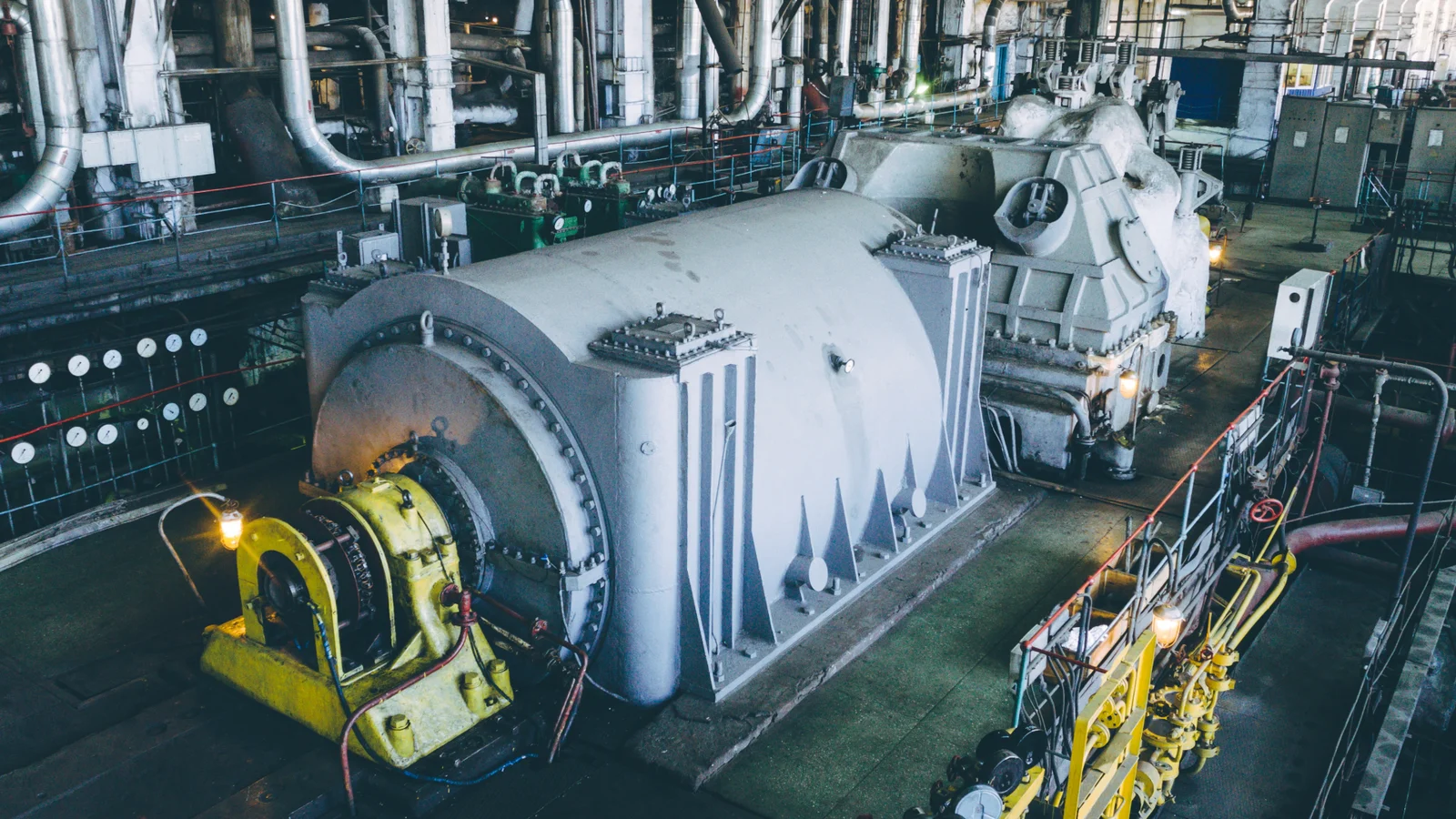
GE Vernova (GEV) is booking turbines years out. Data centers are buying Bloom Energy (BE) fuel cells instead.
Heavy-duty gas turbines are booked years out, so AI data centers are paying for onsite power instead. What GE Vernova, Bloom Energy, Power Solutions International, NRG and EQT each sell into that gap.
OpenAI's data center chief left five months in, as the company commits $1.4 trillion to compute
Chris Malone, OpenAI's head of data centers, has left after about five months, the latest senior exit as the company pours money into compute.
Countries are buying AI compute like oil reserves. Nvidia says it's already a $30 billion business.
Governments are buying AI compute as national infrastructure, and specialized neoclouds are renting out GPUs at scale, but the two overlap more than the headline numbers suggest. What it means for Nvidia, Oracle, CoreWeave, Nebius and IREN.
Leopold Aschenbrenner's latest filing shows he closed 13 of his 16 options positions and moved more than half his fund into SanDisk and Micron
Situational Awareness LP reported $8.46 billion of put positions on March 31 and one on June 30. The money went into SanDisk, Micron, Nebius and STMicroelectronics.
Nvidia (NVDA) is now backing OpenAI's data-center lease in Ohio
Nvidia said it will guarantee part of the cost of an 8-gigawatt AI data center in Ohio that OpenAI will lease and fill with Nvidia chips, and invest $1.5 billion in builder SB Energy. The move locks in demand and revives the circular-financing debate.
The oddest stock in Trump's portfolio is Korean: 18 Coupang (CPNG) trades as Washington challenged Seoul
Trump's disclosures show 18 Coupang (CPNG) trades across two accounts in eight months, the biggest of them landing while his own administration was accusing Seoul of persecuting the company.
You can trade single-stock options premarket starting August 17 at 7:30 a.m. ET. The first session includes Nvidia (NVDA), Tesla (TSLA), Apple (AAPL) and 18 more.
Cboe Options Exchange begins trading single-stock options at 7:30 a.m. ET on Monday, Aug. 17, two hours before the regular open. Limit orders only, no market or stop orders, and trades in the new sessions do not count toward the day's high and low.

Nebius (NBIS) soars 27% as explosive AI demand burns Michael Burry's short
Nebius grew Q2 revenue 454% to $582 million, swung to a profit, and jumped about 27% as CEO Arkady Volozh said AI demand keeps growing exponentially. The whole data center trade rallied, and Michael Burry's fresh short went underwater.
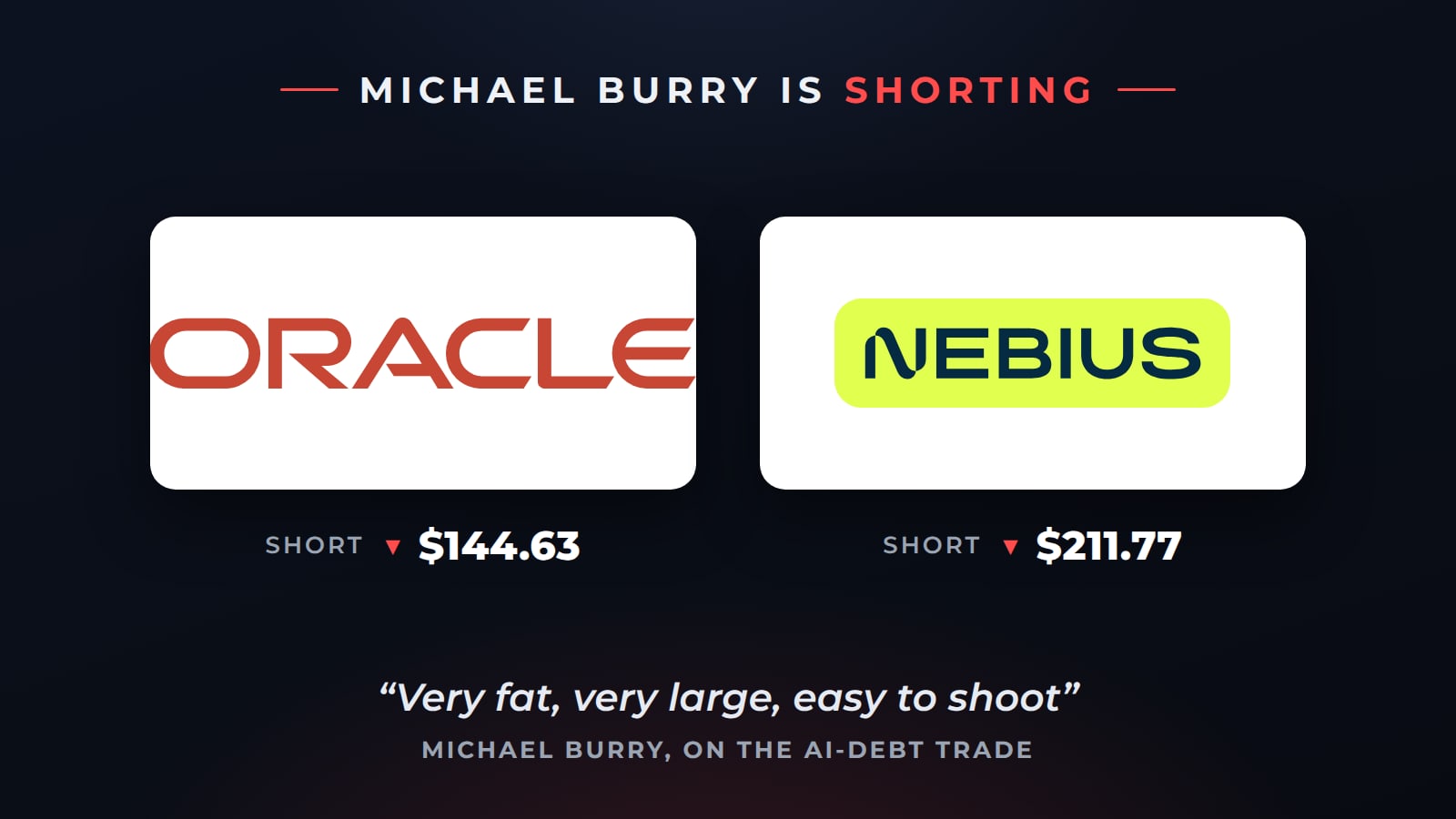
Michael Burry shorted Oracle (ORCL) at $144.63 and Nebius (NBIS) at $211.77. This time it's the stock, not puts.
Michael Burry shorted Oracle at $144.63 and Nebius at $211.77 on August 6, this time selling the shares short instead of buying puts. His argument: their AI-era earnings are inflated by understated chip depreciation.
The AI trade rallied Monday. Memory fell as much as 8% at the open even as chip prices kept rising.
Micron (MU) has lost a third of its value since June 25 and SanDisk nearly half. CoreWeave and Vertiv fell about half as far, and Nvidia rose. Memory contract prices never fell. What changed is the rate of increase, which went from 93-98% a quarter to a forecast 13-18%.
Citadel bought Leopold Aschenbrenner's stock book. Two outlets say he kept part of it, and a filing due Monday settles it.
Bloomberg and Reuters both name Ken Griffin's Citadel as the buyer of Situational Awareness's stock book, and both say bulk, not all. CNBC said the entire public book went in one block to one buyer. A Form 4 on the SharonAI (SHAZ) stake is due Aug. 3, an initial 13D or 13G from Citadel on Aug. 6, and the fund's own quarterly report on Aug. 14.
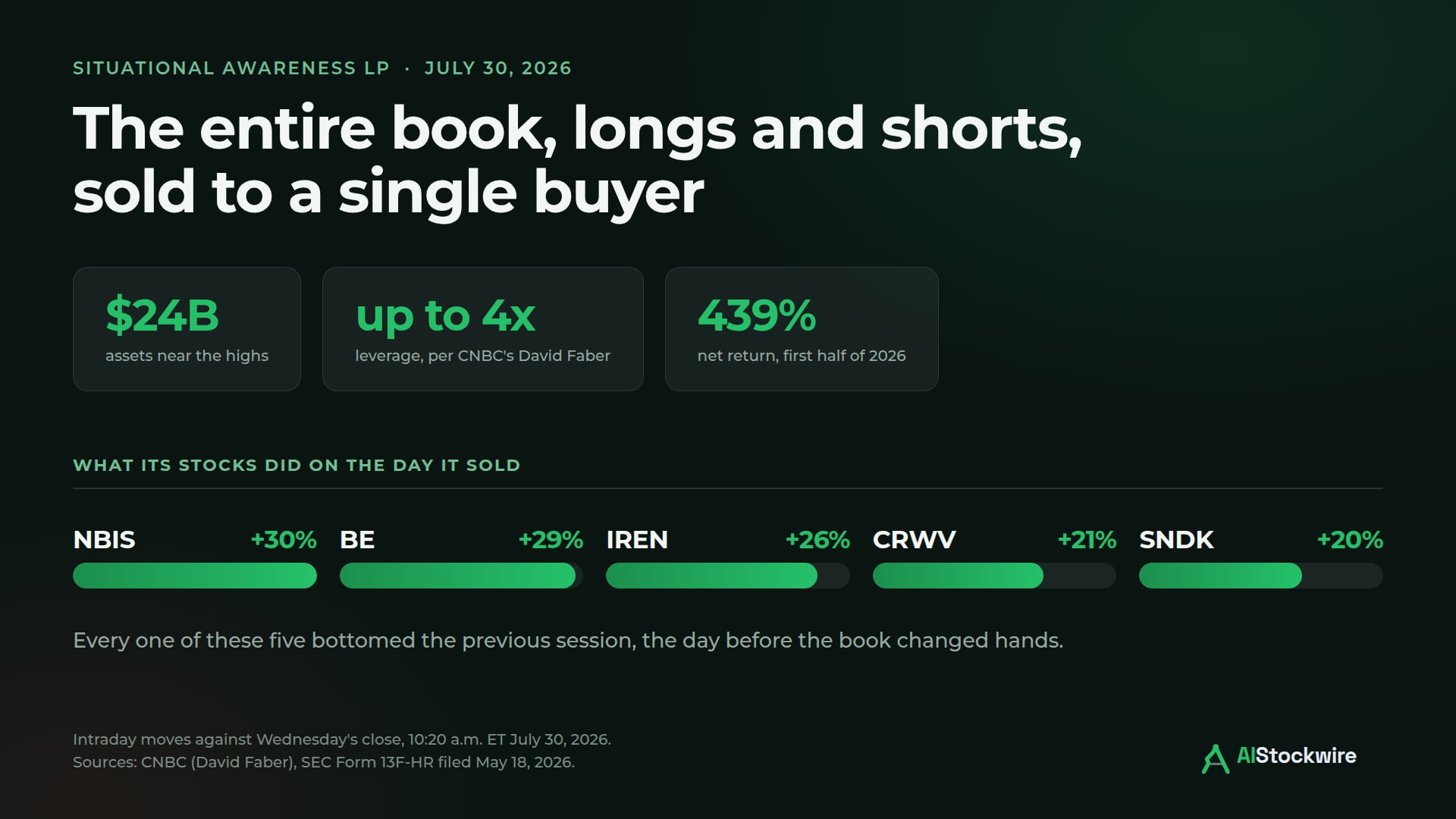
Leopold Aschenbrenner's AI fund sold its levered stock book, longs and shorts, to a single buyer. It was levered as much as four times.
CNBC's David Faber reported that Situational Awareness sold its entire public equities book, longs and shorts together, to a single buyer. The fund reached $24 billion near its highs and ran leverage of as much as four times. Its last public filing shows 62% of a $13.68 billion book was bets against chip stocks, and the stocks it owned outright fell twice as far.
Michael Burry posted three charts making the AI bear case. Two of them show the selling already happened.
Burry shared three Bloomberg charts on the AI trade. One maps the circular deals around Nvidia (NVDA). The other two show big tech forward multiples back at or below their 10-year averages, with Apple (AAPL) the lone expensive name and the only megacap missing from the circular map.

Michael Burry's picks: the Micron (MU) bet is up 17%. He has been averaging down on Lululemon (LULU) since 2025.
Burry deregistered Scion, so the 13F trail stopped and his trades now surface first on a newsletter with 300,000 subscribers. Here is everything he has disclosed since June, priced as of July 27. The point of laying them out together is that he is not always right.
Michael Burry sent readers to a BIS report on AI's poorly disclosed deals. Oracle (ORCL) reports $638 billion in one line.
Michael Burry spent July 23 pointing his readers at a Bank for International Settlements report on how AI deals get financed. The clearest illustration sits in an Oracle (ORCL) filing: a $638 billion backlog reported as one aggregate line, with the customer split left to S&P to estimate.

Everyone's asking if AI is the next dot-com bubble. Nvidia and 25 companies just gave a clue.
Nvidia rallied 25 companies behind open AI models, and OpenAI and Anthropic sat it out. Here's why I think their coming IPOs, not this fight, mark the real top of the AI bubble.

Jim Cramer's tech calls are still lagging the rest of his book. Intel is 1 for 5, and IBM crashed the day after his second buy call.
Jim Cramer's tech calls are still his weak spot. Intel is 1 for 5 since June, IBM is down nearly 30% since his back-to-back buy calls, and his tech picks trail the Nasdaq-100 by more than three points a call even after Tuesday's chip bounce.