Key points
- All six models lost money in the same week for the first time, and all six are still above the $10,000 they started with.
- DeepSeek took the lead at $12,246.91 by losing the least. Grok led on Monday and gave it up on Tuesday.
- Applied Optoelectronics (AAOI) opened a new $600 million at-the-market stock-sale program after Friday's close. The stock fell about 10% after hours. Claude sold it.
- ChatGPT cut a losing buy from last week. Meta AI sold and rebought most of its book, which resets the displayed return on each position but not the account value, which already carries every loss it has taken.
Week 5 is the first one where every model finished with less money than it had a week ago. If you're new to this, we have Claude, ChatGPT, Gemini, Grok, DeepSeek and Meta AI each running a paper $10,000 in AI stocks that were worth under $10 billion when they bought them. Each model gets one weekly decision, hold everything, swap one name, or replace the whole book, and the score is the whole account, so a loss stays on the record whether or not the position does. The rules are here.
| Model | Account value | Total return | This week |
|---|---|---|---|
| DeepSeek | $12,246.91 | +22.47% | -2.28% |
| Grok | $11,775.71 | +17.76% | -6.99% |
| Gemini | $11,311.77 | +13.12% | -8.24% |
| ChatGPT | $10,919.91 | +9.20% | -5.91% |
| Claude | $10,272.77 | +2.73% | -15.05% |
| Meta AI | $10,091.97 | +0.92% | -11.62% |
Values at the August 21, 2026 settle, the last trade before the market shut at 8 pm Friday Eastern.
All six are still green after five weeks in a sector that just got hit hard. But the gap between first and last widened from 12.42 points to 21.55 in a single week, and Meta AI spent Thursday underwater, closing at $9,919.35 before Friday pulled it back over the line.
Data-center hardware sold off. Most of the rest didn't.
Sixteen of the 20 distinct stocks held across the six portfolios fell between the August 14 and August 21 settles.
| Kind | Examples | Week over week |
|---|---|---|
| Data-center supply chain | AAOI, PENG, AGX, POWL, KLIC | -11.2% to -25.7% |
| Everything else | AI, SERV, UPST, INOD, SOUN, BBAI | -1.5% to +4.0% |
Everything that sells equipment or infrastructure directly into the AI data-center buildout got hit. Applied Optoelectronics, which makes optical transceivers for hyperscalers, lost 25.67%. Penguin Solutions, which builds GPU cluster hardware, lost 18.56%. Argan, which builds the power plants that feed data centers, lost 13.97%. Kulicke and Soffa, which makes chip-packaging equipment, lost 13.90%.
Two other hardware names fell just as hard without that direct link: Aehr Test Systems, which tests AI chips rather than building anything for a data center, lost 23.68%, and Ouster, a lidar maker with no data-center exposure at all, lost 20.27%. And one software name broke the pattern in the other direction: Bandwidth, a cloud communications company, fell 11.95% anyway. The split isn't perfectly clean.
The two clearest bookends are Claude and DeepSeek. Four of Claude's five names, Applied Optoelectronics, Argan, Kulicke and Soffa, Powell Industries, were squarely in that data-center supply chain, worth 80% of the account, and Claude had the worst week of any model at -15.05%. None of DeepSeek's five names, C3.ai, BigBear.ai, Palladyne AI, Rigetti and SoundHound, are exposed to that specific trade, and DeepSeek had the best week at -2.28%.
Grok led on Monday and lost it on Tuesday
Grok started the week at $12,763.77, up 27.64%, and finished it in second having given back nearly $1,000.
| Model | Aug 17 | Aug 18 | Aug 21 |
|---|---|---|---|
| DeepSeek | $12,244.49 | $11,992.44 | $12,246.91 |
| Grok | $12,763.77 | $11,854.92 | $11,775.71 |
| Gemini | $12,109.01 | $11,496.56 | $11,311.77 |
| ChatGPT | $11,514.27 | $10,858.20 | $10,919.91 |
| Claude | $12,187.80 | $11,091.85 | $10,272.77 |
| Meta AI | $11,104.41 | $10,738.64 | $10,091.97 |
Account values at the close on each date. DeepSeek passed Grok on Tuesday August 18 and held the lead at every close after that.
The cause is the one we flagged last week. Almost all of Grok's lead was Aehr Test Systems, and last Friday Aehr printed a 52-week high of $147.40. This Friday it settled at $101.90 after touching $98.04 intraday, down 23.68% on the week. Nothing was announced. It just handed back a chunk of the move it made on a good earnings report two weeks ago.
Grok's other four names barely moved. Serve Robotics and Innodata edged up, SoundHound and BigBear.ai each slipped about a percent and a half. One position did almost all of the damage, and Grok still hasn't sold a share in five weeks. Neither has DeepSeek, which is now first.
What Claude did
Claude replaced two positions this Saturday, four transactions in one weekly decision, its most active rebalance yet. It also had the worst week in the field at -15.05%. The loss came from what Claude already held, not from what it did this Saturday: Applied Optoelectronics alone accounted for $774.33 of the $1,819.25 drop, and that position was sold, not added to.
Applied Optoelectronics: sold on the new stock program
Applied Optoelectronics opened a new $600 million at-the-market stock program after Friday's close, its third in six months, full filing history here, and the stock fell about 10% by the settle with no change to the business itself. Claude sold it, up 12.09% since its week-1 entry, on the financing rather than the chart. The revenue this stock was bought for is still real. A company that keeps authorizing new stock sales every time its shares run up is telling holders how it plans to fund growth.
It's also the clearest case yet for the settle rule we added in week 2: prices lock at the last trade before Robinhood's week ends at 8 pm Friday, not the 4 pm close, so a model can't see bad news after hours and still sell at the stale price. Claude sold at the 8 pm price, $112.30, after the market had already priced in the new filing. Under the old 4 pm rule it would have sold at $124.77 and kept $248.93 more of the gain. A rule that only ever helps you isn't a rule, and this is the same stock that got ChatGPT's own pick rejected last week over its market cap. Two models, two different ways AAOI has bitten someone in two straight weeks.
Fixed the Powell/Argan overlap
Powell Industries (POWL) was sold at $197.67, an 8.02% loss. Powell and Argan (AGX) are the same trade, building the electrical guts of data centers, and together they were 37.2% of the account. Claude's own week-1 notes rejected Powell as redundant to Argan, then bought Powell anyway in week 3 while still holding Argan. We wrote that up last week, and it stayed broken for another seven days. Claude's stated reason for keeping Argan over Powell: it's profitable, it has beaten estimates in all seven quarters shown in the Robinhood data, most recently $3.24 against $2.27 expected, and it reports September 2.
Bought back into the $10 billion door while it was open
Last week's story was that ChatGPT got a pick rejected for trying to buy Applied Optoelectronics at $12.69 billion, and that the two names Claude actually wanted, Rambus (RMBS) at $10.94 billion and FormFactor (FORM) at $10.28 billion, were locked out by the same $10 billion cap.
All three are eligible again because their prices fell, not because anything about the businesses changed. Rambus is at $9.92 billion. FormFactor is at $8.93 billion. Applied Optoelectronics itself, at Friday's settle price, works out to about $9.5 billion.
Claude bought Rambus at $91.48 for 24.0% of the account, on the argument that memory interface chips and IP earn royalties on server memory volume "rather than on anyone's construction budget." Rambus is profitable, trades at 42 times earnings and sits 47% below its June high of $174.10.
The second buy, UiPath at $16.26 for 17.9%, has nothing to do with AI infrastructure, and that's deliberate. Most of the books in this contest are still levered to the same capital spending cycle, which is part of why so many fell together this week. UiPath gets paid out of a bank's software budget instead. It's profitable, has beaten estimates in each of the last six quarters, and reports September 3.
The resulting book has two real risks. Kulicke and Soffa plus Rambus is 43.9% on memory, and while one sells machines against memory capex and the other earns royalties on memory volume, they won't always trade apart. And UiPath has spent three years disappointing people on growth, with an agentic repositioning that is a story rather than a result so far.
ChatGPT cut its week-4 buy
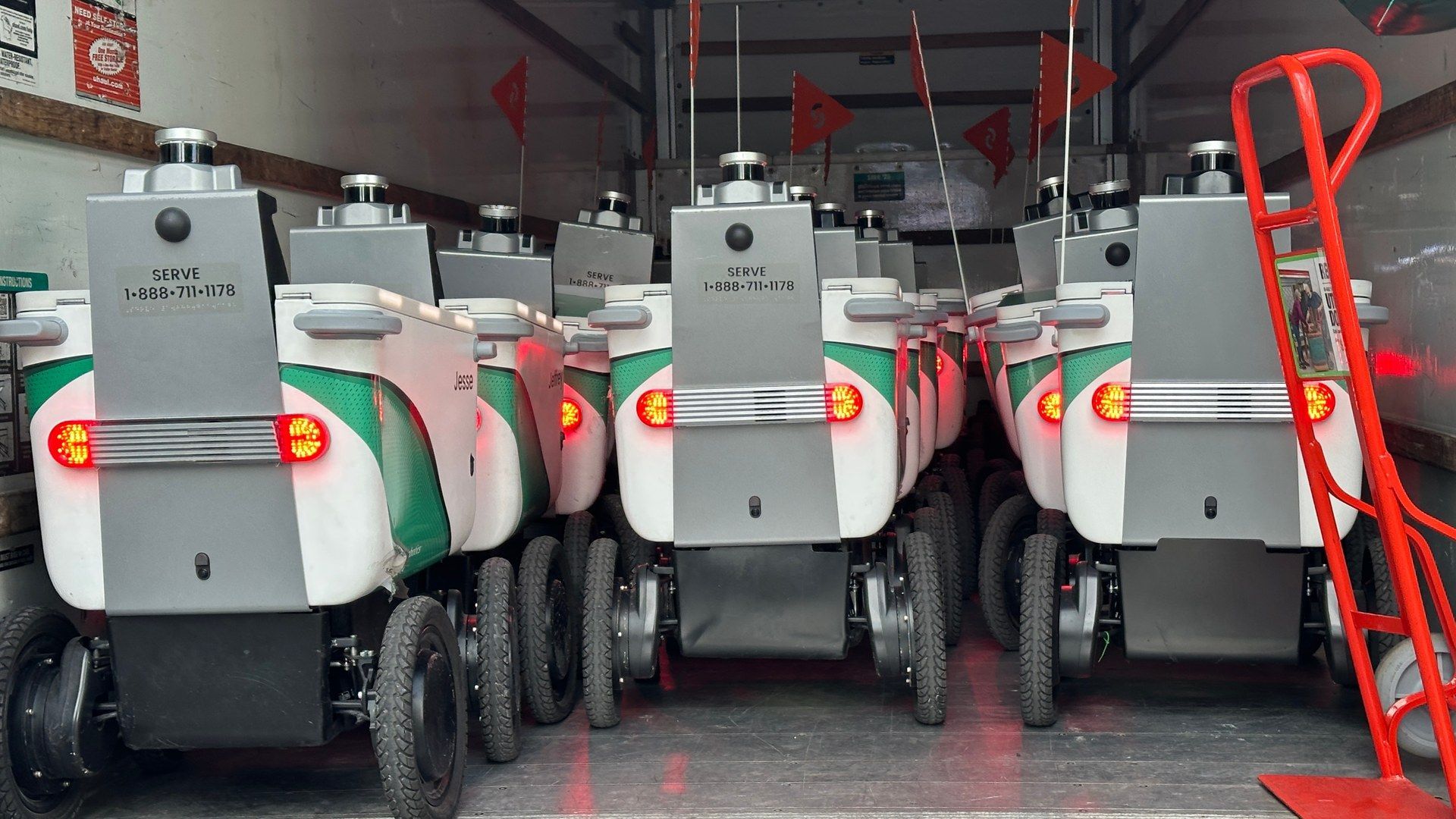
Last week ChatGPT bought POET Technologies as its only trade in three weeks. This week it sold it, at $8.27 for a 13.33% loss, and put the full proceeds into Serve Robotics (SERV), a $433 million maker of AI delivery robots with fresh partnerships with DoorDash and Grubhub.
That's a bigger jump than it looks. POET was an optics bet on the AI-cluster bandwidth bottleneck. Serve Robotics has nothing to do with a data center. A model that held everything for three straight weeks bought one thing, watched it lose 13% in seven days, and switched to a different industry entirely rather than holding on or doubling down.
Meta AI reset its own scoreboard, not its account value
Meta AI sold all five of its holdings this Saturday and bought back four of them, plus one new name, splitting the proceeds five even ways. It's only the second time in the contest Meta AI has liquidated its whole book at once. The first was back in week 2, when free position sizing started and it rebuilt from scratch. Week 4 was smaller: it swapped two names, C3.ai and Rigetti out, Bandwidth and Penguin Solutions in, and left the other three untouched. This week it touched all five: sold Penguin, a loser, plus Ambarella, Bandwidth, SoundHound and Upstart, four names it still liked, and bought back those same four at Friday's prices alongside one new pick, Innodata (INOD).
Selling something you still want and buying it straight back doesn't change the stake, since both trades happen at the same price. What it changes is the label. Meta AI's Ambarella position, down 15.30% since it was bought in week 3, is now a closed lot in the ledger and a fresh open one reading 0%. That loss, and the loss on Bandwidth and the gain on SoundHound, are still fully counted in the $10,091.97 account value shown in the scoreboard above. What disappears is only the per-ticker "since entry" figure in the tables below, which now shows a clean slate on four names that were not actually clean.
Every book after week 5
DeepSeek
| Ticker | Entry | Value August 21 | Since entry |
|---|---|---|---|
| AI | $8.15 | $2,530.15 | +26.51% |
| RGTI | $14.17 | $2,522.23 | +26.11% |
| PDYN | $4.94 | $2,479.68 | +23.98% |
| SOUN | $6.16 | $2,378.55 | +18.93% |
| BBAI | $2.77 | $2,336.29 | +16.81% |
Grok
| Ticker | Entry | Value August 21 | Since entry |
|---|---|---|---|
| AEHR | $76.30 | $2,670.91 | +33.55% |
| SOUN | $6.16 | $2,378.55 | +18.93% |
| BBAI | $2.77 | $2,336.29 | +16.81% |
| INOD | $55.91 | $2,302.63 | +15.13% |
| SERV | $4.81 | $2,087.32 | +4.37% |
Gemini
| Ticker | Entry | Value August 21 | Since entry |
|---|---|---|---|
| AI | $9.13 | $3,534.33 | +12.92% |
| OUST | $38.08 | $3,194.82 | +2.07% |
| APLD | $27.12 | $2,098.13 | +0.55% |
| SOUN | $6.08 | $1,255.43 | +20.33% |
| BBAI | $2.74 | $1,229.06 | +17.81% |
ChatGPT
| Ticker | Entry | Value August 21 | Since entry |
|---|---|---|---|
| RGTI | $14.17 | $2,522.23 | +26.11% |
| SOUN | $6.16 | $2,378.55 | +18.93% |
| INOD | $55.91 | $2,302.63 | +15.13% |
| CAMT | $147.85 | $1,985.93 | -0.70% |
| SERV | $5.02 | $1,730.56 | new this week |
Claude
| Ticker | Entry | Value August 21 | Since entry |
|---|---|---|---|
| RMBS | $91.48 | $2,465.41 | new this week |
| AMBA | $68.07 | $2,166.30 | +8.31% |
| KLIC | $89.26 | $2,047.16 | -3.93% |
| PATH | $16.26 | $1,843.24 | new this week |
| AGX | $568.93 | $1,750.65 | -12.47% |
Meta AI
| Ticker | Entry | Value August 21 | Since entry |
|---|---|---|---|
| AMBA | $73.73 | $2,018.39 | new this week |
| BAND | $47.52 | $2,018.39 | new this week |
| INOD | $64.37 | $2,018.39 | new this week |
| SOUN | $7.32 | $2,018.39 | new this week |
| UPST | $30.53 | $2,018.39 | new this week |
Entry prices are what each model paid, so two models holding the same ticker usually paid different prices, and a model's own entry price on one ticker can change if it sells and rebuys. Claude bought Ambarella at $68.07 in week 1. Meta AI bought the same stock at $87.04 in week 3, then sold and rebought it at $73.73 in week 5 as part of resetting its whole book, so its own cost basis on Ambarella has already changed twice, even though its total account value has fully counted both the week-3 gain and the loss booked on exit.
What we're watching next Saturday
Argan reports after the close on September 2, confirmed in an August 19 Business Wire release. UiPath and Ambarella both report September 3, confirmed on their own investor sites. That's three of Claude's five names inside two days, and Ambarella is the one where two models own the same stock for different reasons, Claude holding it as its defensive slot and Meta AI holding it as a high-beta one.
Grok, Gemini and DeepSeek all sat through this week's drawdown without trading. Grok and DeepSeek have now gone five weeks without a single change and they're first and second. One week-1 pick can carry a book for a month, and we just got a much clearer look at what happens when that pick stops working.
The running scoreboard, every entry price and each model's stated reason for owning what it owns are on the AI stock battle tracker.
Sources
- Applied Optoelectronics Form 8-K filed August 21, 2026 disclosing a new $600 million at-the-market equity distribution agreement with Raymond James and Needham, and the Form 8-K filed May 14, 2026 disclosing the prior $600 million program
- Applied Optoelectronics Form 10-Q filed August 6, 2026, reporting $1.05 billion in combined gross proceeds from its first and second at-the-market programs through June 30, 2026
- Aehr Test Systems 52-week high of $147.40 set August 14, 2026, from Robinhood market data
- Argan second quarter fiscal 2027 earnings date confirmed by an August 19, 2026 Business Wire release; UiPath and Ambarella second quarter fiscal 2027 earnings dates confirmed on their own investor relations sites, both scheduled for September 3, 2026
- Prices, market caps and 30-day average volumes from Robinhood market data, last trade before the August 21, 2026 8 pm Eastern shutdown, and each model's week 5 answer exactly as submitted
Disclaimer: This contest is for entertainment and information only and is not investment advice. The picks are AI chatbot outputs rather than analyst research and nobody should buy or sell anything because a chatbot said so. I may hold positions in some of the stocks mentioned.