Key points
- Google DeepMind's Gemini 4 agents redesign quantum algorithms
- Lean checked DeepMind's programs against formal specs
- DeepMind's 290x cut is an estimate, not a hardware run
Google DeepMind said Monday that teams of AI agents running on its Gemini 4 models found cheaper versions of algorithms for five quantum computing tasks, and that it checked each program and its cost with the Lean theorem prover. The largest gain cut the estimated computing resources needed for one arithmetic routine by more than 290 times.
The work, done with Google Quantum AI, is described in a Nov. 23 blog post and in a paper by 25 authors first posted to arXiv on Nov. 6. Both groups are part of Alphabet (GOOGL). The results are cost estimates for algorithms meant to run on future error-corrected quantum computers.
Lean checked the programs and their cost bounds against formal specifications the researchers wrote. The comparisons with earlier methods depend on the baselines and cost model described in the paper.
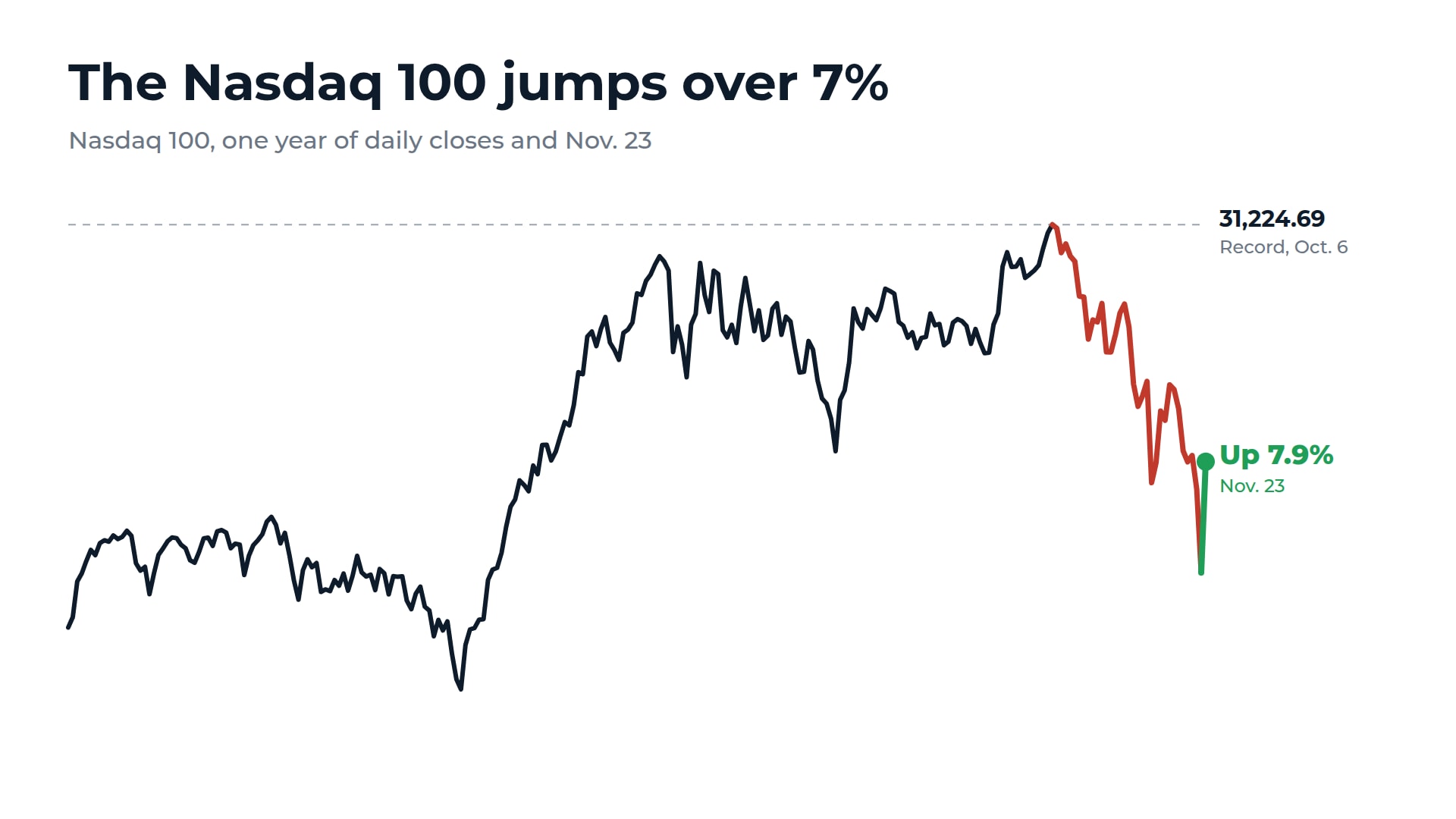
Alphabet shares were up about 6.8 percent at 1:44 p.m. ET, matching the 6.8 percent gain in the Invesco QQQ Trust, which tracks the Nasdaq 100.
DeepMind's agents improved five quantum tasks
The paper measures four of the five results by spacetime cost, the number of qubits multiplied by the number of T gates. A qubit is the quantum version of a computer bit, and a T gate is a type of quantum operation that's costly to carry out on an error-corrected machine.
| Task | Prior cost | New cost | Reduction |
|---|---|---|---|
| Arcsin arithmetic for preparing quantum states | more than 1.08 x 10⁸ | 3.70 x 10⁵ | more than 290x |
| Stopping power of alpha particles in hydrogen (fusion) | 5.42 x 10¹⁵ | 4.59 x 10¹⁴ | 11.8x |
| Dynamics of a light-sensitive molecule (photochemistry) | 4.98 x 10¹⁵ | 6.06 x 10¹⁴ | 8.22x |
| Cytochrome P450 enzyme (drug metabolism) | 1.09 x 10¹² | 4.37 x 10¹¹ | 2.49x |
Source: "Discovering formally verified quantum programs with AI," arXiv:2611.09822, version 3. Costs are qubits multiplied by T gates.
The arcsin gain came in two stages. The agents first searched only a restricted class of circuits that a classical computer can check in seconds, and that cut the cost to 415,000. The researchers then used their Lean library to lift the restriction. The agents found a version of one component, the coefficient lookup, that uses 33 percent fewer gates. The overall cost fell another 11 percent to 370,000, according to the paper.
The fusion result also shrinks the estimated machine from 5,650 logical qubits to 4,338, and the enzyme result shrinks it from 481 logical qubits to 333. A logical qubit is an error-corrected qubit built from many physical ones. Cytochrome P450 enzymes break down many common drugs in the body.
The fifth task is parallel search, a form of Grover's search algorithm that runs several queries at once. When the task is to find any one of several marked targets, the agents cut the expected number of query rounds by up to 1.22 times, according to the paper. When the task is to find all of them, the cut reaches 2.57 times. In the find-one task, the new circuits only match the earlier approach when there's a single target or a single query per round.
Some of the comparison baselines are the authors' own constructions. The paper says the fusion baseline was built from figures in an earlier published study, and the photochemistry baseline includes later improvements to the original published estimate.
The figures also grew between versions of the paper. The summary of the first version, posted Nov. 6, reported parallel-search gains of up to 1.4 times and an 11 times fusion gain. The version dated Nov. 16 reports 2.57 times and 12 times in its summary, and the blog post gives the fusion figure as 11.8 times.
Lean proofs check the agents' work
Each result comes with proofs written in Lean, a programming language that a computer uses to check every logical step of a mathematical argument. One proof shows that the program meets its formal specification, and another proves a bound on its cost, including its T-gate count and number of qubits.
"Because we cannot test resource-intensive quantum circuits on classical computers or today's small quantum processors, we have to prove that they work mathematically," the DeepMind team wrote in the blog post, which is credited to Sergey Shirobokov, Ben Jaderberg, and Ryan Babbush.
Researchers wrote the specification for each problem in Lean before launching an agent team, according to the paper. A tool called the Lean Comparator then checks that the agents didn't change the target theorems or definitions or add new axioms. The paper names weakened theorem statements as one of the risks the tool guards against.
The agent teams shared a wiki of their best verified solutions and reusable Lean lemmas, and they met at a virtual conference every four hours, according to the blog post. DeepMind has posted its Lean library, the problem specifications, and the verified solutions on GitHub.
The Lean community certified a Riemann hypothesis proof developed with Claude, the AI model from Anthropic (ANT), on Nov. 21, two days before DeepMind's post.
The hardware to run these algorithms doesn't exist yet
Running the improved algorithms on real scientific problems "would still demand more computational resources than the first error-corrected quantum computers are likely to provide," the blog post says.
Many promising applications need thousands of logical qubits carrying out between a billion and a quadrillion (109 to 1015) logical operations, according to the paper. It puts the projected capacity of early fault-tolerant processors at roughly one million operations.