Key points
- Meta's Alexandr Wang says superintelligence is arriving
- Wang compares the Riemann proof with the atomic bomb
- Why Meta's Wang challenges AI industry assumptions
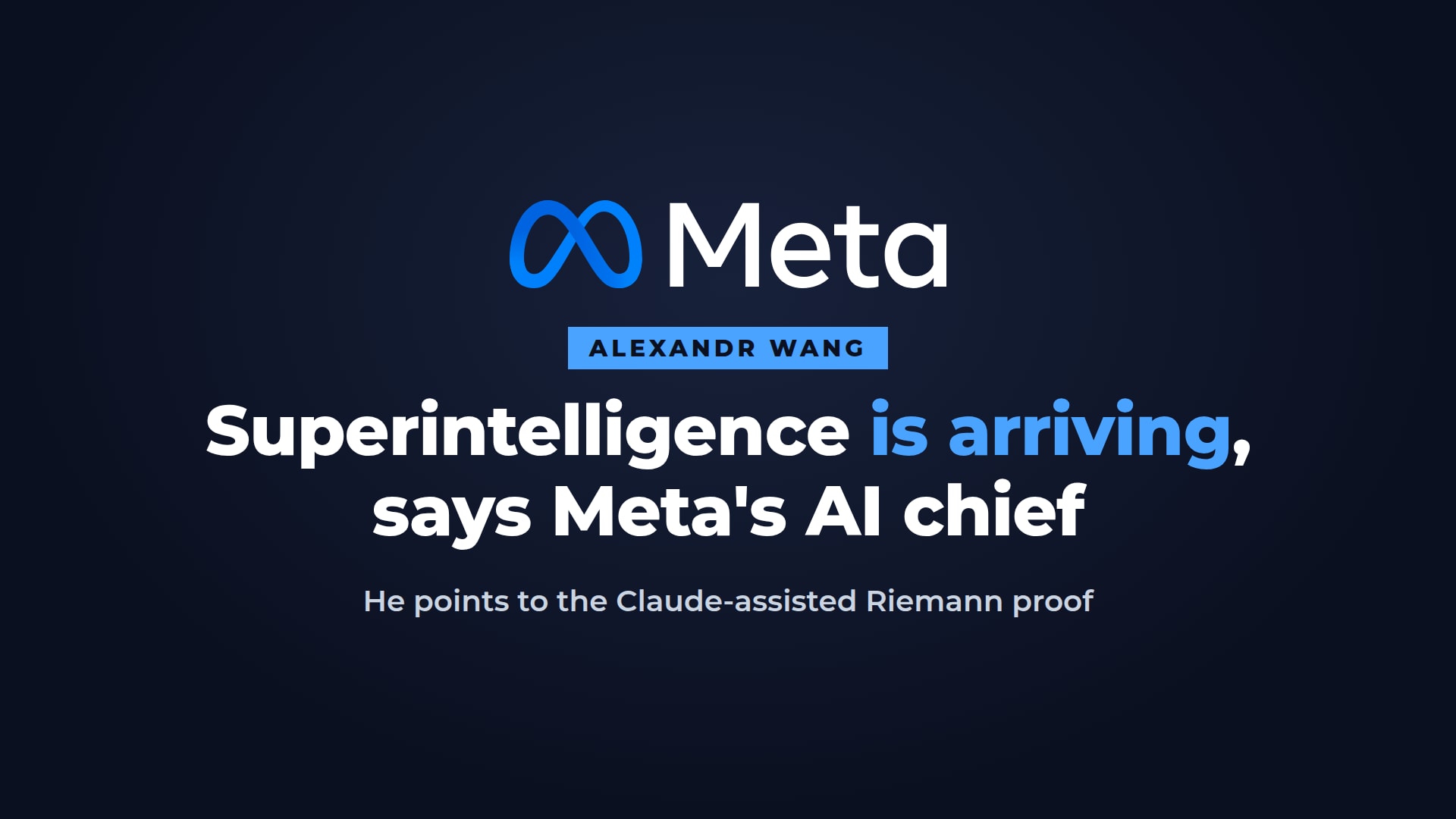
Meta Platforms (META) chief AI officer Alexandr Wang wrote that "superintelligence is arriving," pointing to the Riemann hypothesis proof that Anthropic (ANT) mathematician Levent Alpöge developed with the company's Claude AI model. Wang wrote that it's hard to imagine humanity keeping control of AI that improves itself without limits.
He also criticized the industry view that superintelligence is inevitable and that safety is the only problem left to solve. Wang, who leads Meta Superintelligence Labs, posted the essay, titled "Superintelligence is Arriving," on X at 5:50 p.m. ET on Sunday, Nov. 22. It had about 19.9 million views as of 8:58 p.m. ET on Monday.
Wang compared the proof with the atomic bomb
For most people who have studied math, Wang wrote, proving the hypothesis "represents the absolute pinnacle of intellectual accomplishment."
"As someone who grew up in Los Alamos, New Mexico, many physicists would agree that the discovery of the atomic bomb is a homework problem compared to the Riemann Hypothesis," he wrote. He didn't name any of those physicists.
"It is hard to overstate the magnitude of discovery that we have just witnessed—completed with the help of an alien mind that we don't understand," Wang added.
He compared the moment with December 2024, when OpenAI's o3 model began "acing the AIME," the American Invitational Mathematics Examination, a competition for high school students. Wang wrote that the hardest problems on that exam are much harder than the problems even the most advanced engineers and business people solve day to day. "AIME is an extracurricular activity for teenagers," he wrote, while the Riemann hypothesis "may be the most intellectually demanding problem humanity has ever devised."
The Lean community has checked the proof
Alpöge posted the proof on Nov. 20. On Nov. 21, the Lean and Mathlib communities certified the Riemann hypothesis proof, saying the formal proof establishes the hypothesis as it's stated in Lean. Lean is a programming language that a computer uses to check every logical step of a proof.
Mathematicians are still working to understand the proof, and Alpöge hasn't yet written it up as a paper. The Clay Mathematics Institute's $1 million prize for the problem is at least two years away under its rules, since a solution must first appear in a qualifying publication and then wait two years.
Wang pointed to mathematicians' ongoing work to understand the proof. "In the same way that the math community has not fully digested the proof of the Riemann Hypothesis, nearly every field could be accelerated at a pace beyond what humans can understand or monitor," he wrote.
The Lean checks apply only to the mathematical result. Wang's predictions about AI that improves itself are a separate argument.
Wang says AI research is next
Wang wrote that a lack of raw intelligence is no longer what holds AI models back. The remaining gaps "are domain-specific know-how, plumbing, and experimentation," he wrote.
He put AI research itself on that list. "The models are clearly going to be intelligent enough to automate all of AI research and be clearly superhuman at improving themselves," Wang wrote, adding that they would also speed up biological, weapons, and economics research.
Recursive self-improvement is the idea of an AI system improving its own design, with each new version building the next. "It is hard to imagine a world where humanity can maintain control over fully unconstrained recursive self-improvement," Wang wrote. He said the same about superintelligence "that is 1000x smarter and more capable than humans in every field."
Wang challenges the AI industry's "default path"
Wang wrote that he sees "a particular form of lazy thinking within the AI industry," the view that artificial superintelligence "is inevitable and the only problem to solve is how to do it safely."
"We should not be okay with a 'handover' of society to AI," he wrote. He said a better outcome is possible but likely requires "the whole industry taking meaningfully different actions from the 'default path' in front of us." The essay doesn't say what those actions are or what Meta would do differently.
Earlier on Nov. 22, OpenAI Chief Scientist Jakub Pachocki wrote that an OpenAI model with a log-perplexity score of about 0.76 "started producing groundbreaking results" on open math problems, in a post that published OpenAI's internal perplexity scores.
Meta shares closed up 6.6 percent at $597.60 on Monday, Nov. 23, the first trading day after Wang's post, while the Invesco QQQ Trust rose 7 percent. Anthropic shares fell 1.4 percent to $87.64.