Key points
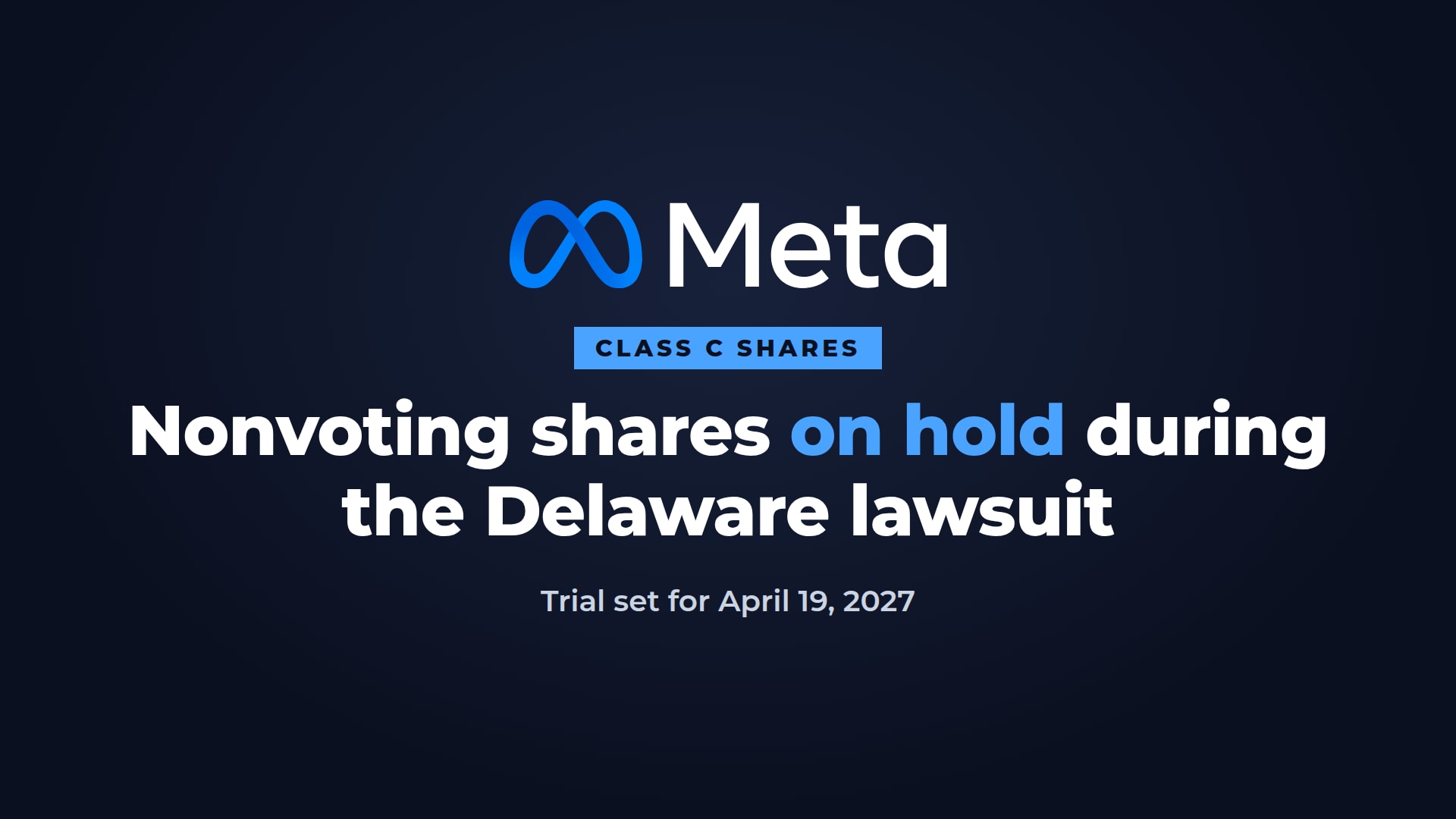
- Meta paused Class C issuance during Delaware litigation over the plan, with a trial set for April 19, 2027
- Zuckerberg waived Meta's January deadline to pay the Class C dividend, until June 30, 2027 at the latest
- Meta expects its $60 billion Class C sale program to wait until after the dividend is paid
Meta Platforms (META) has paused its plan to distribute new nonvoting Class C shares in January. In an 8-K filed on Nov. 23, Meta said it has agreed not to issue any Class C stock while shareholder lawsuits challenging the plan go through pretrial and trial proceedings in Delaware's Court of Chancery. The filing says the trial is scheduled to begin on April 19, 2027.
Meta had planned to give every shareholder one Class C share for each share they own, which works much like a two-for-one stock split. Its new charter is set to take effect on Jan. 19, 2027, and the dividend was due within five business days after that. Meta first agreed to the pause in a Delaware court filing on Nov. 18, Bloomberg reported. The 8-K adds two new pieces, a waiver from Mark Zuckerberg and a delay to Meta's planned stock sales.
Why did Zuckerberg have to sign a waiver?
The five-day deadline is written into the Founder Alignment Agreement, the deal Zuckerberg signed with Meta on Oct. 20. Under that agreement, he commits to live in California, or wherever Meta's headquarters are, for eight years while he leads the company. The agreement also lets him sell 20% of his Class C shares right away. Because Class C shares carry no vote, selling them would let Zuckerberg cash out part of his economic stake while keeping his voting shares. Zuckerberg can end the agreement if the dividend isn't paid on time, according to Meta's information statement from October.
Zuckerberg has now waived that deadline. The waiver ends at the earliest of three points:
- Meta fails to pay the dividend within a reasonable time after the lawsuit ends in a way that doesn't block it
- A final ruling that can't be appealed blocks the dividend
- June 30, 2027, if the dividend hasn't been paid by then
The end of the waiver wouldn't cancel the agreement by itself. Zuckerberg may have the option to end it if the dividend remains unpaid, but the filing doesn't say what he would do.
What happens to Meta's $60 billion stock sale program?
It waits. Meta said in October that it planned an at-the-market program to sell up to $60 billion of Class C shares, starting in early 2027. In an at-the-market program, a company sells new shares gradually through brokers at the going price. Meta said it won't launch the program until Class C stock begins trading, so it doesn't expect to start until after the dividend is paid.
That pushes back one of the tools Meta lined up to fund its AI spending. The company sold $37.5 billion of stock in October, and both of those offerings can switch to Class C shares once they exist.
Who is suing Meta over the Class C shares?
The plaintiffs include the California State Teachers' Retirement System and Danish pension group PFA, Benzinga reported. The suits have been combined into one case, In re Meta Platforms, Inc. Class C Reclassification Litigation. The shareholders argue that Zuckerberg and the board breached their duties by approving the plan. "Zuckerberg dominated and shaped it, coerced the Special Committee with threats and deadlines, and obtained approval from a Committee that never valued what it gave away and from no stockholder other than himself," the complaint said, according to Benzinga.
Meta has been here before. In 2017, when it was still called Facebook, the company dropped a similar plan for nonvoting shares shortly before a Delaware trial was set to begin. This time, entities controlled by Zuckerberg approved the plan by written consent, so no other shareholder vote was needed.
Meta shares closed up 6.6% at $597.60 on Nov. 23, before the filing, and were up 0.2% in after-hours trading at 7:27 p.m. ET.