Key points
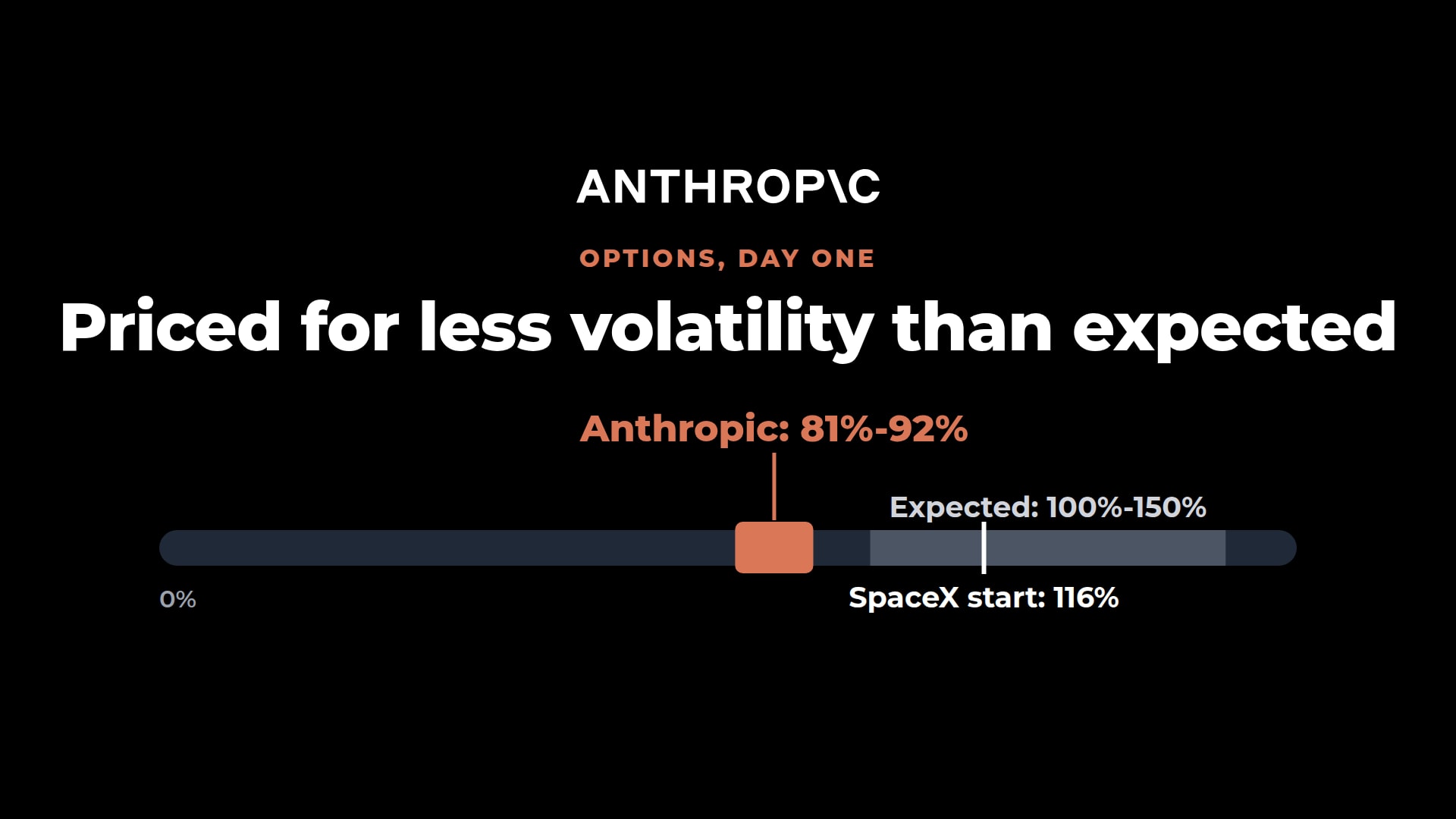
- Anthropic options priced in less volatility than market makers expected on their first day
- Anthropic options traded about 295,000 contracts by early afternoon, trailing SpaceX's first-day record
- Anthropic puts implied higher volatility than calls at the same strikes
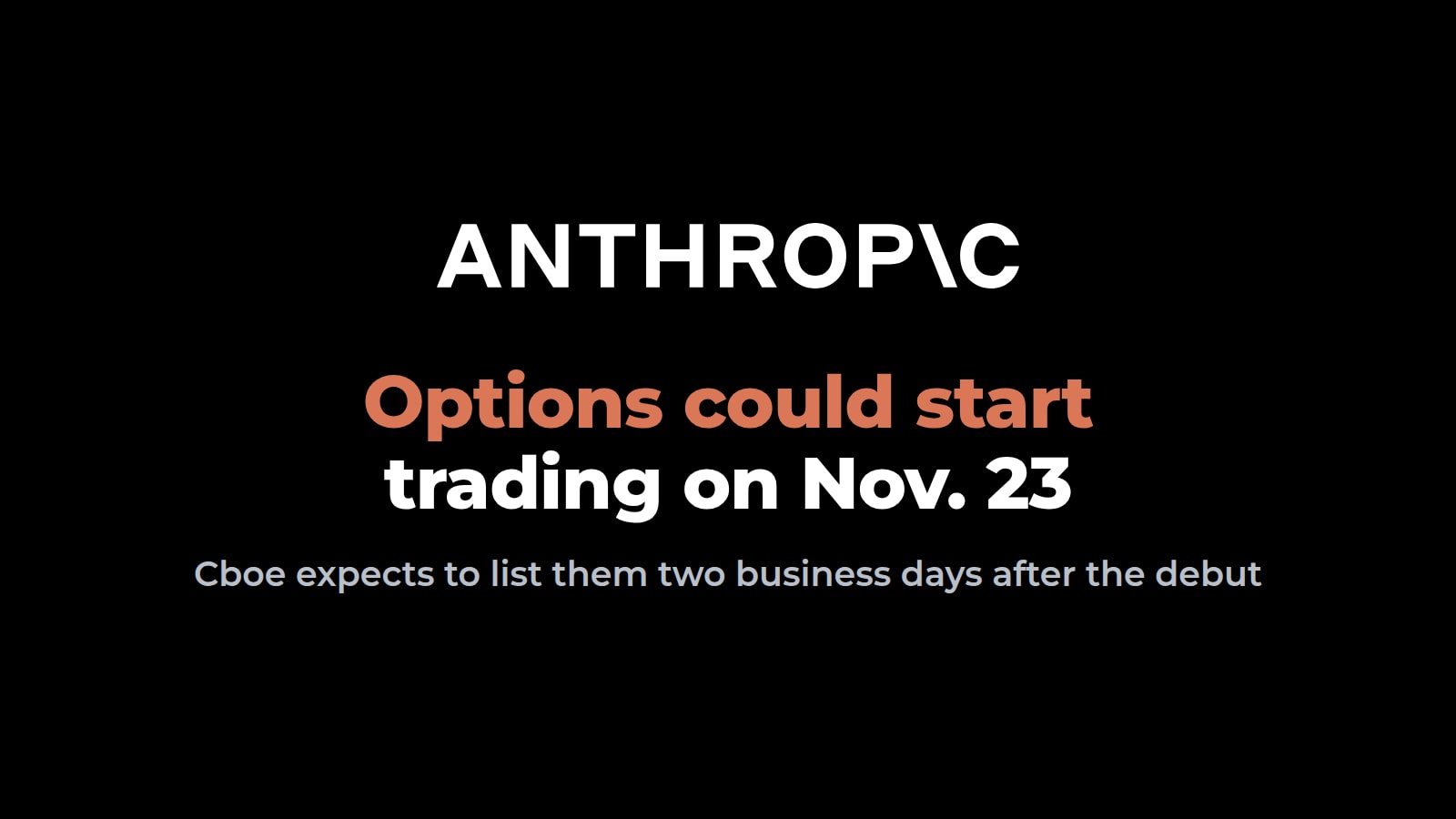
Options on Anthropic (ANT) started trading on Monday, and they priced in less turbulence than Wall Street had expected. At-the-money options expiring Dec. 18 implied annualized volatility of about 81% for calls and 92% for puts at 12:41 p.m. ET. We calculated those figures from prices on Nasdaq's options chain.
That's below the 100% to 150% that market makers on the Cboe trading floor had estimated, CNBC reported on Nov. 20, as we noted in our preview. It's also below the 116% that SpaceX (SPCX) options started at in June, according to the same CNBC report. That report didn't say which expiration or time of day the SpaceX figure reflects, so it isn't an exact match for our December numbers. Implied volatility is an annualized measure of how much the options price in moves in the stock. With everything else held equal, lower implied volatility means lower option prices.
"The options are pricing moves of about 6% a day," Harmeet Goindi, founder of options analytics service Mercury Alerts, told Reuters. Using the square-root-of-time convention, 6% a day scales to roughly 95% a year, close to our numbers.
Anthropic's early options volume trails SpaceX's first-day record
About 160,000 Anthropic contracts traded in the first hour and about 270,000 by noon, according to Mercury Alerts data cited by Reuters. By 12:41 p.m., the total across all expirations was about 295,000, with 149,691 calls and 145,624 puts, according to Nasdaq's data.
At its pace, Anthropic was on track for about 550,000 contracts on the day, Mercury Alerts said. That would beat the 365,000 contracts that traded when Facebook, now Meta Platforms, debuted options in 2012, but fall far short of the roughly 1.8 million contracts that traded on SpaceX's first day.
"We're not seeing anything close to the sort of speculation in far upside strikes that we saw in the early days of SpaceX," said Steve Sosnick, chief strategist at Interactive Brokers, according to Reuters.
Anthropic puts implied higher volatility than calls
At each of the three strikes closest to the share price, December puts implied about 10 to 11 points more volatility than December calls. January options showed the same pattern, with calls near 72% and puts near 80%.
Calls and puts with the same strike and expiration are tied together by a pricing relationship called put-call parity, so a gap like this usually reflects inputs our calculation leaves out. One possible explanation is the cost of borrowing shares to sell short, which we set at zero. A high borrowing cost raises put prices relative to calls. Quotes that weren't updated at the same moment can also skew the comparison. Our calculation assumes a 4% interest rate.
| Anthropic option, Dec. 18 expiration | Mid price | Implied volatility |
|---|---|---|
| $85 call | $9.85 | 81.5% |
| $85 put | $6.30 | 92.2% |
| $90 call | $7.35 | 81.4% |
| $90 put | $8.85 | 92.3% |
| $95 call | $5.40 | 81.7% |
| $95 put | $11.80 | 91.8% |
Source: Nasdaq options chain, 12:41 p.m. ET, Nov. 23, 2026, with Anthropic shares at $89.27. Implied volatility is our calculation using the Black-Scholes model.
Anthropic shares were at $89.27 at 12:41 p.m., above their $83 IPO price. The stock fell toward that price in its second day of trading.