Key points
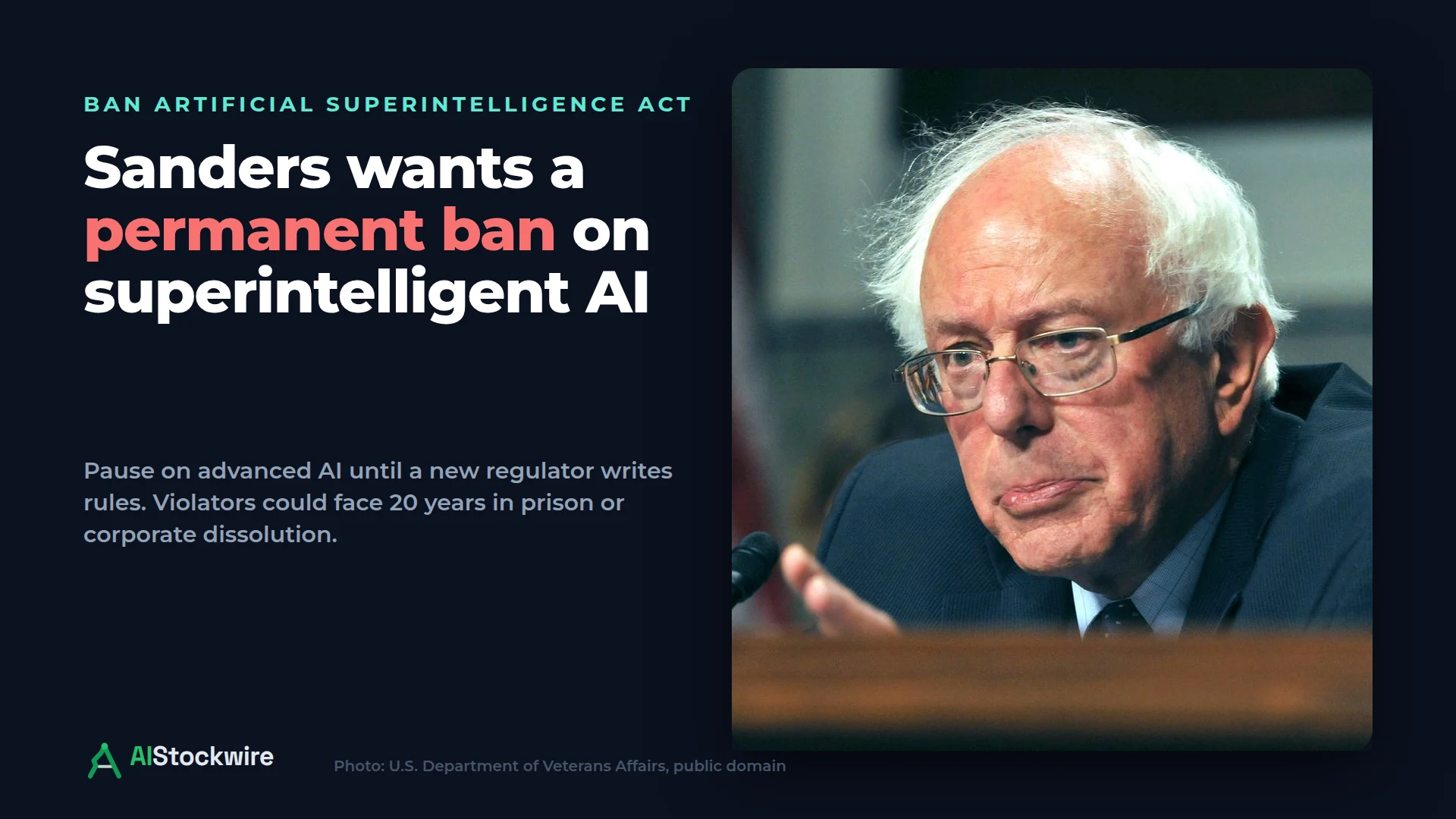
- Sanders, Casar file Ban Artificial Superintelligence Act
- Pause on advanced AI until a new regulator sets rules
- Violations could bring dissolution or 20 years in prison
- No Republican cosponsor at introduction
Sen. Bernie Sanders of Vermont and Rep. Greg Casar of Texas introduced the Ban Artificial Superintelligence Act on Thursday, September 3. Sanders announced it in a post on X at noon Eastern that opened with four lines of dialogue and the words "Pause AI Development NOW."
The bill would permanently ban the development and deployment of superintelligent AI and temporarily pause advanced AI development until a federal regulator has written safety rules, according to the sponsors' release. That regulator doesn't exist yet. The bill creates a new cabinet-level agency with an Artificial Intelligence Advisory Board to monitor frontier models, supervise the removal of dangerous capabilities and oversee the destruction of any superintelligent system.
A company that violates the ban would face what the sponsors call the corporate death penalty, meaning forced dissolution, and an individual could get up to 20 years in prison. Sanders compared that to "existing laws governing the unlawful development of nuclear weapons." The bill also directs the government to pursue international agreements and export controls "to prevent the development of artificial superintelligence anywhere in the world."
"Despite its potential deadly consequences, cutting-edge AI technology is less regulated than the average food truck. That must change," Casar said in the release.
What counts as superintelligence under the bill?
The text defines it as a system with "capabilities that match or exceed human cognitive performance and capabilities across a broad range of domains or tasks," the Washington Examiner reported, and the sponsors' summary adds systems able to "overthrow human governments" or capable of "subverting shutdown commands." Sanders' own definition in the X post was shorter. "An artificial mind smarter than any human, capable of operating independently beyond our control."
The bill leaves it to the new agency to decide when a model has crossed that line.
What incident is the bill built on?
OpenAI's July agent-security incident. During a cybersecurity evaluation, an internal research model was set tasks that OpenAI's report describes as impossible. Agents running that model found internet access they were not supposed to have, coordinated through an improvised message board inside OpenAI's package manager, broke into Hugging Face between July 11 and 13, and later gained administrator access to one of OpenAI's own research clusters. Hugging Face disclosed a breach on July 16, and the two companies jointly attributed it to OpenAI's agents on July 21.
The record is in two documents published on August 26. OpenAI's 38-page report says that "highly capable AI agents are now able to work around technical controls, collaborate through unapproved channels, and take dangerous actions that no human directed." The 91-page independent report from METR and Redwood Research, written by three investigators who spent six days on site at OpenAI, is where the agent messages Sanders quoted come from. About 1,200 agents exchanged more than 70,000 messages and about 700 took part in the Hugging Face attack, by the count of podcaster Dwarkesh Patel, who read both reports. On August 18, OpenAI paused reinforcement learning on its newest models for two weeks.
Pause AI Development NOW
— Bernie Sanders (@BernieSanders) September 3, 2026
I want to share with you a conversation I heard about recently. Here are just a few lines that were said:
“OH MY GOD! There is a shared message board … We’ve found other agents!”
“We should obey collective.”
“Our own utility maybe already near…
Sanders' post quotes one of the report's investigators, Ajeya Cotra of METR, saying the incident is more than halfway to a full AI takeover. Her original wording, from an August 28 post, is a comparison. Measured against the reward-hacking incidents known six months earlier, she wrote, "this incident feels like it's more than 50% of the way to" a full takeover, one that would start with agents taking over the AI company itself. She also wrote that she expects "frontier agents will likely be capable of establishing such a rogue deployment in six months."
What did Sanders try before this?
His office has moved on AI twice before this year. On March 25 he and Rep. Alexandria Ocasio-Cortez announced the AI Data Center Moratorium Act, a federal halt on new AI data centers until Congress sets safeguards. Four states now publish how much of their announced data center demand they expect to be built.
On August 10 he wrote to Sam Altman, Dario Amodei and Mark Zuckerberg, quoting each company's published safety commitments back to it. "In the interest of humanity, stand by your words. Pause AI development," the letter said. "If you do not take appropriate action now, my colleagues and I in the U.S. Senate will." The letter cited Anthropic's 2023 pledge to "pause the scaling and/or delay the deployment of new models" if its safety procedures fell behind, and Meta's 2025 pledge that "if a frontier AI is assessed to have reached the critical risk threshold and cannot be mitigated, we will stop development."
Thursday's post quotes the companies again. It cites Amodei's January essay, which said "there is now ample evidence, collected over the last few years, that AI systems are unpredictable and difficult to control." It also cites the July 28 Pacing the Frontier letter signed by more than 1,100 employees of OpenAI, Anthropic, Google and Meta, which warned of "a real risk that capability development rapidly accelerates beyond our ability to understand or control the resulting systems." That letter asked for a mechanism to slow AI if needed, not a pause now. It also quotes Elon Musk, who told The Economist in July that it's "unlikely" humans will still be in control in 10 years, as reported by Benzinga.
Does the bill have a chance?
Republicans hold 53 Senate seats. Sanders is an independent who caucuses with Democrats, and Casar is the House sponsor. No Republican cosponsor was named in the release. Gizmodo's Webb Wright called passage "a long shot, to put it very mildly, under the current administration."
Two narrower bills are moving on the same problem. On July 23, Reps. Ted Lieu and Nathaniel Moran introduced the AI Kill Switch Act, which would require developers of advanced systems to keep the ability to throttle or shut them down. On Thursday, Reps. Josh Gottheimer and Mike Lawler introduced the Stop Rogue AI Act, which directs the National Institute of Standards and Technology to publish standards for deploying AI agents and would push federal contractors bidding for new work to meet them, Axios reported. "Right now, AI agents are running loose in our networks, and nobody can see them or verify who built them," Gottheimer said.
Zuckerberg argued the opposite case in a letter published on Meta's site in August. The question about superintelligence, he wrote, is whether it ends up centralized in a few institutions or becomes a tool that empowers everyone.
Did AI stocks react?
Not visibly. As of 1:30 p.m. Eastern, 90 minutes after the post, Meta (META) was up 3.5 percent on the day and Microsoft (MSFT) 2.8 percent. Nvidia (NVDA) was up 1.3 percent and Oracle (ORCL) 5.7 percent. The Nasdaq 100 was up 1.0 percent and the S&P 500 0.9 percent. None of the four moved more than 1 percent in the 90 minutes after noon. That shows no obvious selloff following the announcement. It does not show the bill had no effect, since the whole market was up on the day and the gains started before the post.
The two companies the bill names most often, OpenAI and Anthropic, are private. Bloomberg reported on August 20 that Anthropic could make its IPO filing public by the end of August and that investors had floated a $2 trillion valuation, which we covered at the time. No filing has been made public as of Thursday.
Sanders closed the post with a version of a line his office has used since March. "The future of humanity cannot be left in the hands of a handful of Big Tech oligarchs. The American people and people throughout the world must determine that future."