Key points
- CoreWeave rose 17% premarket after beating revenue estimates
- Nebius gained 14.9% ahead of its Thursday earnings report
- CoreWeave's equipment spending exceeded operating cash by $7.5 billion
CoreWeave (CRWV) shares rose 17% in premarket trading Wednesday, leading gains among AI cloud and data center stocks after the company beat third-quarter revenue estimates and raised its 2026 forecast.
The stock traded at $57.08 at 7:36 a.m. ET, up from Tuesday's close of $48.73. Nebius (NBIS), which reports earnings Thursday, was up 14.9%, while Applied Digital (APLD) gained 9.5%. Nvidia (NVDA), a CoreWeave investor and supplier, rose 4.0%.
| Stock | Tuesday close | Premarket, 7:36 a.m. ET | Change |
|---|---|---|---|
| CoreWeave (CRWV) | $48.73 | $57.08 | +17.1% |
| Nebius (NBIS) | $134.00 | $154.00 | +14.9% |
| Applied Digital (APLD) | $16.68 | $18.26 | +9.5% |
| IREN (IREN) | $19.73 | $21.29 | +7.9% |
| Oracle (ORCL) | $117.98 | $124.55 | +5.6% |
| Nvidia (NVDA) | $168.89 | $175.71 | +4.0% |
Source: Robinhood quotes. Premarket prices can change sharply before the 9:30 a.m. ET open.
CoreWeave beat estimates and set out its borrowing plans
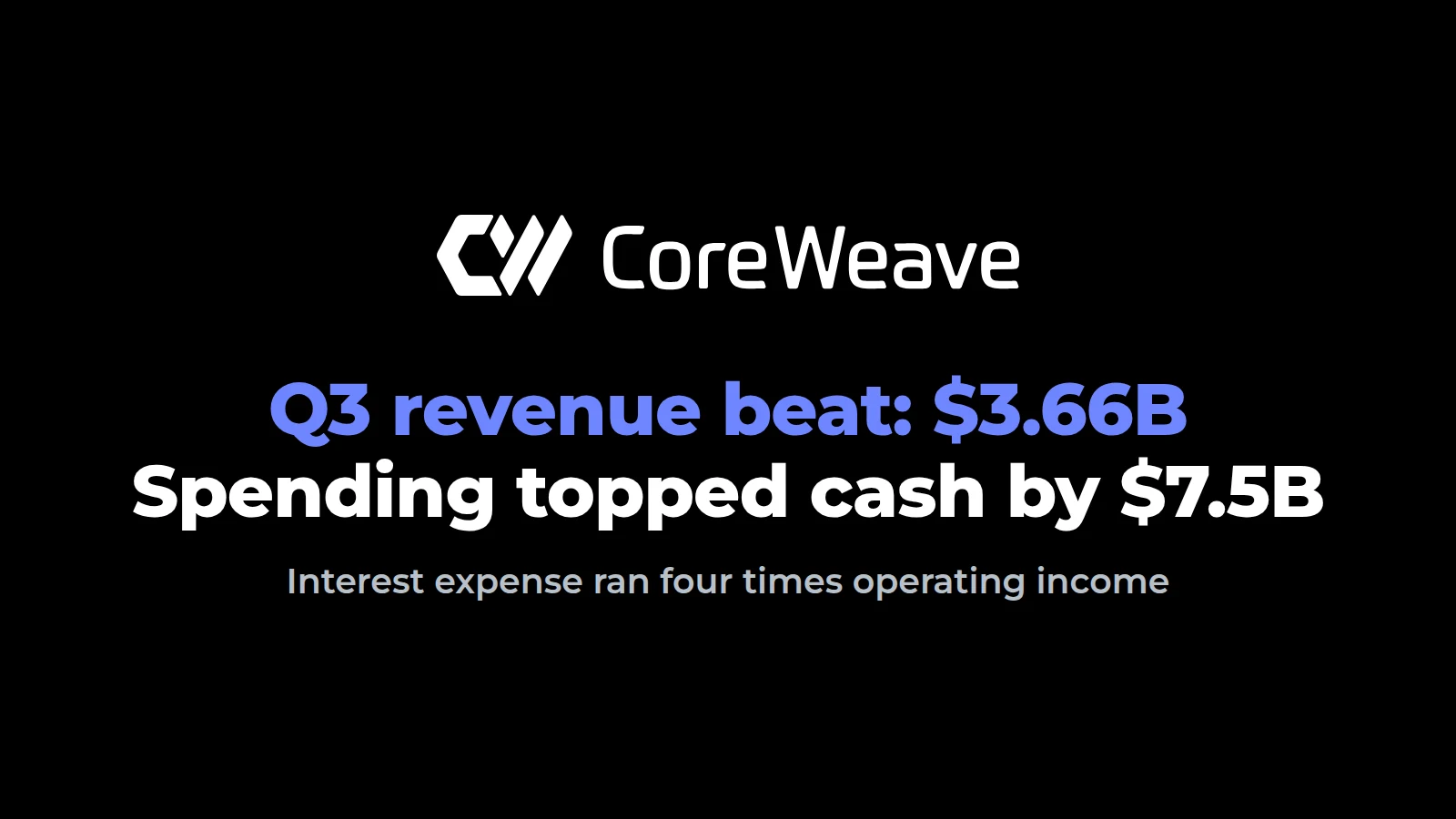
CoreWeave reported third-quarter revenue of $3.66 billion, above the $3.55 billion analysts expected, according to LSEG data cited by CNBC. The company raised its 2026 revenue forecast to $13.0 billion to $13.3 billion.
Chief financial officer Nitin Agrawal said on the earnings call that CoreWeave doesn't plan to issue more parent-level unsecured debt through 2027 at current yields. CoreWeave's 2030 notes yielded 15.2% in Nov. 9 bond-fund holdings, according to our AI debt tracker.
Bernstein analysts led by Madison Rezaei said in a note that CoreWeave "delivered about the best quarter we could have asked for," Reuters reported. They also warned that CoreWeave "will be among the first and hardest hit" when the shortage of AI computing capacity eases.
CoreWeave still spent more than it generated
CoreWeave's operations brought in $1.98 billion of cash in the third quarter, and the company spent $9.44 billion on equipment. The gap was about $7.5 billion, up from about $1.6 billion a year earlier. Interest expense was $846 million, about four times operating income of $207 million.
Nvidia rose after a two-day drop
Nvidia's premarket gain followed a two-day decline of 9.5% on Monday and Tuesday. The stock fell over those two days amid reports about chief executive Jensen Huang's relationship with a woman US officials suspected of spying for China. On Tuesday, the board's independent members hired Wachtell Lipton to run their investigation.
Nebius reports Thursday
Nebius is due to report third-quarter results before Thursday's open, Reuters reported. It's the next AI cloud company on the calendar after CoreWeave, as we noted in our earnings-week preview.
Before Wednesday, Nebius had gained 60% this year, while CoreWeave, IREN, Oracle, and Applied Digital had each lost 32% to 48%, according to Reuters.