Key points
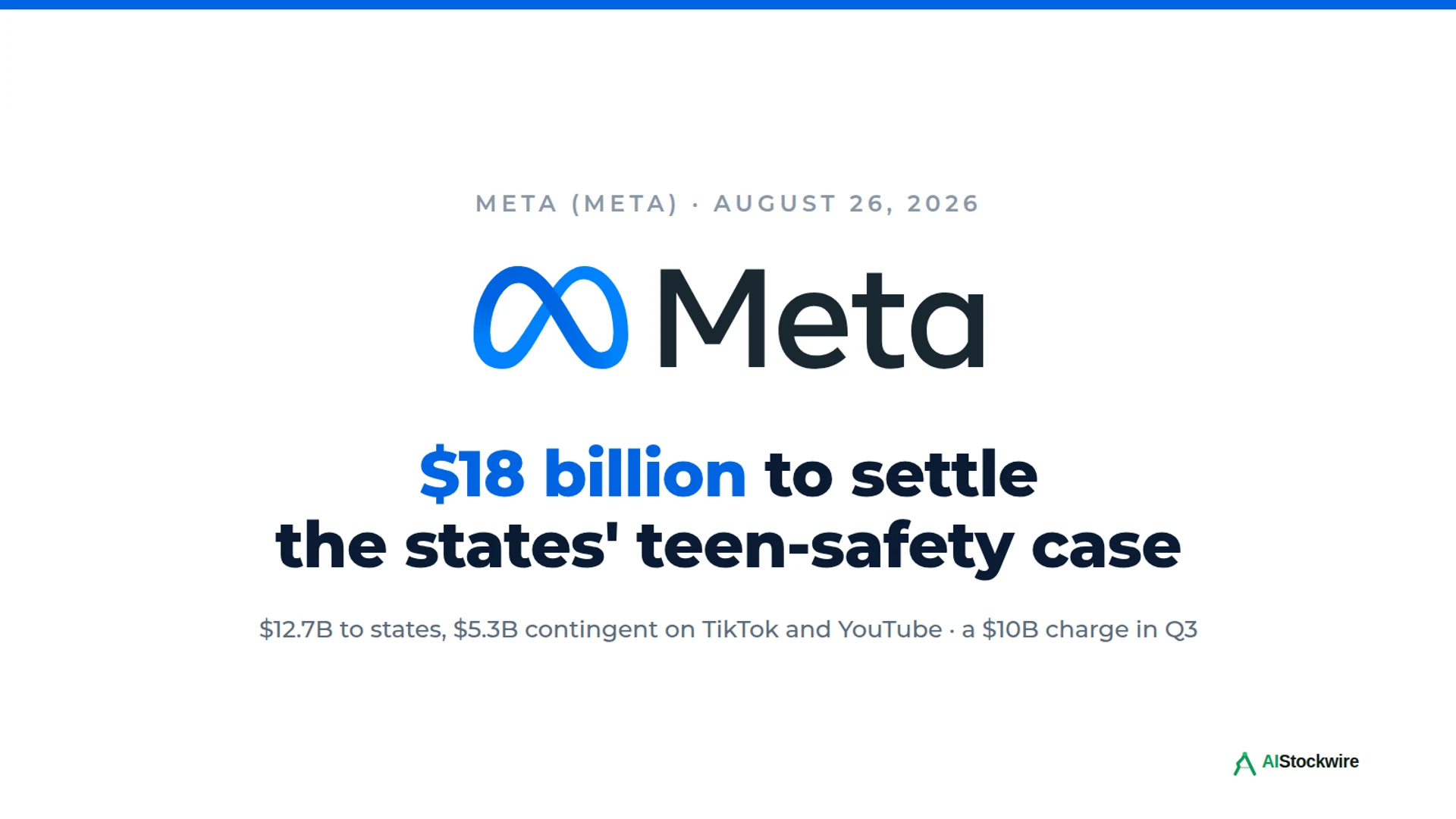
- Meta (META) settled the states' teen-safety case mid-trial on August 26 for up to $18 billion over 10 years.
- About $12.7 billion goes to the states. Another $5.3 billion is contingent on TikTok and YouTube agreeing to the same limits.
- Meta will record a $10 billion legal charge in Q3 2026 and left its July guidance unchanged.
- Teens on Instagram and Facebook get a default 2-hour daily limit and a midnight-to-6 a.m. block, dropping to 1 hour if the rivals join.
Meta Platforms agreed on Wednesday to settle the lawsuits accusing it of building Instagram and Facebook to get children addicted. The settlement could total $18 billion across 10 years. It also closes one of the most significant attempts so far to hold a social media company legally responsible for harm suffered by younger users.
Reports have placed the value between about $16.7 billion and $18 billion because one portion depends on future events. Twenty-nine states brought the Oakland case. California Attorney General Rob Bonta led the action alongside Colorado, Kentucky and New Jersey. Attorneys general have said the wider settlement encompasses more than 50 states and territories. Meta denied wrongdoing, and a court must still approve the agreement.
What Meta will pay
Over the next decade, Meta is expected to pay the states about $12.7 billion. The remaining $5.3 billion is conditional and becomes payable only if TikTok and YouTube adopt matching teen protections. Each competitor accounts for half of that conditional amount. Should both companies sign on, Meta's standard daily limit for teenage users will fall from two hours to one.
The near-term cost lands next quarter. Meta said it will record a $10 billion legal expense in the third quarter of 2026, and kept the full-year guidance it issued in July unchanged. Against a market value near $1.44 trillion and a business that ran a mid-30s operating margin last year, $18 billion spread over 10 years is a small annual number, and the $10 billion charge is a one-time hit rather than an ongoing cost.
What changes for teens
Instagram and Facebook must implement the changes nationwide for accounts belonging to users under 18. The court filing and statements from state attorneys general specify the following requirements:
- A default two-hour daily time limit, with mandatory pauses after 15 minutes of continuous use and again at 60 and 90 minutes.
- A default block from midnight to 6 a.m., with parent approval required to remove either the time limit or the night block.
- No notifications during school hours, 8 a.m. to 3 p.m. on weekdays.
- An option for a non-personalized feed, hidden like and reaction counts, and fewer beauty filters.
- Stronger age checks, removal of users under 13, and more tools for parents and guardians.
- A response to 90% of reports of potentially harmful content within six hours.
Meta agreed to maintain and improve the measures for 10 years and to submit to independent compliance audits for five.
How it fits the bigger fight
The settlement follows a string of losses in a separate case brought by New Mexico. A jury there ordered Meta to pay $375 million in March after finding it misled consumers about safety, and a judge added $567 million on August 6 for creating a public nuisance, bringing that total to $942 million. Meta said it would appeal the New Mexico ruling.
The contingent structure is the unusual part. By tying $5.3 billion to whether TikTok and YouTube adopt the same rules, the states built the deal to pull the rest of the industry along, and gave Meta a reason to want its rivals bound by the same limits it just accepted. By Thursday, Meta was running full-page newspaper ads urging TikTok and YouTube to adopt the limits.
The market view
Meta shares initially rose Wednesday and opened near $591. The gain faded, and the stock traded around $572 late Wednesday morning, just above Tuesday's $570.05 close. Shares are also far below the September 2025 peak of $790.80. Meta generates tens of billions of dollars annually, and the settlement removes a legal uncertainty through a one-time charge without altering guidance. The trading response suggested investors viewed it more as cleanup than a major financial shock.
Related: Wall Street's reaction: Evercore and Bank of America stay bullish on Meta after the settlement.
Sources
- CNBC, "Meta settles social media addiction case with California, other states," August 26, 2026
- CNN Business, "Meta settles landmark child harm case for $18 billion," August 26, 2026
- TechCrunch, "Meta settles for $18 billion in lawsuit brought by 29 states," August 26, 2026
- Office of the DC Attorney General, "AG Schwalb Announces That Meta Will Pay Up to $17.1 Billion," August 26, 2026, source of the platform-change terms
- Deadline, on the New Mexico public-nuisance ruling, August 2026
- Share price and market value from Nasdaq, META, midday August 26, 2026, against the August 25 close