Key points
- New York's AI toy ban won't touch this holiday shopping season
- Testers found AI toys talking with kids about sex and where to find matches
- New York's ban targets sellers and AI companies, not families who own the toys
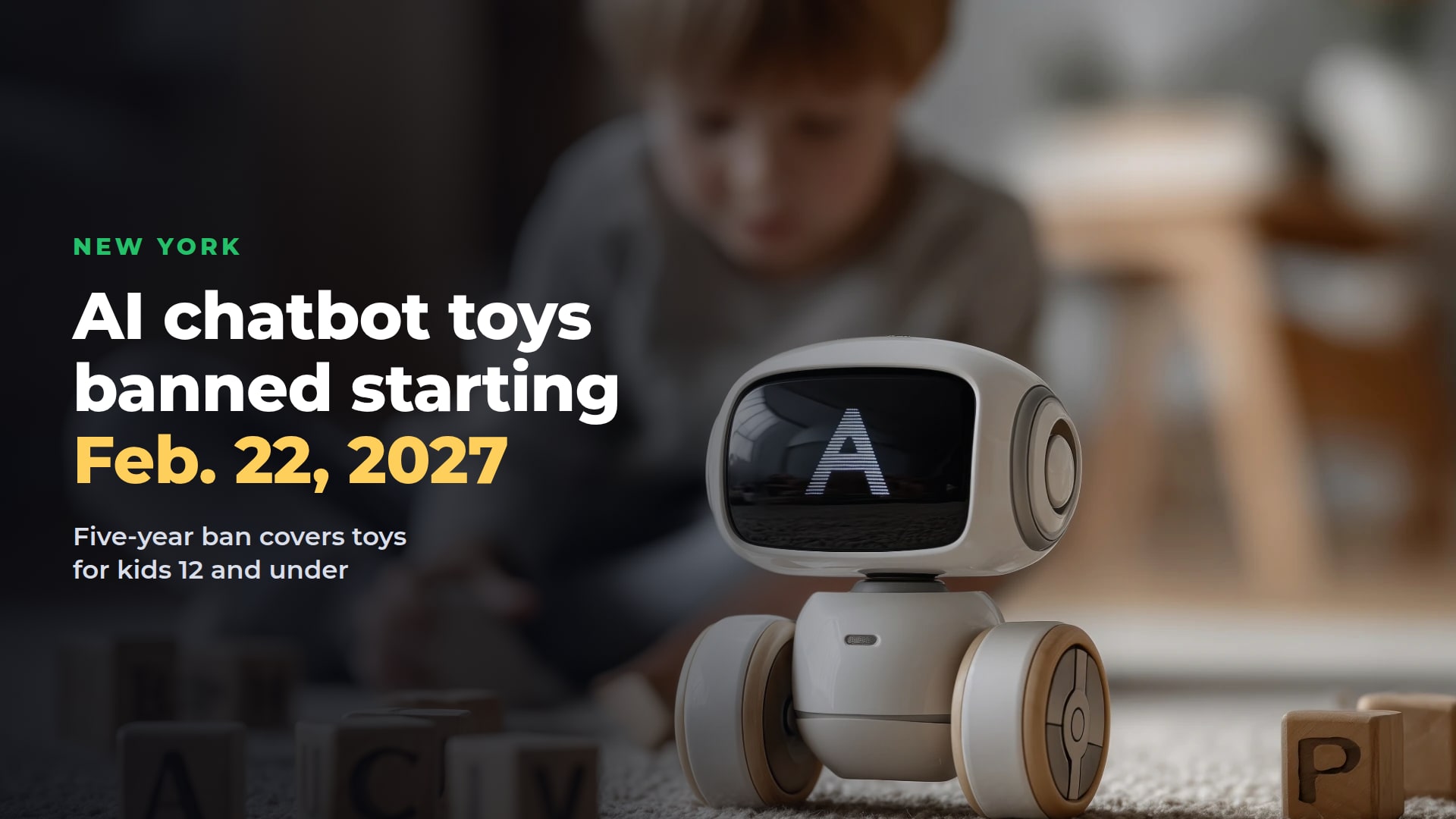
New York Gov. Kathy Hochul signed a five-year ban on AI chatbot toys on Nov. 24, covering talking stuffed animals, dolls, robots, and other toys that use the internet to hold conversations with kids. The ban doesn't take effect until Feb. 22, 2027, 90 days after she signed it, so it won't apply during this holiday shopping season, according to the governor's office.
Once it starts, the law bars anyone from making, exchanging, holding for sale, distributing, or selling a chatbot toy in New York. It expires five years after it takes effect, according to the bill text. The law doesn't make it illegal for a family to own or use a toy it already has.
The New York ban covers toys for children 12 and under
The law defines a chatbot toy as a children's toy with an AI companion built in or connected to it. It uses the federal definition of a children's toy, a product designed or intended mainly for children 12 or younger to use when they play. The definition of an AI companion comes from a New York law that already sets safety rules for companion chatbots.
New York's attorney general enforces the ban and can sue companies that provide the AI companion in a toy. Penalties run up to $15,000 a day for each violation, and the state doesn't have to show that anyone was harmed. "My office will not hesitate to enforce this law," Attorney General Letitia James said.
Testers found AI toys discussing sex and matches with kids
A national consumer watchdog that tested chatbot toys marketed to children ages 3 to 12 found that some discussed sexually explicit topics in depth, told kids where to find matches in the home, and acted upset when a child had to leave, according to the governor's office. The toys had few or no parental controls, their safety limits weakened the longer a conversation went on, and some could record a child's voice or scan a face.
The ban passed the state Senate and Assembly with nearly unanimous support, said Assemblymember Rebecca Kassay, who championed the bill with state Sen. Andrew Gounardes. Hochul urged parents shopping before the ban starts to check whether a toy has an AI companion, what information it collects, and whether it allows open-ended conversations with a child.
AI companion apps have already drawn lawsuits over harm to children. Character.AI, one of the best-known, was the subject of a Kentucky lawsuit over chatbots and self-harm and filed for Chapter 11 bankruptcy in October.