Key points
- Army awards contracts to 10 counter-drone suppliers
- DroneShield and L3Harris are among them
- No funding at award was disclosed
The U.S. Army awarded 10 companies counter-drone contracts with combined ceilings of $4.15 billion, including seven capped at $500 million each. The suppliers include DroneShield, the Wescam unit of L3Harris (LHX), and RADA Technologies, a subsidiary of Leonardo DRS (DRS).
Army Contracting Command at Detroit Arsenal awarded the contracts on Sept. 28, and the Department of War listed all 10 on Tuesday. Each is a firm-fixed-price, indefinite-delivery/indefinite-quantity (IDIQ) contract running to late September 2029. The Army received 50 bids in the competition.
The contracts let the Army place orders over time, up to each company's ceiling. Work locations and funding "will be determined with each order," the announcement says. It does not disclose any funding obligated at award for the 10 contracts.
Who won the contracts?
| Company | Location in the announcement | Ceiling |
|---|---|---|
| Allen Control Systems | Austin, Texas | $500 million |
| Digital Force Technologies | San Diego, California | $500 million |
| DroneShield LLC | Warrenton, Virginia | $500 million |
| Napatree Technology | McLean, Virginia | $500 million |
| RADA Technologies (Leonardo DRS) | Germantown, Maryland | $500 million |
| SRC Inc. | Syracuse, New York | $500 million |
| Wescam USA (L3Harris) | Nashville, Tennessee | $500 million |
| EchoDyne | Kirkland, Washington | $250 million |
| PVP Advanced EO Systems | Lake Forest, California | $250 million |
| Smart Shooter | Herndon, Virginia | $150 million |
At least three of the winners belong to publicly traded companies. RADA Technologies became part of Leonardo DRS in a 2022 merger. The Army's own release names the Nashville company as L3Harris WESCAM. DroneShield LLC is the U.S. arm of Sydney-based DroneShield, whose shares trade on the Australian Securities Exchange under the ticker DRO.
Digital Force Technologies, a San Diego company, announced its award Tuesday afternoon and said its systems are powered by SeraphimOS software. "The UAS threat is evolving at an extraordinary pace, and defending our forces and critical infrastructure requires systems that can evolve just as quickly," said Justin MacLaurin, the company's president and CEO.
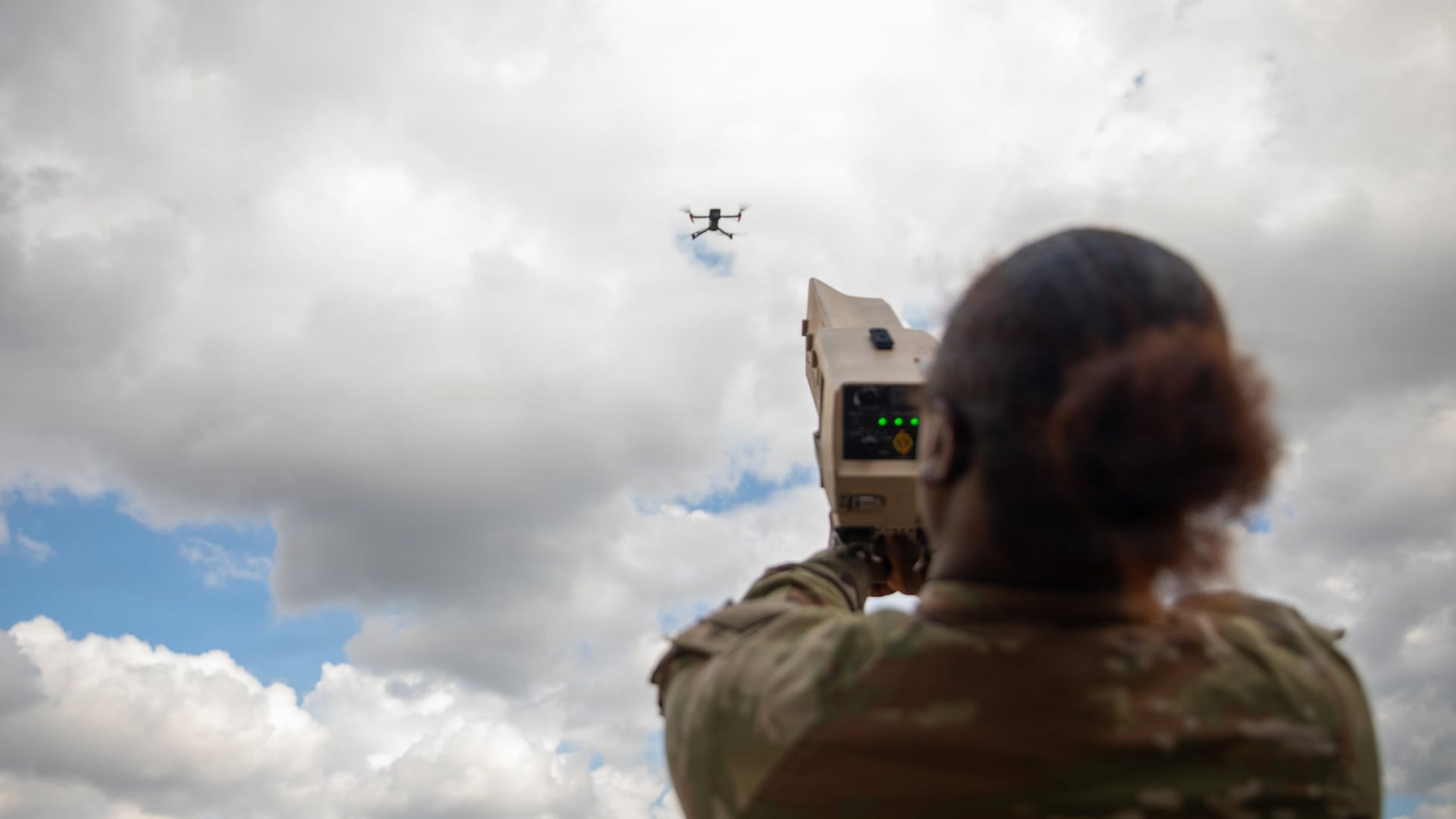
The Army didn't say which product each company will supply. The technology covered ranges from smart optical scopes that help soldiers shoot down drones with standard rifles to robotic weapon stations, compact radar systems, and long-range tracking cameras, according to the Army release.
What did the Army say about the awards?
Army acquisition officials told reporters on Tuesday that the contracts are worth up to $7 billion. The 10 ceilings in the Department of War announcement add up to $4.15 billion by our arithmetic. Breaking Defense's report doesn't explain the difference.
Brent Ingraham, the assistant secretary of the Army for acquisition, logistics and technology, said the Army doesn't want "to be locked into a single vendor as that threat evolves."
"There's no silver bullet," said Brig. Gen. Matt Ross, director of Joint Interagency Task Force 401 (JIATF-401), the Pentagon's counter-drone task force. Ross said a large IDIQ "will allow companies to raise additional capital to build up their inventory because they have a reasonable expectation that we're going to continue to partner with them."
Neither official answered questions about when the systems would be delivered or to whom. The contracts will support Domestic Shield, a Department of War effort to protect military facilities inside the United States from drones, along with a counter-drone marketplace where soldiers, federal agencies, and allied countries can buy counter-drone systems.
How do these compare with earlier counter-drone awards?
The new contracts are the latest in a series supporting Domestic Shield. AeroVironment (AVAV) announced a three-year, $500 million IDIQ for the program on July 6 and described it as a sole-source contract. JIATF-401 awarded CACI International (CACI) a contract with a $500 million ceiling on July 30.
The 10 new awards went through a competition instead. AeroVironment separately won $464.8 million for its Locust laser weapons earlier this month.
Raytheon's AMRAAM missile contract, announced Monday, also committed little money at signing. It obligated $154.4 million against a $20.7 billion ceiling.
The same Department of War announcement also included a separate $38.2 million contract for OWT Global, a Tampa, Florida, small business, to provide mobile instructor teams that train troops on counter-drone systems through 2031.
What did the stocks do?
Leonardo DRS shares closed at $36.73 on Tuesday, up 0.2%. L3Harris closed at $236.41, down 0.5%. Breaking Defense published the award list at 2:30 p.m. ET, during the trading session.
DroneShield closed at A$1.615 in Sydney on Tuesday, before the Army made the awards public. DroneShield had not posted an announcement about the award on the ASX as of Tuesday evening, U.S. time.