Key points
- What the former Palo Alto Networks executive alleges about reseller orders
- How Palo Alto Networks responded to the lawsuit
- How much of Palo Alto's revenue runs through two distributors
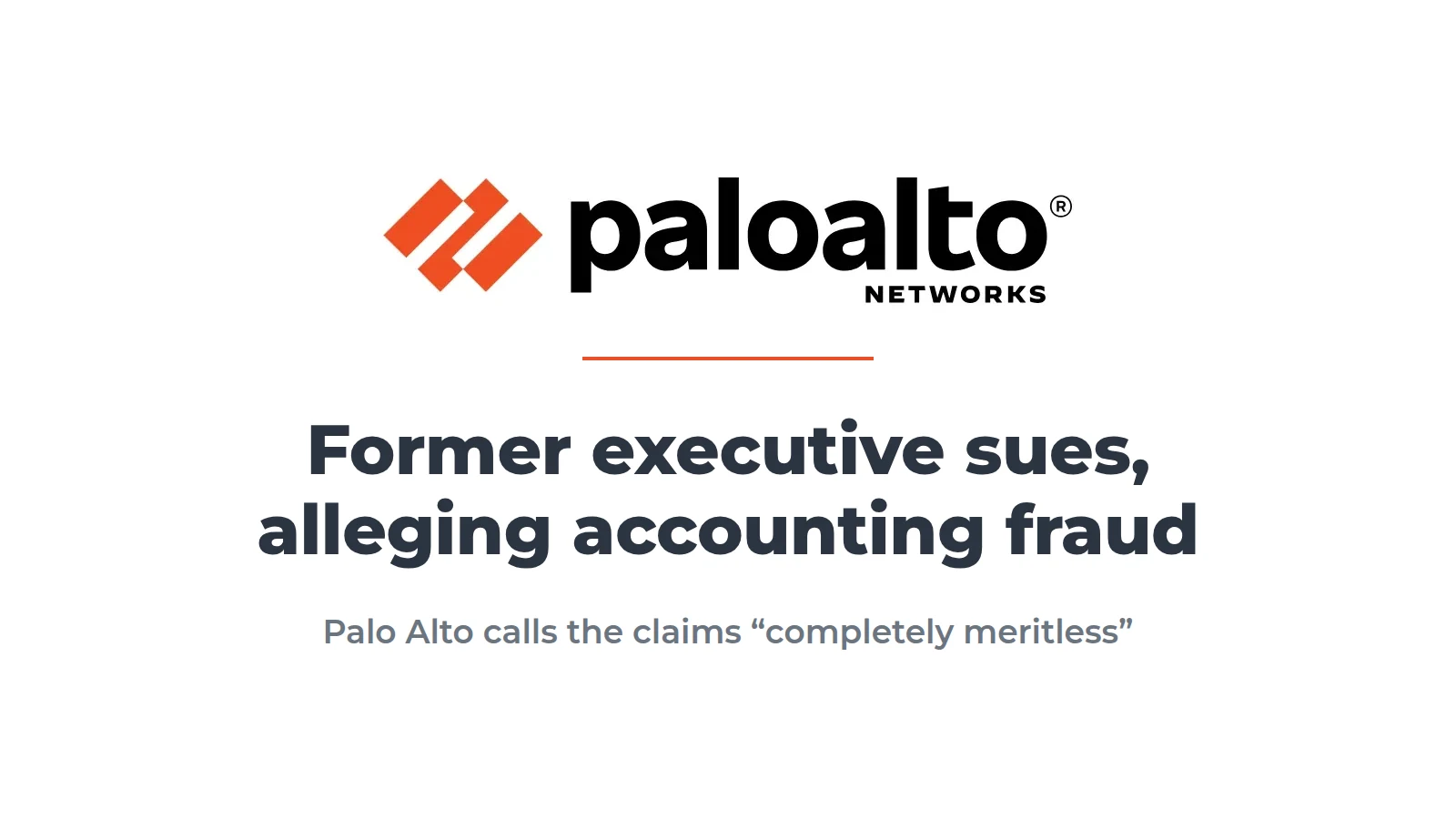
A former Palo Alto Networks (PANW) executive has sued the cybersecurity company, alleging he was fired for pushing back against accounting fraud. Palo Alto shares were down 4.4% in after-hours trading on Wednesday after Bloomberg reported the lawsuit.
Dan McGill, a former regional vice president, says he called attention to efforts to misrepresent transactions as booked sales in order to boost earnings, according to the report. He alleges senior management encouraged resellers to issue purchase orders before customers had formally approved the deals. McGill also says his superiors made up a reason to fire him after he raised the concerns internally.
A Palo Alto spokesperson called the allegations "completely meritless."
The case, McGill v. Palo Alto Networks, was opened in federal court in Manhattan on Nov. 25, the court docket shows. As of Wednesday, the docket listed only the complaint and three related filings from McGill's side, and nothing from Palo Alto.
Palo Alto sells through distributors and resellers
The claims involve resellers, the last link before the customer in Palo Alto's sales chain. A substantial portion of the company's sales to end customers runs through a two-tier system, Palo Alto said in its annual report in September. Palo Alto sells to distributors, the distributors sell to resellers, and the resellers sell to the end customers.
Two distributors accounted for 25% of Palo Alto's revenue in the quarter that ended Oct. 31, according to the company's latest quarterly report. For the full fiscal year that ended July 31, sales to two distributors made up 30% of revenue.
The suit follows a strong quarter and a $4.5 billion deal
The lawsuit lands a week after Palo Alto beat Wall Street's estimates for the fiscal first quarter. Revenue rose 39% to $3.44 billion, a figure that includes CyberArk, the identity security company Palo Alto bought in February. Palo Alto also raised its full-year revenue forecast to $14.52 billion to $14.57 billion.
The same day, Palo Alto agreed to buy Applied Compute, an AI startup founded by former OpenAI researchers, in an all-stock deal valued at $4.5 billion. Palo Alto expects to complete that purchase in the three months that end in April 2027.
The deal uses a fixed price to calculate the stock consideration. Palo Alto will pay $4.5 billion, subject to adjustments, in shares valued at $337.16 each, according to an 8-K filing. That was the volume-weighted average closing price over the 15 trading days through Nov. 17. Dividing $4.5 billion by that price gives about 13.3 million shares before adjustments, although Palo Alto says the final number isn't yet known. A fall in Palo Alto's stock price would reduce the market value of a given number of shares received at closing.
Where Palo Alto stock stands
Palo Alto shares ended Wednesday's regular session at $356.14, up 0.9%. They were at $340.31 at 5:41 p.m. ET, down 4.4% from that close, according to Nasdaq.
The stock had jumped 9.9% on Nov. 18, the day of the earnings report. Even after Wednesday's after-hours drop, the shares were 10% above their Nov. 17 close of $309.29.